Díez-Alonso Manuel, Mendoza-Moreno Fernando, Jiménez-Álvarez Laura, Nuñez Oscar, Blazquez-Martín Alma, Sanchez-Gollarte Ana, Matías-García Belén, Molina Raquel, San-Juan Alberto, Gutierrez-Calvo Alberto
Department of General and Digestive Surgery, Príncipe de Asturias Teaching Hospital, Alcalá de Henares, Madrid 28805, Spain.
National Center for Epidemiology, Carlos III Health Institute, Madrid 28029, Spain.
Mol Clin Oncol. 2021 May;14(5):93. doi: 10.3892/mco.2021.2255. Epub 2021 Mar 11.
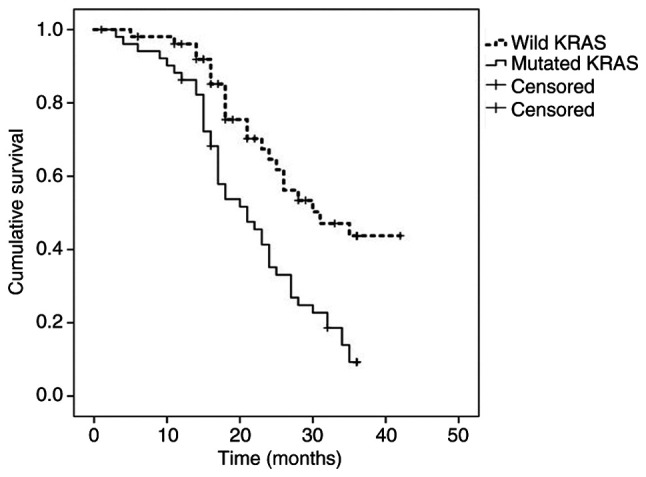
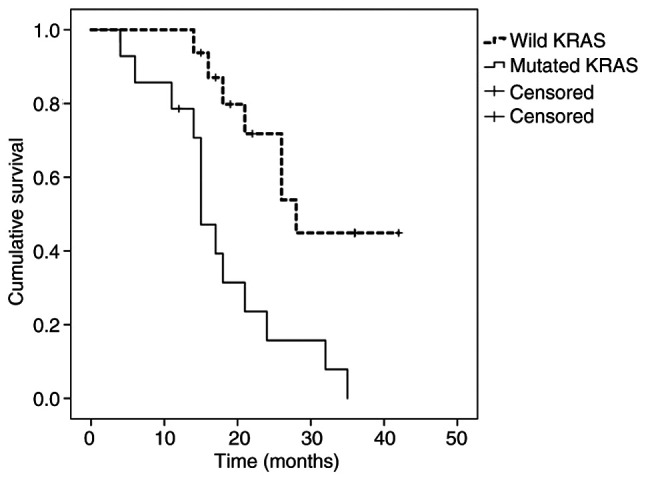
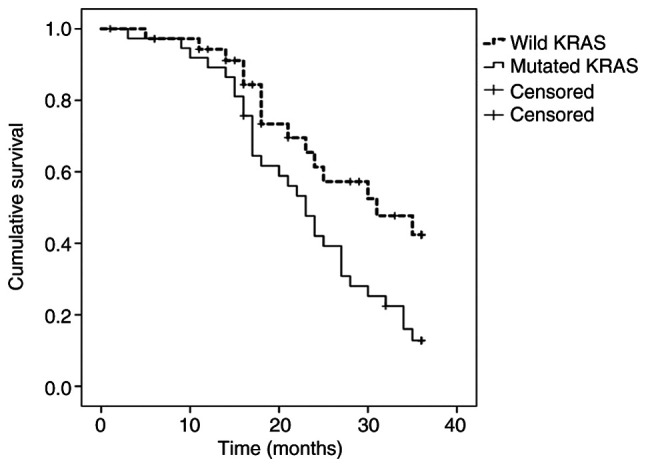
The aim of the present study was to identify predictive parameters of survival in patients affected by stage IV colorectal cancer with synchronous and bilateral liver metastases. A retrospective cohort study was performed. Patients diagnosed between January 2013 and December 2018 were included in the present study. Data on the histopathological, clinical and treatment factors (chemotherapy as the first measure or resection of the primary tumor) were collected. The effect of each variable on survival was evaluated using Cox regression analysis. A total of 104 patients were included [43 women (41.3%) and 61 men (58.7%); mean age, 63 years]. The long-term survival rate at 36 months was 29% (median, 25 months). Kaplan-Meier analysis was used to estimate that survival was higher in patients with wild-type KRAS tumors (42%) than in patients with mutated KRAS tumors (9%; P=0.001). In the multivariate analysis, KRAS mutation (HR, 2.484; 95% CI, 1.472-4.192), T4 tumors (HR, 1.795; 95% CI, 1.045-3.084), resection/local treatment of hepatic metastases (HR, 0.447; 95% CI, 0.222-0.901), Eastern Cooperative Oncology Group performance status (HR, 1.632; 95% CI, 1.182-2.254), were revealed to have independent predictive value. The type of treatment (chemotherapy or resection of the primary tumor) did not influence the survival. The results indicated that mutation of the KRAS gene was an important prognostic factor and associated with survival.
本研究的目的是确定患有IV期结直肠癌并伴有同步性双侧肝转移患者的生存预测参数。进行了一项回顾性队列研究。本研究纳入了2013年1月至2018年12月期间诊断的患者。收集了组织病理学、临床和治疗因素(以化疗作为首要措施或原发肿瘤切除术)的数据。使用Cox回归分析评估每个变量对生存的影响。共纳入104例患者[43例女性(41.3%)和61例男性(58.7%);平均年龄63岁]。36个月时的长期生存率为29%(中位数为25个月)。采用Kaplan-Meier分析估计,KRAS基因野生型肿瘤患者的生存率(42%)高于KRAS基因突变型肿瘤患者(9%;P = 0.001)。在多变量分析中,KRAS突变(HR,2.484;95%CI,1.472 - 4.192)、T4期肿瘤(HR,1.795;95%CI,1.045 - 3.084)、肝转移灶的切除/局部治疗(HR,0.447;95%CI,0.222 - 0.901)、东部肿瘤协作组体能状态(HR,1.632;95%CI,1.182 - 2.254)被发现具有独立的预测价值。治疗类型(化疗或原发肿瘤切除术)不影响生存。结果表明,KRAS基因突变是一个重要的预后因素且与生存相关。