Department of Psychology, University of California, San Diego, San Diego, California, USA.
J Vis. 2021 Mar 1;21(3):22. doi: 10.1167/jov.21.3.22.
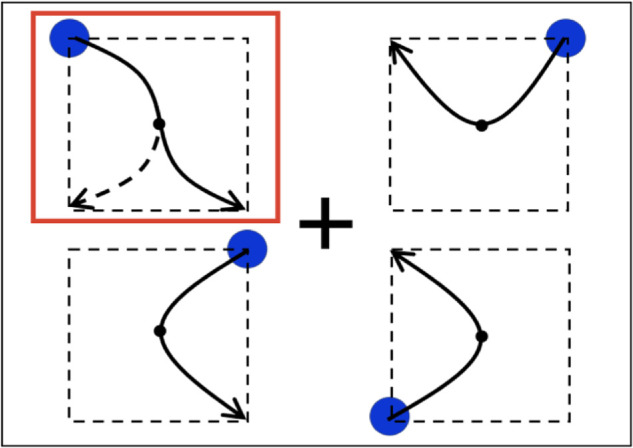
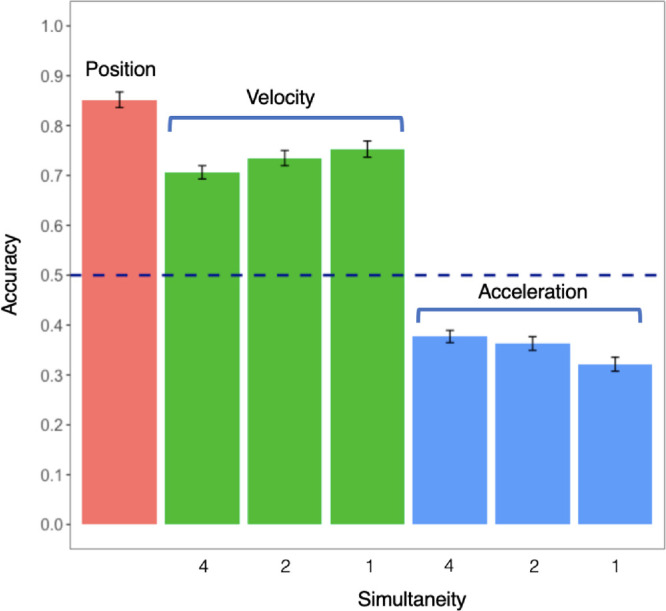
People commonly track objects moving in complex natural displays and their performance in the multiple object tracking paradigm has been used to study such visual attention for more than three decades. Given the theoretical and practical importance of object tracking, it is critical to understand how people solve the correspondence problem to track objects; however, it remains unclear what information people use to achieve this feat. In particular, although people can track multiple moving objects based on their positions, there is ambiguity about whether people can track objects via higher order kinematic information, such as velocity. We designed a paradigm in which position was rendered uninformative to directly examine whether people could use higher order kinematic information to track multiple objects. We find that people can track via velocity, but not acceleration, even though observers can reliably detect the acceleration cue that they cannot use for tracking. Furthermore, we show a capacity constraint on using higher order kinematic information-people perform worse when required to use velocity to resolve correspondence for multiple object pairs simultaneously. Together, our results suggest that, although people can use higher order kinematic information for object tracking, precise higher order kinematic information is not freely available from the early visual system.
人们通常会追踪复杂自然场景中移动的物体,而人们在多项物体追踪范式中的表现已经被用于研究这种视觉注意力超过三十年了。鉴于物体追踪具有理论和实际重要性,理解人们如何解决对应问题以追踪物体至关重要;然而,人们使用什么信息来实现这一壮举仍不清楚。特别是,尽管人们可以根据物体的位置追踪多个移动的物体,但人们是否可以通过更高阶的运动信息(例如速度)来追踪物体仍存在歧义。我们设计了一个范式,使位置信息变得不相关,以直接检验人们是否可以使用更高阶的运动信息来追踪多个物体。我们发现,人们可以通过速度进行追踪,但不能通过加速度进行追踪,尽管观察者可以可靠地检测到他们无法用于追踪的加速度提示。此外,我们还展示了使用更高阶运动信息的能力限制-当需要同时使用速度来解决多个物体对的对应关系时,人们的表现会更差。总的来说,我们的结果表明,尽管人们可以使用更高阶的运动信息进行物体追踪,但早期视觉系统中并没有自由提供精确的高阶运动信息。