Department of Chemistry and Biochemistry, University of California, Los Angeles, California 90095-1569, United States.
College of Sciences, Nanjing Agricultural University, Nanjing 210095, China.
J Org Chem. 2021 Apr 16;86(8):5792-5804. doi: 10.1021/acs.joc.1c00239. Epub 2021 Mar 26.
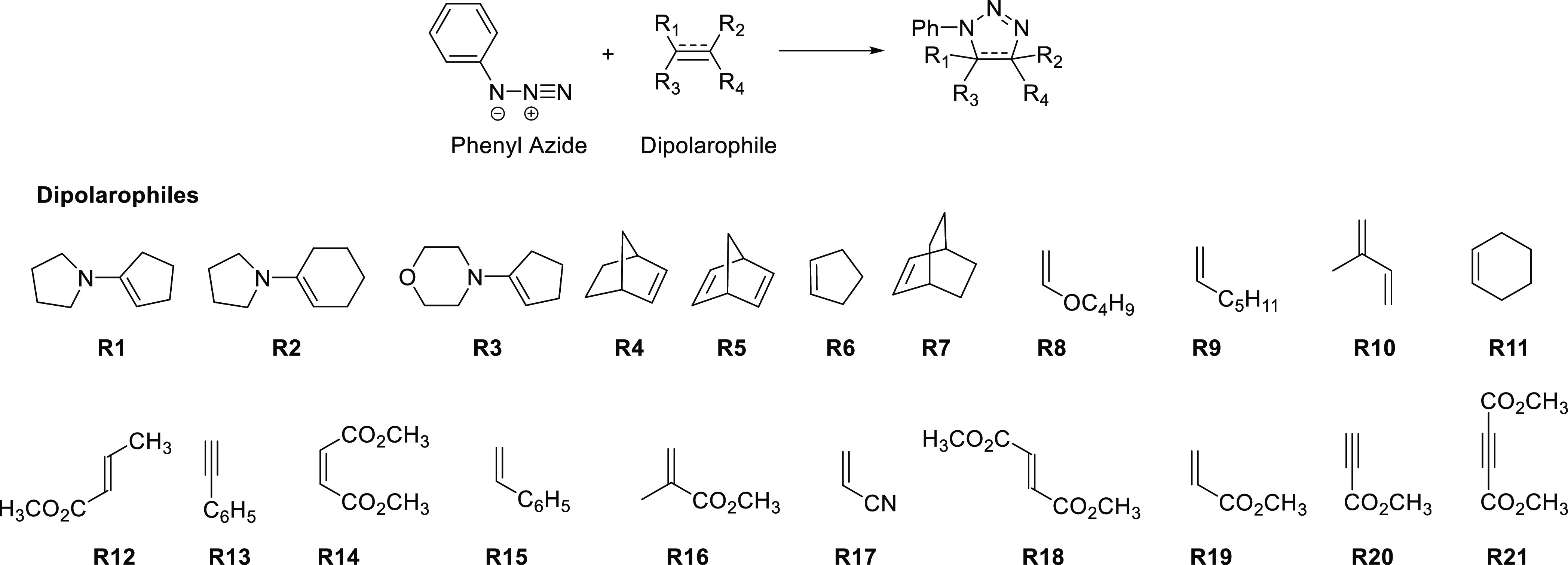
We examine the theoretical underpinnings of the seminal discoveries by Reiner Sustmann about the ambiphilic nature of Huisgen's phenyl azide cycloadditions. Density functional calculations with ωB97X-D and B2PLYP-D3 reproduce the experimental data and provide insights into ambiphilic control of reactivity. Distortion/interaction-activation strain and energy decomposition analyses show why Sustmann's use of dipolarophile ionization potential is such a powerful predictor of reactivity. We add to Sustmann's data set several modern distortion-accelerated dipolarophiles used in bioorthogonal chemistry to show how these fit into the orbital energy criteria that are often used to understand cycloaddition reactivity. We show why such a simple indicator of reactivity is a powerful predictor of reaction rates that are actually controlled by a combination of distortion energies, charge transfer, closed-shell repulsion, polarization, and electrostatic effects.
我们考察了 Reiner Sustmann 关于 Huisgen 的苯基亚硝酰环加成的两性本质的开创性发现的理论基础。使用 ωB97X-D 和 B2PLYP-D3 的密度泛函计算重现了实验数据,并提供了对反应性的两性控制的深入了解。扭曲/相互作用-激活应变和能量分解分析表明,为什么 Sustmann 使用偶极子离域能是反应性的如此有力的预测指标。我们在 Sustmann 的数据集上添加了几个用于生物正交化学的现代扭曲加速的偶极子,以展示它们如何符合通常用于理解环加成反应性的轨道能量标准。我们展示了为什么如此简单的反应性指标是反应速率的有力预测指标,而反应速率实际上是由扭曲能、电荷转移、满壳排斥、极化和静电效应的组合控制的。