Weng Cuilian, Wang Xincai, Huang Long, Lin Xingsheng, Liu Qinghua
Department of Intensive Care Unit, Fujian Provincial Hospital South Branch, The Shengli Clinical Medical College of Fujian Medical University, Fuzhou, Fujian Province, China.
Department of Otorhinolaryngology, Fujian Provincial Hospital, The Shengli Clinical Medical College of Fujian Medical University, Fuzhou, Fujian Province, China.
PLoS One. 2021 Mar 26;16(3):e0248603. doi: 10.1371/journal.pone.0248603. eCollection 2021.
Patients at intermediate-high risk of developing a pulmonary embolism (PE) are very likely to experience adverse outcomes, such as cardiovascular instability and death. The role of thrombolytic therapy in intermediate-high-risk PE remains controversial.
This study aimed to determine the efficacy and safety of low-dose urokinase (UK) thrombolytic therapy for intermediate-high-risk PE.
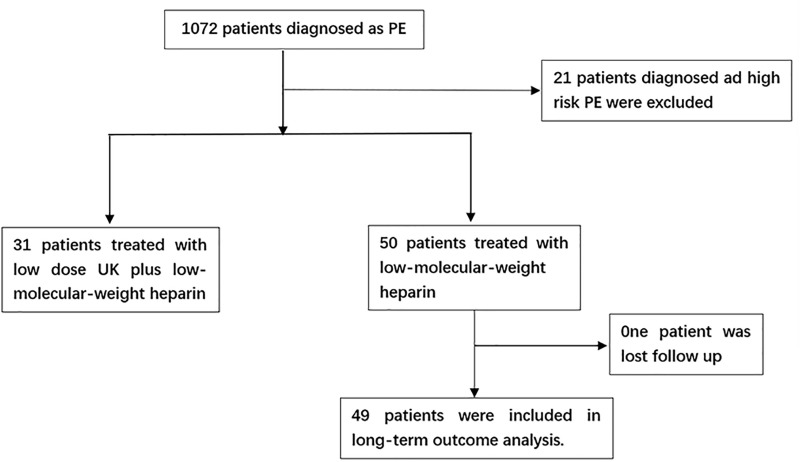
This retrospective study included 81 consecutive patients with intermediate-high-risk PE from two centers. Patients received low-dose UK or low-molecular-weight heparin (anticoagulant therapy group). The efficacy outcomes were mortality, computed tomography pulmonary angiography (CTPA)-confirmed absorption, and dyspnea. Safety was assessed as the incidence of bleedings.
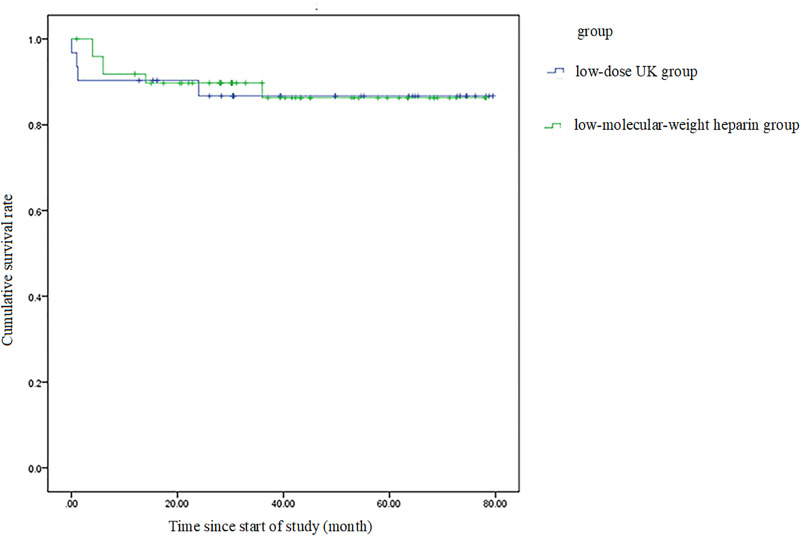
The in-hospital mortality, 9-month mortality, and long-term mortality at the last follow-up were comparable for the low-dose UK group and the anticoagulant therapy group (6.45% vs. 0%, p = 0.144, 9.68% vs. 8.16%, p = 0.815, and 12.90% vs. 12.24%, p = 0.931, respectively). CTPA-confirmed absorption at one month after admission was higher in the low-dose UK group than in the anticoagulant therapy group (p = 0.016). The incidences of short-term dyspnea at discharge and long-term dyspnea at the last follow-up were lower in the low-dose UK group than in the anticoagulant therapy group (27.59% vs. 52%, p = 0.035, 33.33% vs. 58.14%, p = 0.043, respectively). No major bleeding occurred. The incidence of minor bleeding was not significantly different between the two groups (3.23% vs. 6%, p = 0.974).
In intermediate-high-risk PE, a low-dose UK might increase CTPA-confirmed absorption and improve short-term and long-term dyspnea without affecting mortality or increasing the bleeding risk.
发生肺栓塞(PE)中高风险的患者很可能会出现不良后果,如心血管不稳定和死亡。溶栓治疗在中高风险PE中的作用仍存在争议。
本研究旨在确定低剂量尿激酶(UK)溶栓治疗中高风险PE的有效性和安全性。
这项回顾性研究纳入了来自两个中心的81例连续的中高风险PE患者。患者接受低剂量UK或低分子量肝素(抗凝治疗组)。疗效指标为死亡率、计算机断层扫描肺动脉造影(CTPA)证实的吸收情况和呼吸困难。安全性通过出血发生率进行评估。
低剂量UK组和抗凝治疗组的住院死亡率、9个月死亡率以及最后一次随访时的长期死亡率相当(分别为6.45%对0%,p = 0.144;9.68%对8.16%,p = 0.815;12.90%对12.24%,p = 0.931)。低剂量UK组入院后1个月时CTPA证实的吸收情况高于抗凝治疗组(p = 0.016)。低剂量UK组出院时短期呼吸困难和最后一次随访时长期呼吸困难的发生率低于抗凝治疗组(分别为27.59%对52%,p = 0.035;33.33%对58.14%,p = 0.043)。未发生大出血。两组间轻微出血的发生率无显著差异(3.23%对6%,p = 0.974)。
在中高风险PE中,低剂量UK可能会增加CTPA证实的吸收情况,并改善短期和长期呼吸困难,而不影响死亡率或增加出血风险。