Departement of Diagnostic and Interventional Radiology and Nuclear Medicine, University Medical Center Hamburg-Eppendorf, Martinistraße 52, 20246, Hamburg, Germany.
Department of Diagnostic and Interventional Neuroradiology, University Medical Center Hamburg-Eppendorf, Martinistraße 52, 20246, Hamburg, Germany.
Eur Radiol. 2021 Oct;31(10):7529-7539. doi: 10.1007/s00330-021-07820-1. Epub 2021 Mar 26.
To quantify the proportion of fat within the skeletal muscle as a measure of muscle quality using dual-energy CT (DECT) and to validate this methodology with MRI.
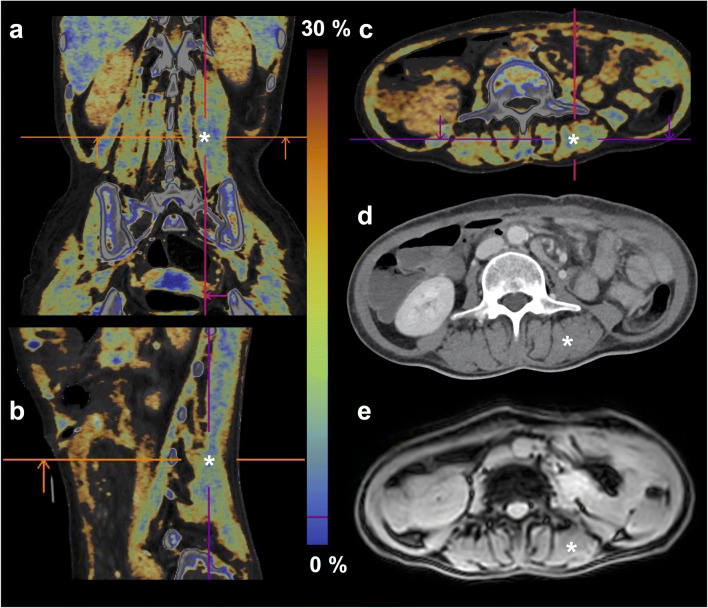
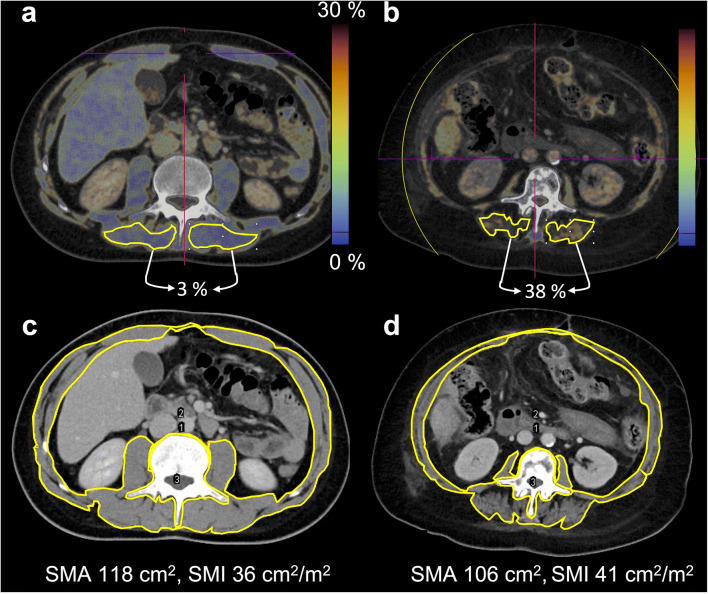
Twenty-one patients with abdominal contrast-enhanced DECT scans (100 kV/Sn 150 kV) underwent abdominal 3-T MRI. The fat fraction (DECT-FF), determined by material decomposition, and HU values on virtual non-contrast-enhanced (VNC) DECT images were measured in 126 regions of interest (≥ 6 cm) within the posterior paraspinal muscle. For validation, the MR-based fat fraction (MR-FF) was assessed by chemical shift relaxometry. Patients were categorized into groups of high or low skeletal muscle mean radiation attenuation (SMRA) and classified as either sarcopenic or non-sarcopenic, according to the skeletal muscle index (SMI) and cut-off values from non-contrast-enhanced single-energy CT. Spearman's and intraclass correlation, Bland-Altman analysis, and mixed linear models were employed.
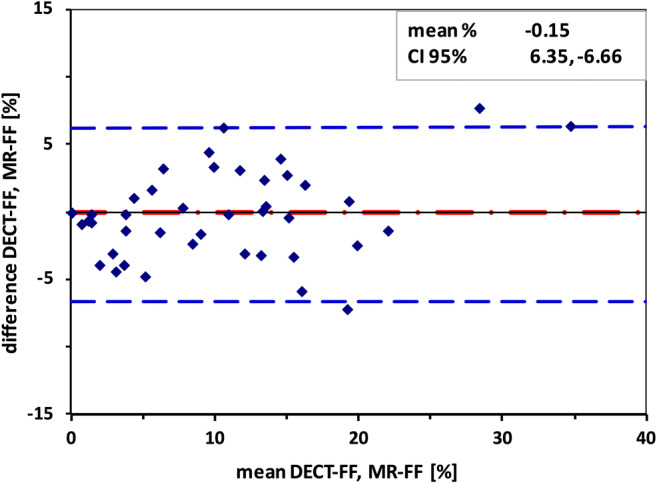
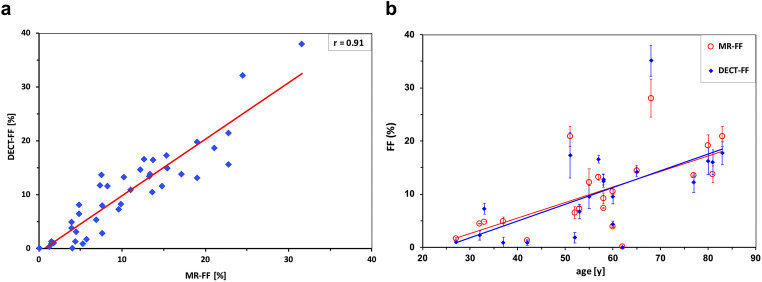
The correlation was excellent between DECT-FF and MR-FF (r = 0.91), DECT VNC HU and MR-FF (r = - 0.90), and DECT-FF and DECT VNC HU (r = - 0.98). Intraclass correlation between DECT-FF and MR-FF was good (r = 0.83 [95% CI 0.71-0.90]), with a mean difference of - 0.15% (SD 3.32 [95% CI 6.35 to - 6.66]). Categorization using the SMRA yielded an eightfold difference in DECT VNC HU values between both groups (5 HU [95% CI 23-11], 42 HU [95% CI 33-56], p = 0.05). No significant relationship between DECT-FF and SMI-based classifications was observed.
Fat quantification within the skeletal muscle using DECT is both feasible and reliable. DECT muscle analysis offers a new approach to determine muscle quality, which is important for the diagnosis and therapeutic monitoring of sarcopenia, as a comorbidity associated with poor clinical outcome.
• Dual-energy CT (DECT) material decomposition and virtual non-contrast-enhanced DECT HU values assess muscle fat reliably. • Virtual non-contrast-enhanced dual-energy CT HU values allow to differentiate between high and low native skeletal muscle mean radiation attenuation in contrast-enhanced DECT scans. • Measuring muscle fat by dual-energy computed tomography is a new approach for the determination of muscle quality, an important parameter for the diagnostic confirmation of sarcopenia as a comorbidity associated with poor clinical outcome.
使用双能 CT(DECT)定量测量骨骼肌内的脂肪比例,作为肌肉质量的指标,并通过 MRI 对该方法进行验证。
21 名患者行腹部增强 DECT 扫描(100 kV/Sn 150 kV),同时进行腹部 3-T MRI 检查。通过物质分解法测量 126 个感兴趣区(≥6cm)的后脊柱旁肌内的脂肪分数(DECT-FF),并在虚拟非增强(VNC)DECT 图像上测量 CT 值(HU 值)。为了验证,通过化学位移弛豫法评估基于 MRI 的脂肪分数(MR-FF)。根据骨骼肌指数(SMI)和非增强单能 CT 的截断值,将患者分为高或低骨骼肌平均辐射衰减(SMRA)组,并分类为肌少症或非肌少症。采用 Spearman 相关分析、组内相关分析、Bland-Altman 分析和混合线性模型。
DECT-FF 与 MR-FF(r = 0.91)、DECT VNC HU 值与 MR-FF(r = -0.90)、DECT-FF 与 DECT VNC HU 值(r = -0.98)之间的相关性均极好。DECT-FF 与 MR-FF 之间的组内相关度较好(r = 0.83[95%CI 0.71-0.90]),平均差值为 -0.15%(SD 3.32[95%CI 6.35-6.66])。使用 SMRA 进行分类,两组之间的 DECT VNC HU 值差异高达 8 倍(5 HU[95%CI 23-11],42 HU[95%CI 33-56],p = 0.05)。未观察到 DECT-FF 与基于 SMI 的分类之间存在显著关系。
使用 DECT 定量测量骨骼肌内的脂肪是可行且可靠的。DECT 肌肉分析为确定肌肉质量提供了一种新方法,这对于肌少症的诊断和治疗监测很重要,因为肌少症是一种与不良临床结局相关的合并症。
双能 CT(DECT)物质分解和虚拟非增强 DECT HU 值可可靠地评估肌肉脂肪。
虚拟非增强双能 CT HU 值可区分增强 DECT 扫描中高和低的固有骨骼肌平均辐射衰减。
通过双能计算机断层扫描测量肌肉脂肪是确定肌肉质量的一种新方法,肌肉质量是作为与不良临床结局相关的合并症的肌少症诊断的重要参数。