Department of Neurology, Hanyang University Guri Hospital, Hanyang University College of Medicine, 153, Gyeongchun-ro, Guri, 11923, South Korea.
Department of Translational Medicine, Hanyang University Graduate School of Biomedical Science & Engineering, Seoul, 04763, South Korea.
Alzheimers Res Ther. 2021 Mar 26;13(1):66. doi: 10.1186/s13195-021-00803-w.
Our previous studies showed that GV1001 has various protective effects against β-amyloid and other stressors. Based on these findings, we hypothesized that GV1001 might have beneficial effects in patients with Alzheimer's disease (AD).
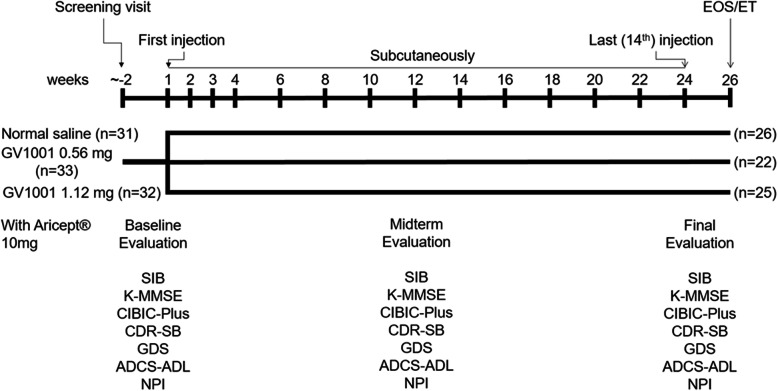
A phase 2, double-blind, parallel-group, placebo-controlled, 6-month randomized clinical trial was performed to evaluate the safety and efficacy of subcutaneously administered GV1001. Between September 2017 and September 2019, 13 centers in South Korea recruited participants. A total of 106 patients were screened, and 96 patients with moderate-to-severe AD were randomized 1:1:1 to the placebo (group 1, n = 31), GV1001 0.56 mg (group 2, n = 33), and 1.12 mg (group 3, n = 32) groups. GV1001 was administered every week for 4 weeks (4 times), followed by every 2 weeks until week 24 (10 times). The primary endpoint was the change in the Severe Impairment Battery (SIB) score from baseline to week 24. The key secondary efficacy endpoints were the change in the Clinical Dementia Rating Sum of Box (CDR-SOB), Alzheimer's Disease Cooperative Study-Activities of Daily Living (ADCS-ADL), Neuropsychiatric Inventory (NPI), Mini-Mental State Examination, and Global Deterioration Scale scores. The safety endpoints were also assessed based on adverse events, laboratory test results, vital signs, and other observations related to safety.
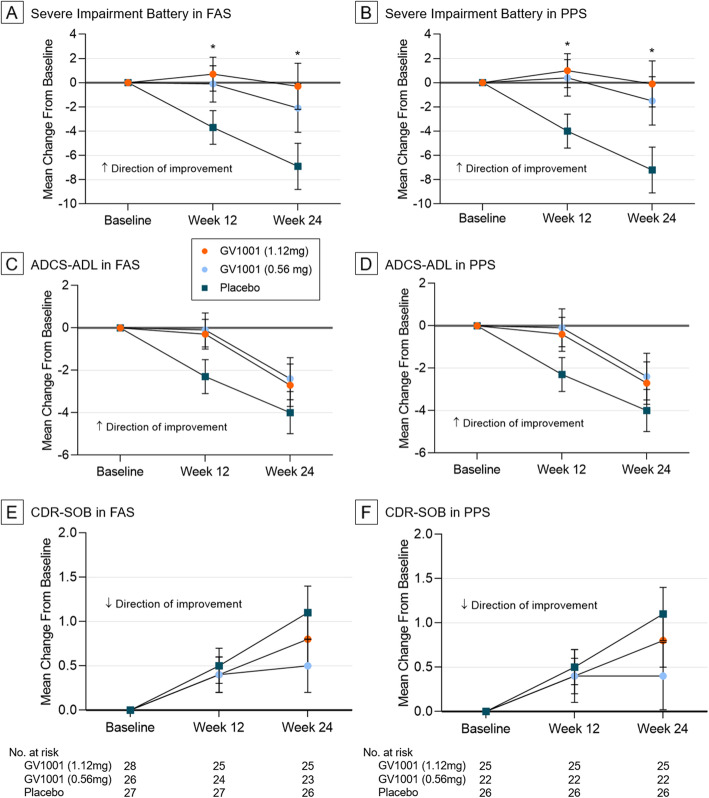
Group 3 showed less decrease in the SIB score at 12 and 24 weeks compared with group 1 (P < 0.05). These were not significantly observed in group 2. Among the secondary endpoints, only the NPI score showed significantly better improvement in group 2 than in group 3 at week 12; however, there were no other significant differences between the groups. Although the ADCS-ADL and CDR-SOB scores showed a pattern similar to SIB scores, a statistically significant result was not found. Adverse events were similar across all three groups.
The results indicate that GV1001 1.12 mg met the primary endpoint of a statistically significant difference. GV1001 was well tolerated without safety concerns. This study warrants a larger clinical trial.
ClinicalTrials.gov NCT03184467 . Registered on June 12, 2017.
我们之前的研究表明,GV1001 对β-淀粉样蛋白和其他应激源具有多种保护作用。基于这些发现,我们假设 GV1001 可能对阿尔茨海默病(AD)患者有有益的作用。
一项 2 期、双盲、平行组、安慰剂对照、6 个月随机临床试验,评估皮下给予 GV1001 的安全性和疗效。2017 年 9 月至 2019 年 9 月,韩国的 13 个中心招募了参与者。共筛选了 106 名患者,其中 96 名中重度 AD 患者以 1:1:1 的比例随机分为安慰剂(第 1 组,n=31)、GV1001 0.56mg(第 2 组,n=33)和 1.12mg(第 3 组,n=32)。GV1001 每周给药 4 次(4 次),持续 4 周,然后每 2 周给药 1 次,直至第 24 周(10 次)。主要终点是从基线到第 24 周严重损伤电池(SIB)评分的变化。关键次要疗效终点是临床痴呆评定量表总和框(CDR-SOB)、阿尔茨海默病合作研究-日常生活活动(ADCS-ADL)、神经精神问卷(NPI)、简易精神状态检查和全球衰退量表评分的变化。还根据不良事件、实验室检查结果、生命体征和其他与安全性相关的观察结果评估了安全性终点。
第 3 组在第 12 周和第 24 周时 SIB 评分下降幅度小于第 1 组(P<0.05)。第 2 组无明显差异。在次要终点中,只有第 2 组的 NPI 评分在第 12 周时较第 3 组有明显改善,但组间无其他显著差异。尽管 ADCS-ADL 和 CDR-SOB 评分与 SIB 评分模式相似,但未发现统计学显著结果。三组的不良反应相似。
结果表明,GV1001 1.12mg 达到了统计学显著差异的主要终点。GV1001 耐受性良好,无安全性问题。这项研究需要更大规模的临床试验。
ClinicalTrials.gov NCT03184467。于 2017 年 6 月 12 日注册。