Lao-Oxford-Mahosot Hospital-Wellcome Trust Research Unit, Microbiology Laboratory, Mahosot Hospital, Vientiane, Laos; Centre for Tropical Medicine and Global Health, Nuffield Department of Medicine, University of Oxford, Oxford, United Kingdom.
Lao-Oxford-Mahosot Hospital-Wellcome Trust Research Unit, Microbiology Laboratory, Mahosot Hospital, Vientiane, Laos.
Infect Genet Evol. 2021 Jul;91:104818. doi: 10.1016/j.meegid.2021.104818. Epub 2021 Mar 23.
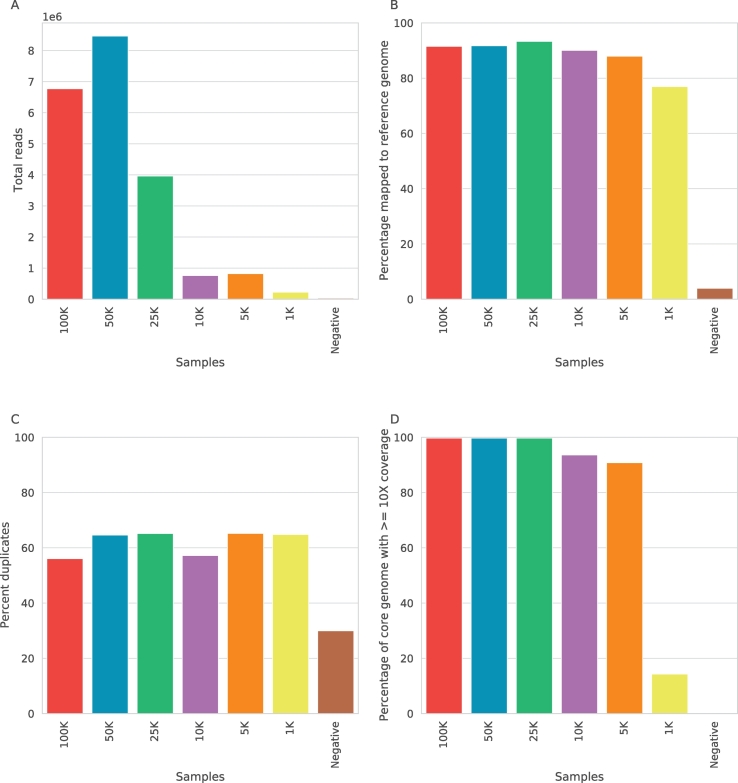
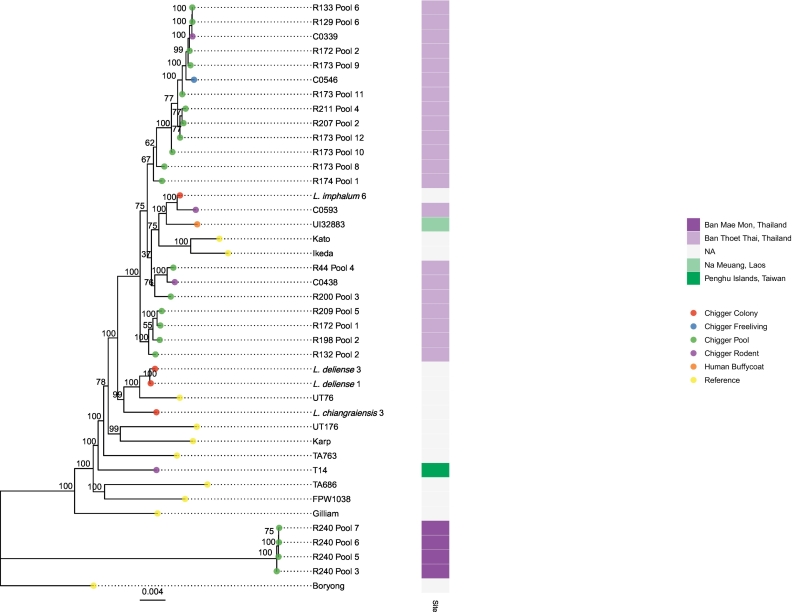
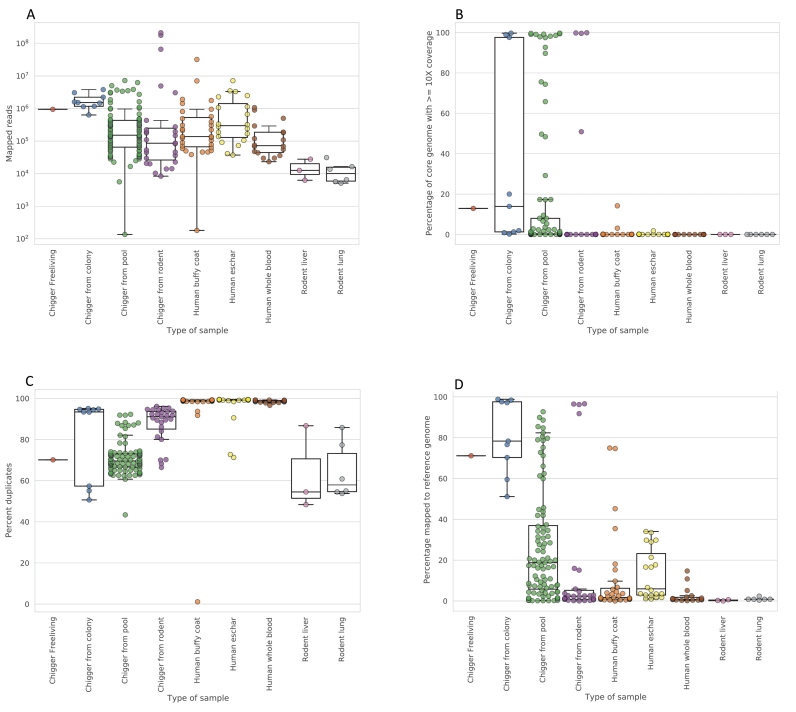
Scrub typhus is a febrile disease caused by Orientia tsutsugamushi, transmitted by larval stage Trombiculid mites (chiggers), whose primary hosts are small mammals. The phylogenomics of O. tsutsugamushi in chiggers, small mammals and humans remains poorly understood. To combat the limitations imposed by the low relative quantities of pathogen DNA in typical O. tsutsugamushi clinical and ecological samples, along with the technical, safety and cost limitations of cell culture, a novel probe-based target enrichment sequencing protocol was developed. The method was designed to capture variation among conserved genes and facilitate phylogenomic analysis at the scale of population samples. A whole-genome amplification step was incorporated to enhance the efficiency of sequencing by reducing duplication rates. This resulted in on-target capture rates of up to 93% for a diverse set of human, chigger, and rodent samples, with the greatest success rate in samples with real-time PCR C values below 35. Analysis of the best-performing samples revealed phylogeographic clustering at local, provincial and international scales. Applying the methodology to a comprehensive set of samples could yield a more complete understanding of the ecology, genomic evolution and population structure of O. tsutsugamushi and other similarly challenging organisms, with potential benefits in the development of diagnostic tests and vaccines.
恙虫病是一种由恙虫东方体引起的发热性疾病,通过幼虫期恙螨(恙螨)传播,其主要宿主是小型哺乳动物。恙虫东方体在恙螨、小型哺乳动物和人类中的系统基因组学仍然知之甚少。为了克服典型恙虫病临床和生态样本中病原体 DNA 相对数量低、细胞培养的技术、安全和成本限制带来的限制,开发了一种新的基于探针的目标富集测序方案。该方法旨在捕获保守基因之间的变异,并促进人群样本的系统基因组分析。通过减少重复率,整合全基因组扩增步骤以提高测序效率。对于一系列不同的人类、恙螨和啮齿动物样本,该方法的靶向捕获率高达 93%,实时 PCR C 值低于 35 的样本的成功率最高。对表现最佳的样本的分析显示了在本地、省级和国际范围内的地理聚类。将该方法应用于综合样本集可以更全面地了解恙虫东方体和其他具有挑战性的生物体的生态学、基因组进化和种群结构,在诊断测试和疫苗开发方面具有潜在的益处。