Martínez-Valdebenito Constanza, Acosta-Jamett Gerardo, Abello Rayitray, Jiang Ju, Richards Allen L, Abarca Katia, Weitzel Thomas
Departamento de Enfermedades Infecciosas e Inmunología Pediátricas, Escuela de Medicina, Pontificia Universidad Católica de Chile, Santiago, Chile.
Instituto de Medicina Preventiva Veterinaria and Center for Disease Surveillance and Evolution of Infectious Diseases, Facultad de Ciencias Veterinarias, Universidad Austral de Chile, Valdivia, Chile.
Parasit Vectors. 2024 Dec 18;17(1):514. doi: 10.1186/s13071-024-06602-0.
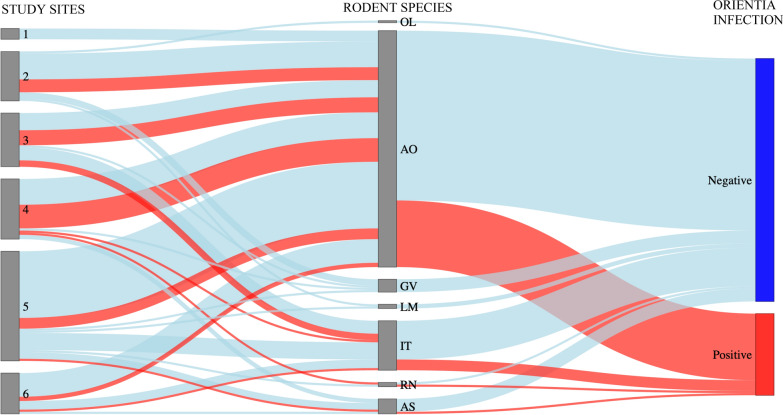
Candidatus Orientia chiloensis causes scrub typhus over a wide geographical range in southern Chile. The life cycle, including vectors and reservoirs of this novel rickettsial pathogen, is incompletely understood. We analyzed rodent tissue and rodent-associated mite samples collected during a field study in six localities on Chiloé Island, where human scrub typhus cases have occurred. Using molecular methods, we detected Orientia DNA in 24.8% of rodents, belonging to five of seven captured species. Orientia-infection rates showed geographical variations, but were not influenced by rodent species, sex, age, and mite infestation. Phylogenetic analysis showed that Orientia sequences from trombiculid mites (Proschoengastia eloisae) were identical to those from scrub typhus patients from the same region. The results suggest that these rodent-associated mites serve as vectors and play an important role in the ecology of scrub typhus in southern Chile. Further studies are required to determine whether Orientia-infected rodents can also serve as reservoir of Orientia in Chile.
新立东方体(暂定种)智利种(Candidatus Orientia chiloensis)在智利南部广泛的地理区域引发恙虫病。这种新型立克次氏体病原体的生命周期,包括其传播媒介和宿主,目前尚未完全了解。我们分析了在奇洛埃岛六个地区进行的实地研究期间收集的啮齿动物组织和与啮齿动物相关的螨类样本,这些地区曾出现过人类恙虫病病例。通过分子方法,我们在24.8%的啮齿动物中检测到东方体DNA,这些啮齿动物分属于七个捕获物种中的五个。东方体感染率呈现出地理差异,但不受啮齿动物物种、性别、年龄和螨类感染情况的影响。系统发育分析表明,来自纤恙螨(Proschoengastia eloisae)的东方体序列与来自同一地区恙虫病患者的序列相同。结果表明,这些与啮齿动物相关的螨类作为传播媒介,在智利南部恙虫病的生态中发挥着重要作用。需要进一步研究以确定感染东方体的啮齿动物在智利是否也可作为东方体的宿主。