Medical Oncology, Lowe Center for Thoracic Oncology, Dana Farber Cancer Institute, Boston, Massachusetts, USA.
Inivata, Research Triangle Park, North Carolina, USA.
J Immunother Cancer. 2021 Mar;9(3). doi: 10.1136/jitc-2020-001504.
Currently available biomarkers are imperfect in their ability to predict responses to the multiple first-line treatment options available for patients with advanced non-small cell lung cancer (NSCLC). Having an early pharmacodynamic marker of treatment resistance may help redirect patients onto more effective alternative therapies. We sought to determine if changes in circulating tumor DNA (ctDNA) levels after initiation of first-line pembrolizumab±chemotherapy in NSCLC would enable early prediction of response prior to radiological assessment.
Plasma collected from patients with advanced NSCLC prior to and serially after starting first-line pembrolizumab±platinum doublet chemotherapy was analyzed by next-generation sequencing using enhanced tagged-amplicon sequencing of hotspots and coding regions from 36 genes. Early change in ctDNA allele fraction (AF) was correlated with radiographic responses and long-term clinical outcomes.
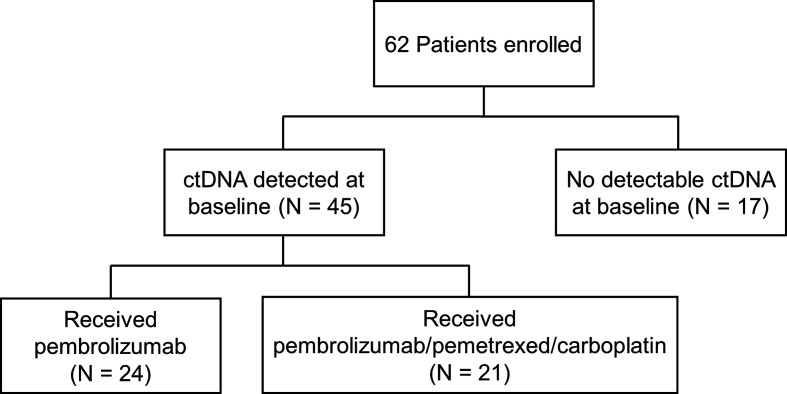
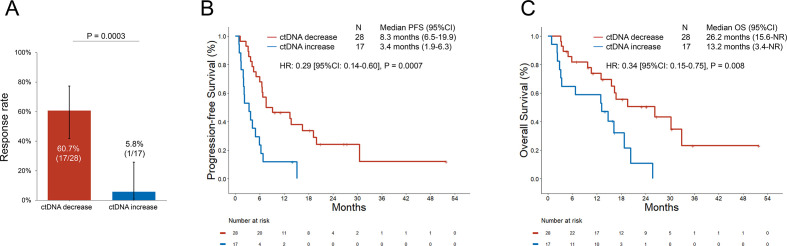
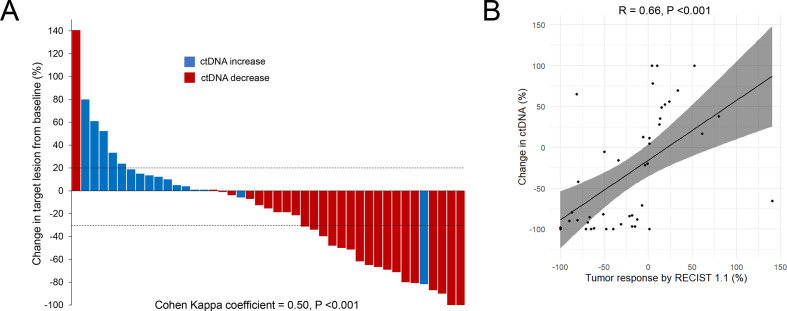
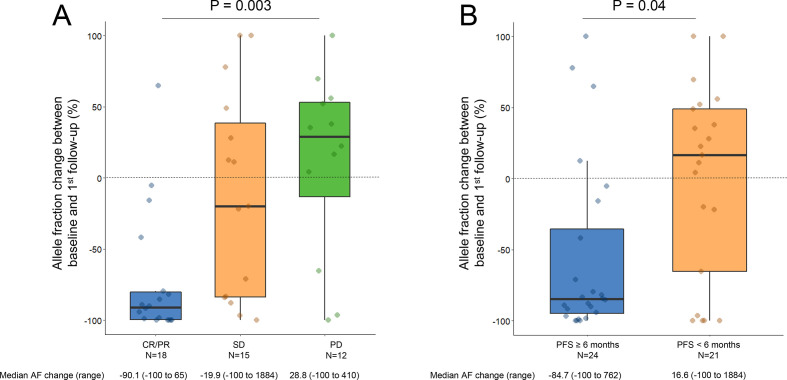
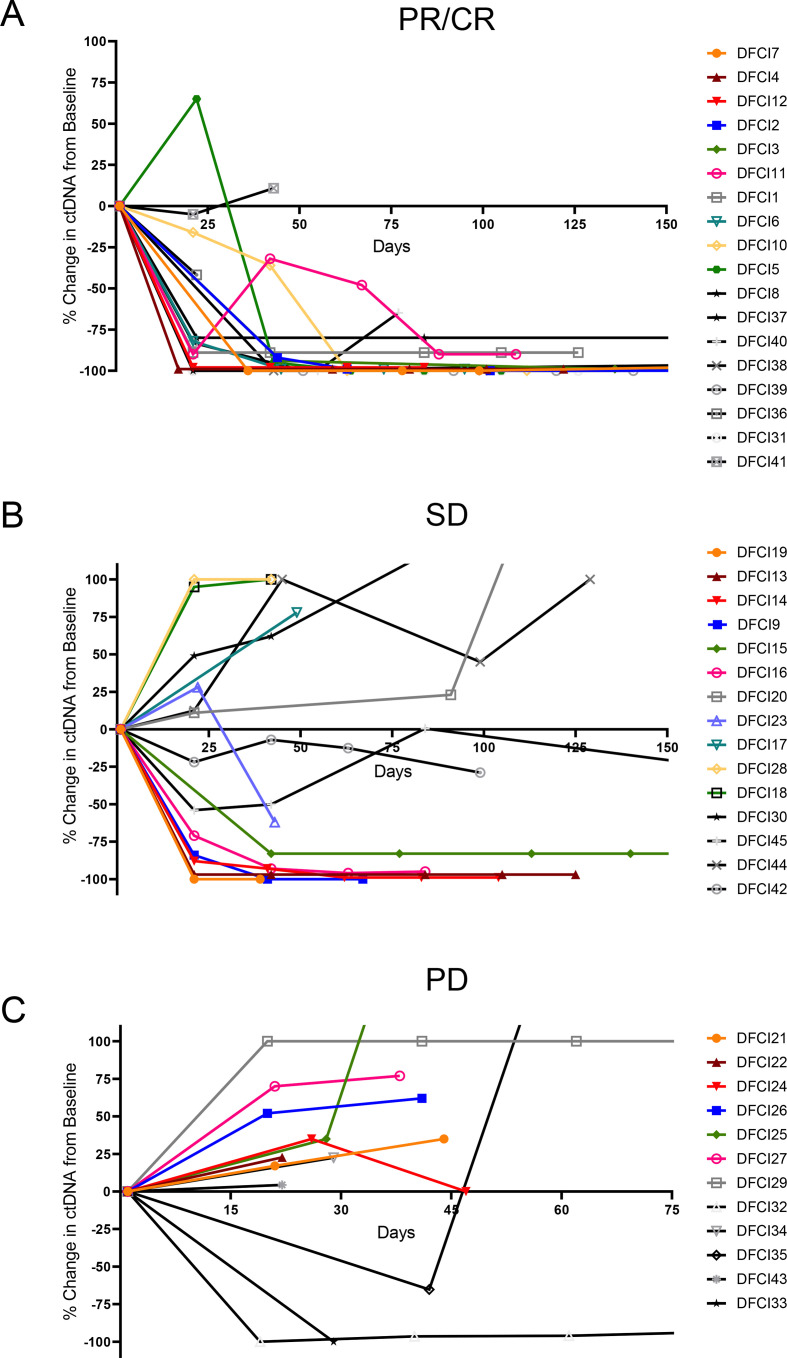
Among 62 patients who received first-line pembrolizumab±platinum/pemetrexed and underwent ctDNA assessment, 45 had detectable ctDNA alterations at baseline. The median change in AF at the first follow-up (at a median of 21 days after treatment initiation) was -90.1% (range -100% to +65%) among patients who subsequently had a radiologic response (n=18), -19.9% (range: -100% to +1884%) among stable disease cases (n=15), and +28.8% (range: -100% to +410%) among progressive disease cases (n=12); p=0.003. In addition, there was a significant correlation between the percent change in ctDNA at the first follow-up and the percent change in tumor target lesions from baseline (R=0.66, p<0.001). AF decrease between the pretreatment and first on-treatment blood draw was associated with significantly higher response rate (60.7% vs 5.8%, p=0.0003), and significantly longer median progression-free survival (8.3 vs 3.4 months, HR: 0.29 (95% CI: 0.14 to 0.60), p=0.0007) and median overall survival (26.2 vs 13.2 months, HR: 0.34 (95% CI: 0.15 to 0.75), p=0.008) compared with cases with an AF increase.
In patients with advanced NSCLC, rapid decreases in ctDNA prior to radiological assessment correlated with clinical benefit. These results suggest a potential role for ctDNA as an early pharmacodynamic biomarker of response or resistance to immunotherapies.
目前可用的生物标志物在预测晚期非小细胞肺癌(NSCLC)患者多种一线治疗选择的反应方面存在缺陷。早期有治疗耐药的药效动力学标志物可能有助于将患者转向更有效的替代疗法。我们试图确定在开始一线帕博利珠单抗±化疗后,循环肿瘤 DNA(ctDNA)水平的变化是否能够在影像学评估之前预测早期反应。
在开始一线帕博利珠单抗±铂类双药化疗之前和之后,采集晚期 NSCLC 患者的血浆,通过下一代测序,使用 36 个基因热点和编码区的增强标记扩增子测序进行分析。ctDNA 等位基因分数(AF)的早期变化与放射学反应和长期临床结局相关。
在 62 名接受一线帕博利珠单抗±铂类/培美曲塞治疗并进行 ctDNA 评估的患者中,45 名患者在基线时有可检测到的 ctDNA 改变。在第一次随访(治疗开始后 21 天中位数)时,ctDNA 等位基因分数(AF)的中位变化在随后出现影像学反应的患者中为-90.1%(范围为-100%至+65%),在疾病稳定的患者中为-19.9%(范围为-100%至+1884%),在疾病进展的患者中为+28.8%(范围为-100%至+410%);p=0.003。此外,在第一次随访时 ctDNA 的百分比变化与基线时肿瘤靶病变的百分比变化之间存在显著相关性(R=0.66,p<0.001)。治疗前和第一次治疗时血液样本之间的 AF 下降与显著更高的反应率(60.7%与 5.8%,p=0.0003)和显著更长的中位无进展生存期(8.3 与 3.4 个月,HR:0.29(95%CI:0.14 至 0.60),p=0.0007)和中位总生存期(26.2 与 13.2 个月,HR:0.34(95%CI:0.15 至 0.75),p=0.008)相关。
在晚期 NSCLC 患者中,在影像学评估之前 ctDNA 的快速下降与临床获益相关。这些结果表明 ctDNA 作为免疫治疗反应或耐药的药效动力学生物标志物具有潜在作用。