Department of General Surgery, Queen Elizabeth Hospital, Kota Kinabalu, Sabah, Malaysia.
Department of Surgery, Faculty of Medicine, University of Malaya, Malaysia.
Asian Pac J Cancer Prev. 2021 Mar 1;22(3):749-755. doi: 10.31557/APJCP.2021.22.3.749.
Malaysia is an ethnically diverse nation, comprising Malay, Chinese, Indian and indigenous groups. However, epidemiological studies on colorectal cancer have mainly focused on the three main ethnic groups. There is evidence that the clinico-pathological characteristics of some cancers may differ in indigenous populations, namely that they occur earlier and behave more aggressively. We aimed to determine if there were similar differences in colorectal cancer, focusing on the indigenous populations of Sabah.
Histopathological reports of all patients diagnosed with colorectal carcinoma from January 2012 to December 2016 from public hospitals in Sabah were retrieved from the central computerized database of the Pathology Department of Queen Elizabeth Hospital in Kota Kinabalu, Sabah. Supplementary data was obtained from patients' case files from each hospital. Clinico-pathological data were analysed using the IBM SPSS Statistical Software Version 23 for Windows for descriptive statistics (mean, median, ASR, AR, relative risk) and inferential statistics (Chi square test).
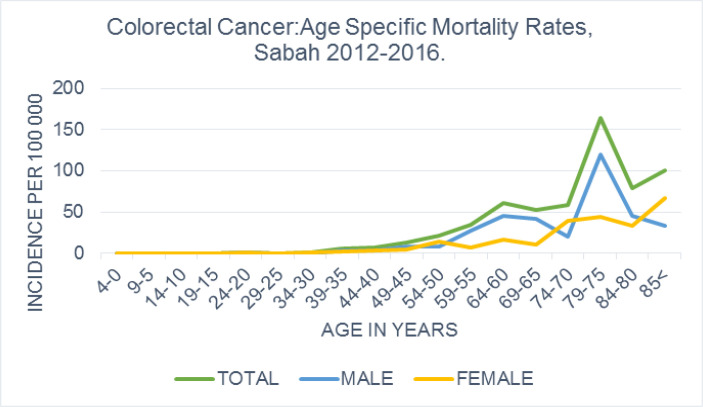
A total of 696 patients met the inclusion criteria. The median age for colorectal cancer in Sabah was 62 years (95% CI 60.3 to 62.3), with an age specific incidence rate of 21.4 per 100 000 population. The age specific incidence rate in the indigenous populations was 26.6 per 100 000, much lower than the Chinese, at 65.0 per 100 000. The risk of colorectal cancer occurring before the age of 50 was three times higher in the indigenous population compared to the Chinese. The tumours were mainly left-sided (56.5%), adenocarcinoma in histology (98.4%) and moderately differentiated (88.7%). Approximately 79.2% of patients received curative treatment.
Indigenous populations in Sabah develop colorectal cancer at an earlier age, and present at more advanced stages. This has implications for screening and therapeutic strategic planning.
.
马来西亚是一个种族多元化的国家,由马来人、华人、印度人和土著群体组成。然而,结直肠癌的流行病学研究主要集中在这三个主要种族群体上。有证据表明,一些癌症的临床病理特征在土著人群中可能存在差异,即它们发生得更早,表现得更具侵袭性。我们旨在确定在结直肠癌中是否存在类似的差异,重点关注沙巴的土著人群。
方法:从沙巴州哥打京那巴鲁伊丽莎白女王医院病理科中央计算机数据库中检索了 2012 年 1 月至 2016 年 12 月期间所有在沙巴公立医院诊断为结直肠癌的患者的组织病理学报告。从每家医院的患者病历中获得补充数据。使用 IBM SPSS 统计软件版本 23 for Windows 对临床病理数据进行分析,采用描述性统计(均值、中位数、ASR、AR、相对风险)和推断性统计(卡方检验)。
结果:共有 696 名患者符合纳入标准。沙巴结直肠癌的中位年龄为 62 岁(95%CI 60.3 至 62.3),年龄特异性发病率为 21.4/10 万。土著人群的年龄特异性发病率为 26.6/10 万,远低于华人的 65.0/10 万。与华人相比,土著人群在 50 岁之前患结直肠癌的风险高 3 倍。肿瘤主要位于左侧(56.5%),组织学上为腺癌(98.4%),分化程度中等(88.7%)。约 79.2%的患者接受了根治性治疗。
结论:沙巴的土著人群结直肠癌发病年龄更早,且处于更晚期。这对筛查和治疗策略规划有影响。