Clinical Memory Research Unit, Department of Clinical Sciences, Lund University, Lund, Sweden.
Memory Clinic, Skåne University Hospital, Malmö, Sweden.
Alzheimers Res Ther. 2021 Mar 27;13(1):68. doi: 10.1186/s13195-021-00804-9.
Plasma glial fibrillary acidic protein (GFAP) is a marker of astroglial activation and astrocytosis. We assessed the ability of plasma GFAP to detect Alzheimer's disease (AD) pathology in the form of AD-related amyloid-β (Aβ) pathology and conversion to AD dementia in a mild cognitive impairment (MCI) cohort.
One hundred sixty MCI patients were followed for 4.7 years (average). AD pathology was defined using cerebrospinal fluid (CSF) Aβ42/40 and Aβ42/total tau (T-tau). Plasma GFAP was measured at baseline and follow-up using Simoa technology.
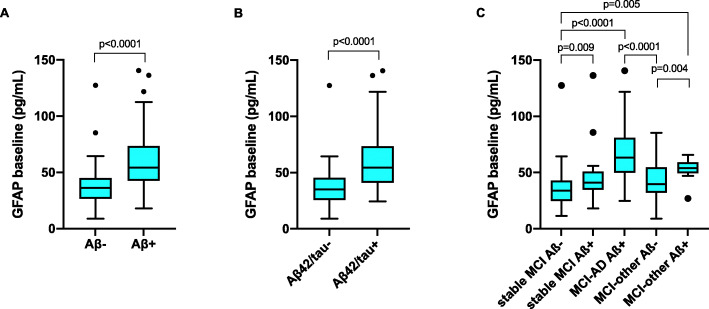
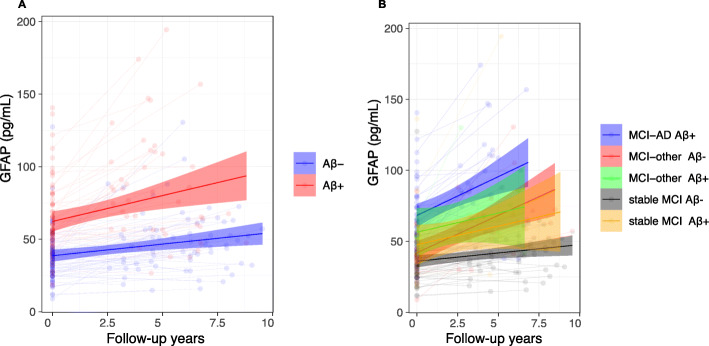
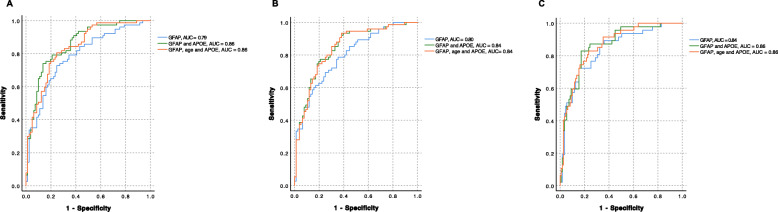
Baseline plasma GFAP could detect abnormal CSF Aβ42/40 and CSF Aβ42/T-tau with an AUC of 0.79 (95% CI 0.72-0.86) and 0.80 (95% CI 0.72-0.86), respectively. When also including APOE ε4 status as a predictor, the accuracy of the model to detect abnormal CSF Aβ42/40 status improved (AUC = 0.86, p = 0.02). Plasma GFAP predicted subsequent conversion to AD dementia with an AUC of 0.84 (95% CI 0.77-0.91), which was not significantly improved when adding APOE ε4 or age as predictors to the model. Longitudinal GFAP slopes for Aβ-positive and MCI who progressed to dementia (AD or other) were significantly steeper than those for Aβ-negative (p = 0.007) and stable MCI (p < 0.0001), respectively.
Plasma GFAP can detect AD pathology in patients with MCI and predict conversion to AD dementia.
血浆神经胶质纤维酸性蛋白(GFAP)是星形胶质细胞激活和星形胶质细胞增生的标志物。我们评估了血浆 GFAP 检测阿尔茨海默病(AD)病理学的能力,这种病理学表现为 AD 相关的淀粉样β(Aβ)病理学以及向轻度认知障碍(MCI)患者转化为 AD 痴呆。
160 名 MCI 患者接受了 4.7 年(平均)的随访。AD 病理学定义为使用脑脊液(CSF)Aβ42/40 和 Aβ42/总 tau(T-tau)。使用 Simoa 技术在基线和随访时测量血浆 GFAP。
基线血浆 GFAP 可以检测到异常 CSF Aβ42/40 和 CSF Aβ42/T-tau,AUC 分别为 0.79(95%CI 0.72-0.86)和 0.80(95%CI 0.72-0.86)。当将 APOE ε4 状态也作为预测因子时,该模型检测异常 CSF Aβ42/40 状态的准确性提高(AUC=0.86,p=0.02)。血浆 GFAP 预测随后转化为 AD 痴呆的 AUC 为 0.84(95%CI 0.77-0.91),当向模型中添加 APOE ε4 或年龄作为预测因子时,其并没有显著提高。Aβ 阳性和进展为痴呆(AD 或其他)的 MCI 患者的纵向 GFAP 斜率明显比 Aβ 阴性(p=0.007)和稳定的 MCI 患者更陡峭(p<0.0001)。
血浆 GFAP 可以检测 MCI 患者的 AD 病理学,并预测向 AD 痴呆的转化。