Division of Nephrology, Department of Medicine, University of Texas Health San Antonio, 7703 Floyd Curl Dr, San Antonio, TX, USA.
University Health, 4502 Medical Dr, San Antonio, TX, USA.
BMC Nephrol. 2021 Mar 27;22(1):112. doi: 10.1186/s12882-021-02314-0.
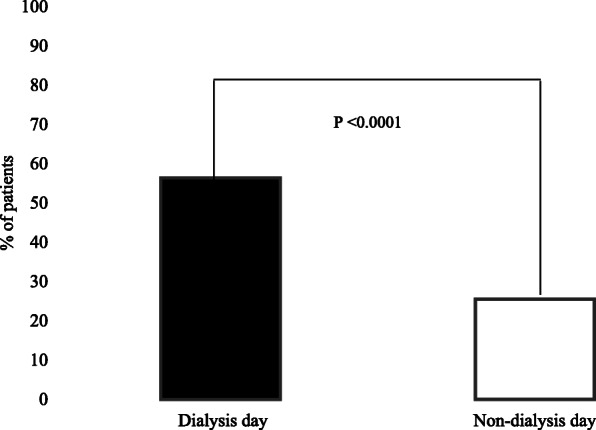
Fatigue is prevalent in hemodialysis patients who for survival follow a strict dialysis treatment regimen - dialysis and non-dialysis days. As a result, the daily activities, symptom burden, and clinical outcomes of hemodialysis patients vary significantly between dialysis and non-dialysis days. Fatigue is one of the most reported debilitating symptoms by hemodialysis patients with profound negative impact on their quality of life. Prior studies assessed fatigue during the preceding 7 or 30 days and did not discriminate fatigue characteristics between dialysis and non-dialysis days. We aimed to characterize and compare fatigue severity and fatigue interference with daily activities between dialysis and non-dialysis days.
Hemodialysis patients self-reported fatigue on consecutive dialysis and non-dialysis days using the 9-item Brief Fatigue Inventory. The differences in fatigue characteristics between dialysis and non-dialysis days were analyzed using one-way ANCOVA.
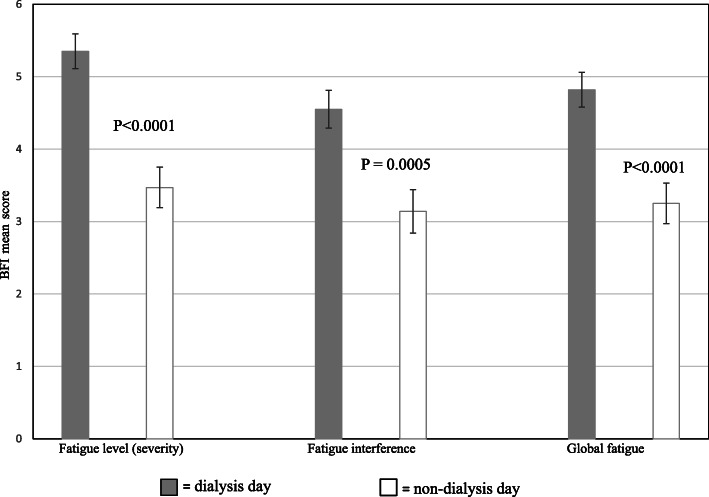
Global fatigue burden was worse on a dialysis day compared to a non-dialysis day (P for all < 0.001). Age and education were associated with fatigue, but hemodialysis-related variables were not. A significant inverse association of physical activity with fatigue severity observed on non-dialysis day; there was also a negative association between the normalized protein catabolic rate and fatigue severity on both dialysis and non-dialysis days. The positive association of depression with fatigue severity and fatigue interference were consistent on both dialysis and non-dialysis days. None of these factors, however, explained differences in fatigue characteristics between dialysis and non-dialysis days.
Fatigue, measured in severity and interference, was more pronounced on a dialysis day relative to a non-dialysis day. These differences were not explained by age, sex, education, hemodialysis-related variables, habitual exercise, nutritional status, and or depression. The quantitative measures of fatigue characteristics may facilitate future interventional trials design and better fatigue management for hemodialysis patients.
由于需要生存,接受血液透析的患者必须严格遵循透析治疗方案,包括透析日和非透析日。因此,血液透析患者的日常活动、症状负担和临床结局在透析日和非透析日之间存在显著差异。疲劳是血液透析患者报告最多的衰弱症状之一,对其生活质量有深远的负面影响。先前的研究评估了过去 7 天或 30 天内的疲劳情况,并未区分透析日和非透析日之间的疲劳特征。我们旨在描述和比较透析日和非透析日之间疲劳的严重程度和对日常活动的干扰。
血液透析患者在连续的透析日和非透析日使用 9 项简短疲劳量表自我报告疲劳情况。采用单向方差分析比较透析日和非透析日之间疲劳特征的差异。
与非透析日相比,透析日的整体疲劳负担更重(所有 P 值均<0.001)。年龄和教育与疲劳有关,但与血液透析相关的变量无关。在非透析日,体力活动与疲劳严重程度呈显著负相关;在透析日和非透析日,归一化蛋白分解率与疲劳严重程度也呈负相关。在透析日和非透析日,抑郁与疲劳严重程度和疲劳干扰呈正相关。然而,这些因素均无法解释透析日和非透析日之间疲劳特征的差异。
与非透析日相比,透析日时疲劳的严重程度和干扰程度更为明显。这些差异不能用年龄、性别、教育、血液透析相关变量、习惯性运动、营养状况或抑郁来解释。疲劳特征的定量测量可能有助于未来干预试验的设计和更好地管理血液透析患者的疲劳。