Department of Immunology, Key Laboratory of Xinjiang Endemic and Ethnic Diseases, Shihezi University School of Medicine, Shihezi, Xinjiang, China.
Medical Laboratory, the First Affiliated Hospital, Shihezi University School of Medicine, Shihezi, Xinjiang, China.
Parasitology. 2021 Jun;148(7):887-894. doi: 10.1017/S0031182021000548. Epub 2021 Mar 29.
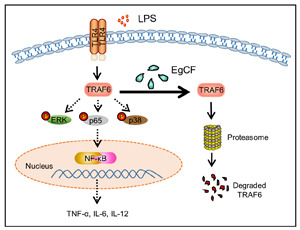
Echinococcus granulosus sensu lato has complex defence mechanisms that protect it from the anti-parasitic immune response for long periods. Echinococcus granulosus cyst fluid (EgCF) is involved in the immune escape. Nevertheless, whether and how EgCF modulates the inflammatory response in macrophages remains poorly understood. Here, real-time polymerase chain reaction and enzyme-linked immunosorbent assay revealed that EgCF could markedly attenuate the lipopolysaccharide (LPS)-induced production of pro-inflammatory factors including tumour necrosis factor-α, interleukin (IL)-12 and IL-6 but increase the expression of IL-10 at mRNA and protein levels in mouse peritoneal macrophages and RAW 264.7 cells. Mechanically, western blotting and immunofluorescence assay showed that EgCF abolished the activation of nuclear factor (NF)-κB p65, p38 mitogen-activated protein kinase (MAPK) and ERK1/2 signalling pathways by LPS stimulation in mouse macrophages. EgCF's anti-inflammatory role was at least partly contributed by promoting proteasomal degradation of the critical adaptor TRAF6. Moreover, the EgCF-promoted anti-inflammatory response and TRAF6 proteasomal degradation were conserved in human THP-1 macrophages. These findings collectively reveal a novel mechanism by which EgCF suppresses inflammatory responses by inhibiting TRAF6 and the downstream activation of NF-κB and MAPK signalling in both human and mouse macrophages, providing new insights into the molecular mechanisms underlying the E. granulosus-induced immune evasion.
细粒棘球蚴(Echinococcus granulosus)感观复杂,具有防御机制,可使其逃避寄生虫的免疫反应达很长一段时间。细粒棘球蚴囊液(EgCF)参与了免疫逃避。然而,EgCF 是否以及如何调节巨噬细胞中的炎症反应仍知之甚少。实时聚合酶链反应和酶联免疫吸附试验显示,EgCF 可显著减弱脂多糖(LPS)诱导的促炎因子的产生,包括肿瘤坏死因子-α、白细胞介素(IL)-12 和 IL-6,但可增加 LPS 刺激的小鼠腹腔巨噬细胞和 RAW264.7 细胞中 IL-10 的 mRNA 和蛋白表达。机制上,Western blot 和免疫荧光分析显示,EgCF 可通过 LPS 刺激使核因子(NF)-κB p65、p38 丝裂原激活蛋白激酶(MAPK)和 ERK1/2 信号通路失活。EgCF 的抗炎作用至少部分归因于促进 TRAF6 关键衔接子的蛋白酶体降解。此外,EgCF 促进的抗炎反应和 TRAF6 蛋白酶体降解在人 THP-1 巨噬细胞中是保守的。这些发现共同揭示了一种新的机制,即 EgCF 通过抑制 TRAF6 及其下游 NF-κB 和 MAPK 信号通路的激活,抑制人源和鼠源巨噬细胞中的炎症反应,为细粒棘球蚴诱导的免疫逃避的分子机制提供了新的见解。