Omolaoye Temidayo S, Windvogel Shantal Lynn, Du Plessis Stefan S
Division of Medical Physiology, Faculty of Medicine and Health Sciences, Stellenbosch University, Tygerberg, South Africa.
Department of Basic Sciences, College of Medicine, Mohammed Bin Rashid University of Medicine and Health Sciences, Dubai, United Arab Emirates.
Diabetes Metab Syndr Obes. 2021 Mar 19;14:1267-1280. doi: 10.2147/DMSO.S285025. eCollection 2021.
Testicular insulin signalling is altered in diabetic (DM) males. While unravelling the mechanism through which DM exert these detrimental effects, studies have shown the importance of insulin regulation in glucose homeostasis, and how a lack in insulin secretion indirectly led to reduced male fertility. The current study aimed to investigate the role of rooibos, honeybush and on insulin signalling in the testicular tissue of type I diabetic rats.
Animals (n=60) were randomly divided into six groups. The groups include a control group, a vehicle group, and diabetes was induced in the remainder of animals via a single intraperitoneal injection of STZ at 45mg/kg. The remaining four groups included a diabetic control (DC), diabetic + rooibos (DRF), diabetic + honeybush (DHB) and diabetic + group (DSL). Animals were sacrificed after seven weeks of treatment, and blood and testes were collected.
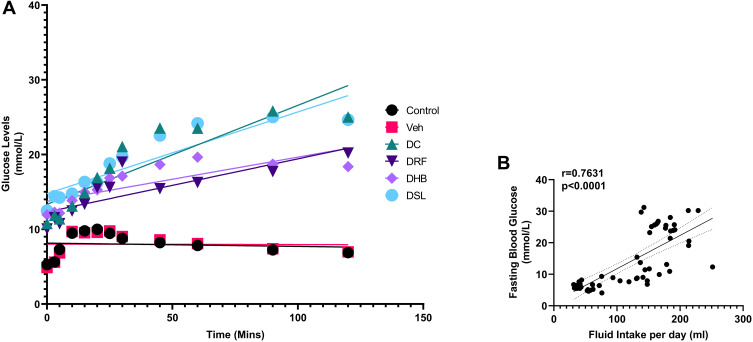
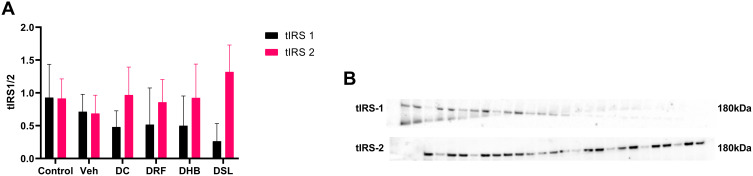
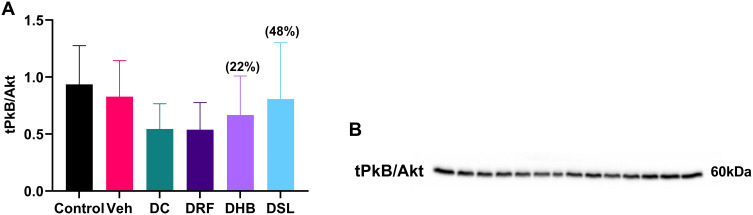
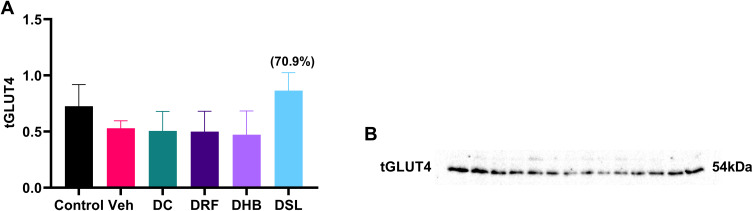
All diabetic groups (DC, DRF, DHB, DSL) presented with a significant increase in blood glucose levels after diabetes induction compared to the control and vehicle (p<0.001). The DC animals presented with decreased testicular protein expression of IRS-1, PkB/Akt and GLUT4 compared to controls. DRF and DHB animals displayed an acute upregulation in IRS-1, while the DSL group showed improvement in IRS-2 compared to DC. Although, DRF animals presented with a decrease in PkB/Akt, DHB and DSL animals displayed upregulation (22.3%, 48%) compared to controls, respectively.
The results taken together, it can be suggested that these infusions may enhance insulin signalling through diverse pathways.
糖尿病(DM)男性的睾丸胰岛素信号传导发生改变。在探究DM产生这些有害影响的机制时,研究表明胰岛素调节在葡萄糖稳态中的重要性,以及胰岛素分泌缺乏如何间接导致男性生育力下降。本研究旨在调查南非红叶茶、蜜树茶和[此处原文缺失一种物质名称]对I型糖尿病大鼠睾丸组织中胰岛素信号传导的作用。
将60只动物随机分为六组。这些组包括一个对照组、一个赋形剂组,其余动物通过腹腔注射45mg/kg链脲佐菌素(STZ)诱导糖尿病。其余四组包括糖尿病对照组(DC)、糖尿病+南非红叶茶组(DRF)、糖尿病+蜜树茶组(DHB)和糖尿病+[此处原文缺失一种物质名称]组(DSL)。治疗七周后处死动物,采集血液和睾丸。
与对照组和赋形剂组相比,所有糖尿病组(DC、DRF、DHB、DSL)在诱导糖尿病后血糖水平均显著升高(p<0.001)。与对照组相比,DC组动物睾丸中胰岛素受体底物-1(IRS-1)、蛋白激酶B/蛋白激酶B(PkB/Akt)和葡萄糖转运蛋白4(GLUT4)的蛋白表达降低。与DC组相比,DRF组和DHB组动物IRS-1急性上调,而DSL组IRS-2有所改善。尽管DRF组动物的PkB/Akt降低,但与对照组相比,DHB组和DSL组动物分别上调(22.3%、48%)。
综合这些结果,可以认为这些浸液可能通过多种途径增强胰岛素信号传导。