Kern Charlotte, Schöning Verena, Chaccour Carlos, Hammann Felix
Clinical Pharmacology and Toxicology, Department of General Internal Medicine, Inselspital (Bern University Hospital), University of Bern, Bern, Switzerland.
Graduate School for Health Sciences, University of Bern, Bern, Switzerland.
Front Pharmacol. 2021 Mar 10;12:625678. doi: 10.3389/fphar.2021.625678. eCollection 2021.
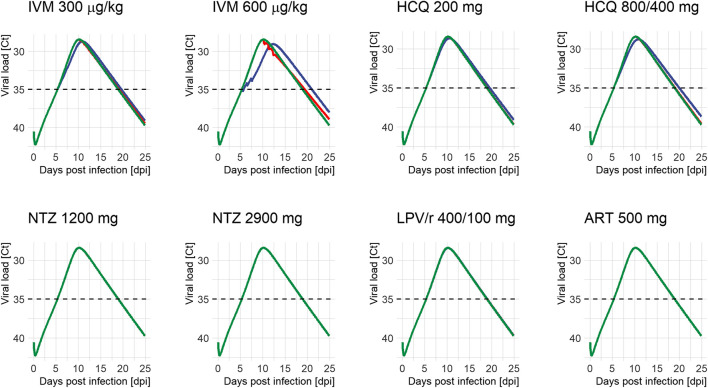
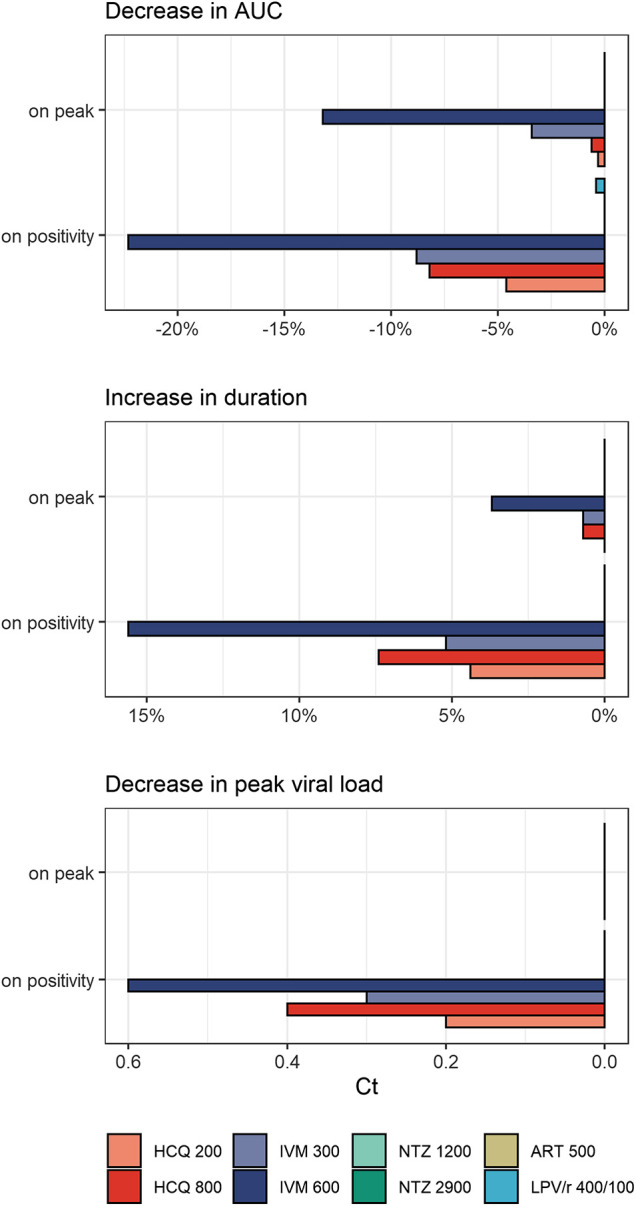
Several repurposed drugs are currently under investigation in the fight against coronavirus disease 2019 (COVID-19). Candidates are often selected solely by their effective concentrations , an approach that has largely not lived up to expectations in COVID-19. Cell lines used in experiments are not necessarily representative of lung tissue. Yet, even if the proposed mode of action is indeed true, viral dynamics , host response, and concentration-time profiles must also be considered. Here we address the latter issue and describe a model of human SARS-CoV-2 viral kinetics with acquired immune response to investigate the dynamic impact of timing and dosing regimens of hydroxychloroquine, lopinavir/ritonavir, ivermectin, artemisinin, and nitazoxanide. We observed greatest benefits when treatments were given immediately at the time of diagnosis. Even interventions with minor antiviral effect may reduce host exposure if timed correctly. Ivermectin seems to be at least partially effective: given on positivity, peak viral load dropped by 0.3-0.6 log units and exposure by 8.8-22.3%. The other drugs had little to no appreciable effect. Given how well previous clinical trial results for hydroxychloroquine and lopinavir/ritonavir are explained by the models presented here, similar strategies should be considered in future drug candidate prioritization efforts.
目前有几种重新利用的药物正在用于抗击2019冠状病毒病(COVID-19)的研究中。候选药物通常仅根据其有效浓度来选择,这种方法在COVID-19治疗中很大程度上未达预期。实验中使用的细胞系不一定能代表肺组织。然而,即使所提出的作用模式确实正确,也必须考虑病毒动力学、宿主反应以及浓度-时间曲线。在此,我们解决后一个问题,并描述一个具有获得性免疫反应的人类严重急性呼吸综合征冠状病毒2(SARS-CoV-2)病毒动力学模型,以研究羟氯喹、洛匹那韦/利托那韦、伊维菌素、青蒿素和硝唑尼特的给药时间和给药方案的动态影响。我们观察到在诊断时立即进行治疗能带来最大益处。如果时机把握正确,即使是抗病毒作用较小的干预措施也可能减少宿主暴露。伊维菌素似乎至少有部分效果:在检测呈阳性时给药,病毒载量峰值下降0.3 - 0.6个对数单位,暴露量下降8.8 - 22.3%。其他药物几乎没有明显效果。鉴于本文所展示的模型能够很好地解释羟氯喹和洛匹那韦/利托那韦之前的临床试验结果,在未来的候选药物优先级排序工作中应考虑类似策略。