Reid Tessa E, Kavamura Vanessa N, Abadie Maïder, Torres-Ballesteros Adriana, Pawlett Mark, Clark Ian M, Harris Jim, Mauchline Tim H
Sustainable Agriculture Sciences, Rothamsted Research, Harpenden, United Kingdom.
Cranfield Soil and Agrifood Institute, Cranfield University, Cranfield, United Kingdom.
Front Microbiol. 2021 Mar 11;12:642587. doi: 10.3389/fmicb.2021.642587. eCollection 2021.
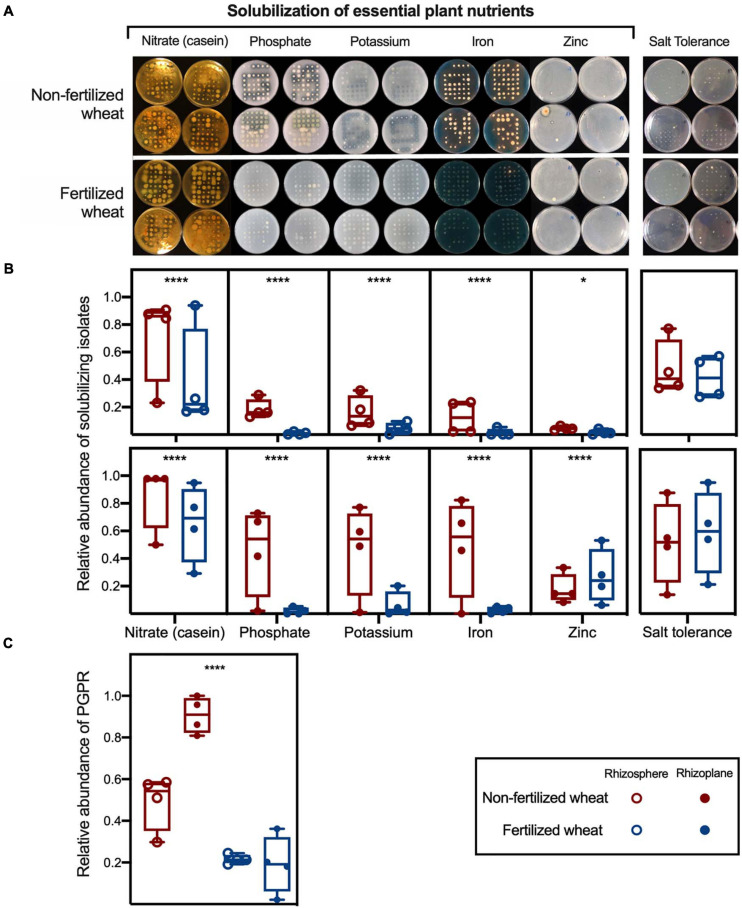
The profound negative effect of inorganic chemical fertilizer application on rhizobacterial diversity has been well documented using 16S rRNA gene amplicon sequencing and predictive metagenomics. We aimed to measure the function and relative abundance of readily culturable putative plant growth-promoting rhizobacterial (PGPR) isolates from wheat root soil samples under contrasting inorganic fertilization regimes. We hypothesized that putative PGPR abundance will be reduced in fertilized relative to unfertilized samples. cv. Cadenza seeds were sown in a nutrient depleted agricultural soil in pots treated with and without Osmocote fertilizer containing nitrogen-phosphorous-potassium (NPK). Rhizosphere and rhizoplane samples were collected at flowering stage (10 weeks) and analyzed by culture-independent (CI) amplicon sequence variant (ASV) analysis of rhizobacterial DNA as well as culture-dependent (CD) techniques. Rhizosphere and rhizoplane derived microbiota culture collections were tested for plant growth-promoting traits using functional bioassays. In general, fertilizer addition decreased the proportion of nutrient-solubilizing bacteria (nitrate, phosphate, potassium, iron, and zinc) isolated from rhizocompartments in wheat whereas salt tolerant bacteria were not affected. A "PGPR" database was created from isolate 16S rRNA gene sequences against which total amplified 16S rRNA soil DNA was searched, identifying 1.52% of total community ASVs as culturable PGPR isolates. Bioassays identified a higher proportion of PGPR in non-fertilized samples [rhizosphere (49%) and rhizoplane (91%)] compared to fertilized samples [rhizosphere (21%) and rhizoplane (19%)] which constituted approximately 1.95 and 1.25% in non-fertilized and fertilized total community DNA, respectively. The analyses of 16S rRNA genes and deduced functional profiles provide an in-depth understanding of the responses of bacterial communities to fertilizer; our study suggests that rhizobacteria that potentially benefit plants by mobilizing insoluble nutrients in soil are reduced by chemical fertilizer addition. This knowledge will benefit the development of more targeted biofertilization strategies.
利用16S rRNA基因扩增子测序和预测宏基因组学,无机化肥施用对根际细菌多样性的深远负面影响已有充分记载。我们旨在测定在不同无机施肥制度下,从小麦根际土壤样品中易于培养的假定植物促生根际细菌(PGPR)分离株的功能和相对丰度。我们假设,与未施肥样品相比,施肥样品中假定PGPR的丰度会降低。将品种为Cadenza的种子播种在营养贫瘠的农业土壤花盆中,部分花盆施用含有氮磷钾(NPK)的奥绿肥,部分不施用。在开花期(10周)采集根际和根表样品,并通过对根际细菌DNA进行非培养(CI)扩增子序列变异(ASV)分析以及培养依赖(CD)技术进行分析。使用功能生物测定法对根际和根表来源的微生物培养物进行植物促生特性测试。总体而言,施肥降低了从小麦根际隔室分离出的营养溶解细菌(硝酸盐、磷酸盐、钾、铁和锌)的比例,而耐盐细菌不受影响。根据分离株的16S rRNA基因序列创建了一个“PGPR”数据库,并以此搜索土壤中总扩增16S rRNA DNA,将群落ASV总数的1.52%鉴定为可培养的PGPR分离株。生物测定法表明,与施肥样品[根际(21%)和根表(19%)]相比,未施肥样品[根际(49%)和根表(91%)]中PGPR的比例更高,在未施肥和施肥的总群落DNA中分别约占1.95%和1.25%。对16S rRNA基因和推导的功能概况分析,能深入了解细菌群落对肥料的反应;我们的研究表明,通过在土壤中活化不溶性养分而可能使植物受益的根际细菌会因化肥添加而减少。这一知识将有助于制定更具针对性的生物施肥策略。