Laboratory of Immunogenetics, Department of Immunology, Aggeu Magalhães Institute, Oswaldo Cruz Foundation, Recife, Brazil.
Hospital da Restauração Gov. Paulo Guerra, Recife, Brazil.
Front Immunol. 2021 Mar 12;12:582935. doi: 10.3389/fimmu.2021.582935. eCollection 2021.
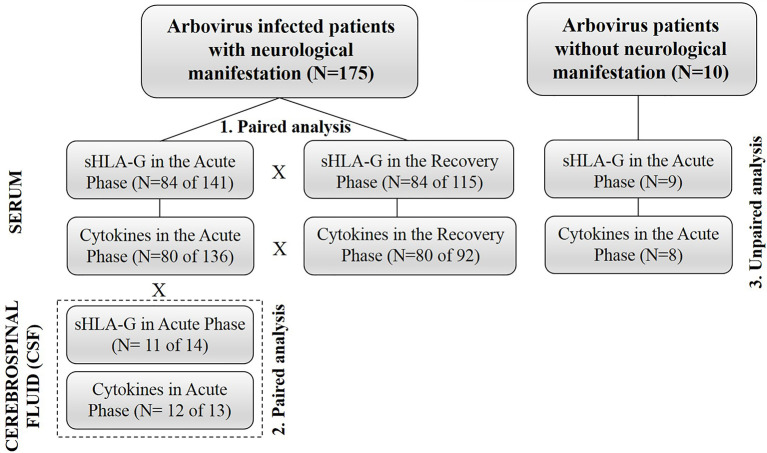
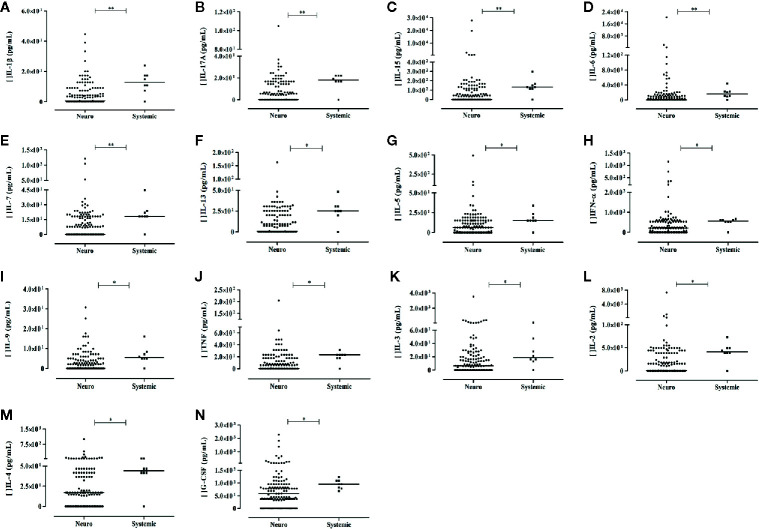
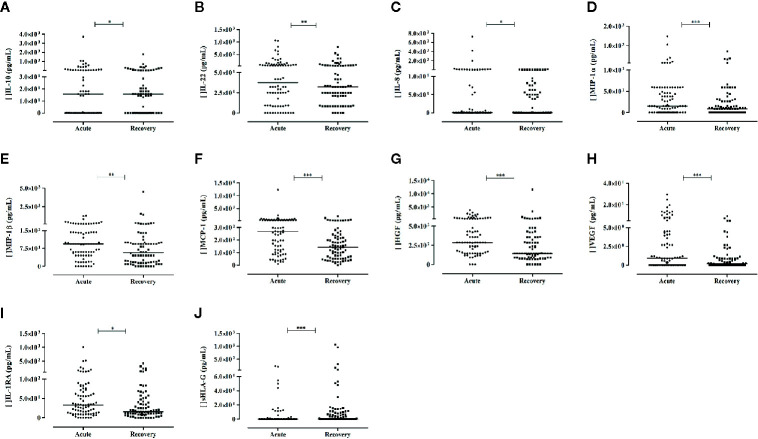
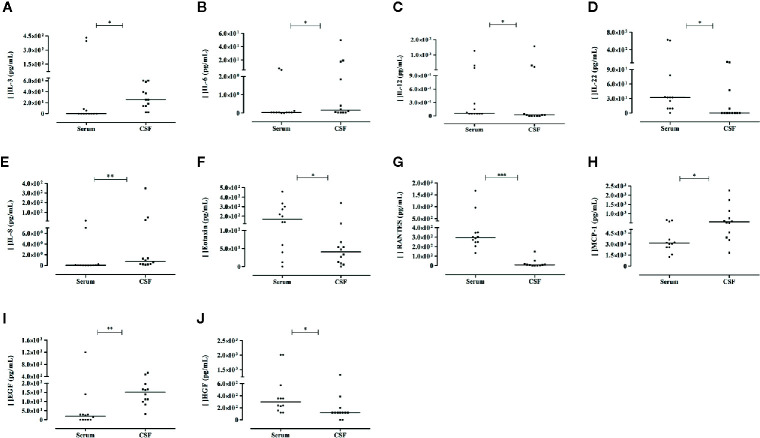
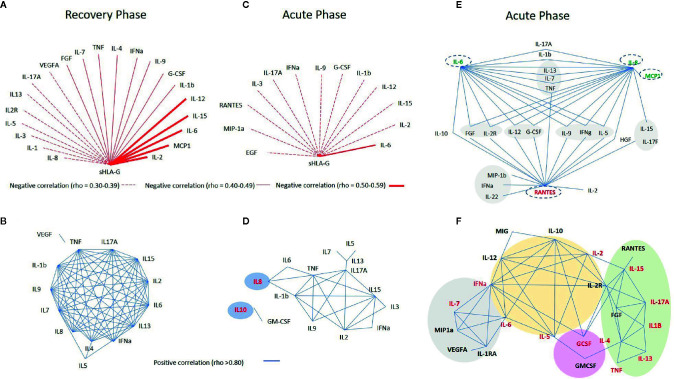
Severe neurological complications following arbovirus infections have been a major concern in seasonal outbreaks, as reported in the Northeast region of Brazil, where the same mosquito transmitted Zika (ZIKV), Dengue (DENV), and Chikungunya (CHIKV) viruses. In this study, we evaluated the levels of 36 soluble markers, including cytokines, chemokines, growth factors, and soluble HLA-G (Luminex and ELISA) in: i) serum and cerebrospinal fluid (CSF), during the acute phase and two years after the infection (recovery phase, only serum), ii) the relationship among all soluble molecules in serum and CSF, and iii) serum of infected patients without neurological complications, during the acute infection. Ten markers (sHLA-G, IL-10, IL-22, IL-8, MIP-1α, MIP-1β, MCP-1, HGF, VEGF, and IL-1RA) exhibited differential levels between the acute and recovery phases, with pronounced increases in MIP-1α (<0.0001), MCP-1 (<0.0001), HGF (= 0.0001), and VEGF (<0.0001) in the acute phase. Fourteen molecules (IL-1β, IL-2, IL-3, IL-4, IL-5, IL-6, IL-7, IL-9, IL-13, IL-15, IL-17A, IFN-α, TNF, and G-CSF) exhibited distinct levels between arbovirus patients presenting or not neurological complications. IL-8, EGF, IL-6, and MCP-1 levels were increased in CSF, while RANTES and Eotaxin levels were higher in serum. Soluble serum (IL-22, RANTES, Eotaxin) and CSF (IL-8, EGF, IL-3) mediators may discriminate putative risks for neurological complications following arbovirus infections. Neurological complications were associated with the presence of a predominant inflammatory profile, whereas in non-complicated patients an anti-inflammatory profile may predominate. Mediators associated with neuroregeneration (EGF and IL-3) may be induced in response to neurological damage. Broad spectrum immune checkpoint molecules (sHLA-G) interact with cytokines, chemokines, and growth factors. The identification of soluble markers may be useful to monitor neurological complications and may aid in the development of novel therapies against neuroinflammation.
巴西东北部曾发生过虫媒病毒感染引发的严重神经并发症,寨卡病毒(ZIKV)、登革热病毒(DENV)和基孔肯雅热病毒(CHIKV)都可通过同一种蚊子传播。本研究评估了 36 种可溶性标志物的水平,包括细胞因子、趋化因子、生长因子和可溶性 HLA-G(Luminex 和 ELISA):i)在急性感染期和感染后两年的恢复期(仅血清),ii)血清和脑脊液(CSF)中所有可溶性分子之间的关系,以及 iii)急性感染期无神经并发症的感染患者的血清。有 10 种标志物(sHLA-G、IL-10、IL-22、IL-8、MIP-1α、MIP-1β、MCP-1、HGF、VEGF 和 IL-1RA)在急性和恢复期之间表现出不同的水平,其中 MIP-1α(<0.0001)、MCP-1(<0.0001)、HGF(= 0.0001)和 VEGF(<0.0001)在急性感染期明显增加。有 14 种分子(IL-1β、IL-2、IL-3、IL-4、IL-5、IL-6、IL-7、IL-9、IL-13、IL-15、IL-17A、IFN-α、TNF 和 G-CSF)在出现或不出现神经并发症的 arbovirus 患者之间表现出不同的水平。IL-8、EGF、IL-6 和 MCP-1 的水平在 CSF 中升高,而 RANTES 和 Eotaxin 的水平在血清中升高。血清可溶性(IL-22、RANTES、Eotaxin)和 CSF(IL-8、EGF、IL-3)介质可能区分 arbovirus 感染后发生神经并发症的潜在风险。神经并发症与存在主要炎症特征有关,而在无并发症患者中,抗炎特征可能占主导地位。与神经再生相关的介质(EGF 和 IL-3)可能是对神经损伤的反应而被诱导产生的。广谱免疫检查点分子(sHLA-G)与细胞因子、趋化因子和生长因子相互作用。可溶性标志物的鉴定可能有助于监测神经并发症,并有助于开发针对神经炎症的新疗法。