Xu Hongbing, Brook Robert D, Wang Tong, Song Xiaoming, Feng Baihuan, Yi Tieci, Liu Shengcong, Wu Rongshan, Chen Jie, Zhang Yi, Liu Shuo, Zhao Qian, Wang Yang, Zheng Lemin, Huo Yong, Rajagopalan Sanjay, Li Jianping, Huang Wei
Department of Occupational and Environmental Health, Peking University School of Public Health, Beijing, China.
Key Laboratory of Molecular Cardiovascular Sciences of Ministry of Education, Health Science Center, Peking University, Beijing, China.
Environ Epidemiol. 2019 Dec 2;3(6):e078. doi: 10.1097/EE9.0000000000000078. eCollection 2019 Dec.
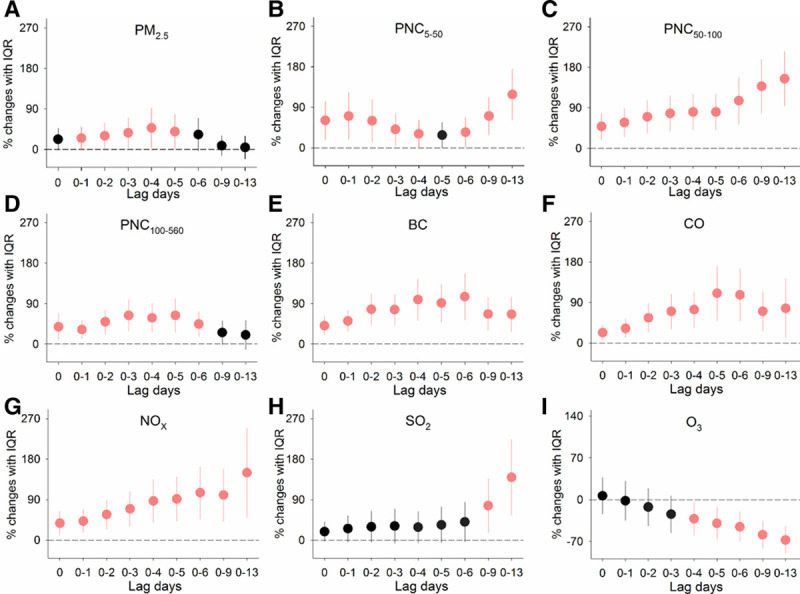
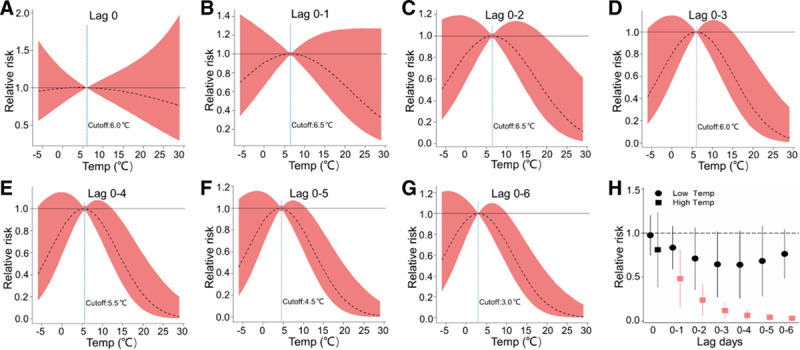
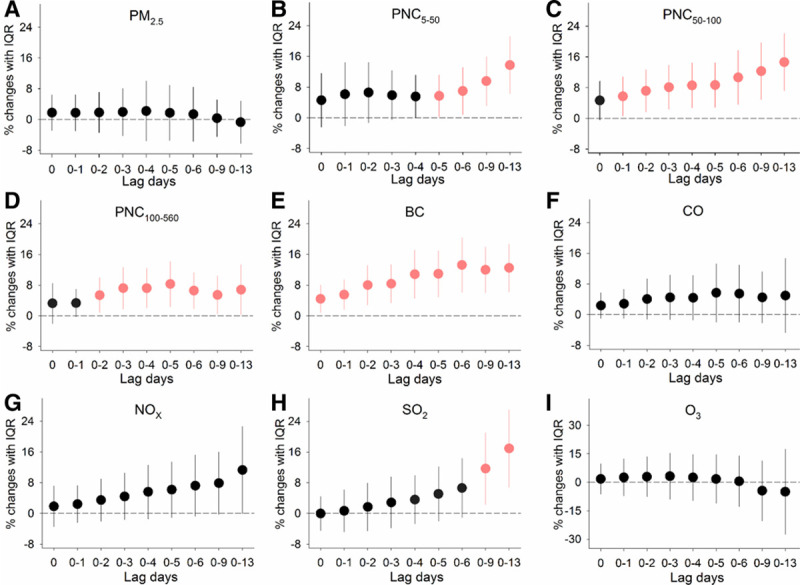
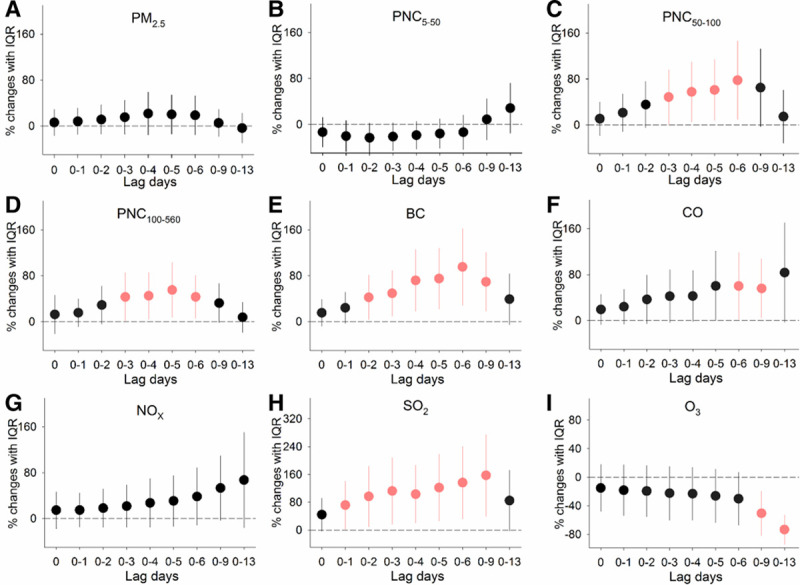
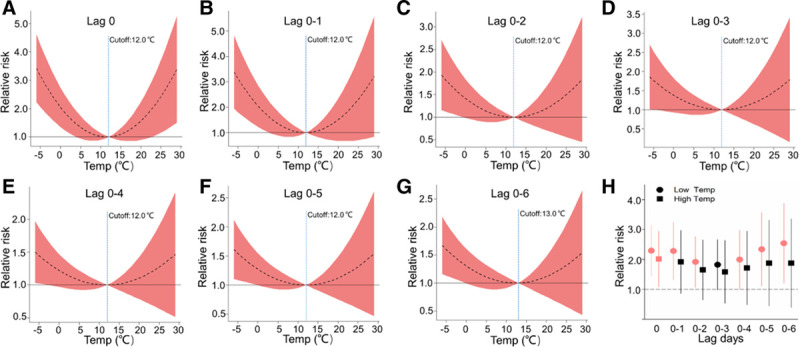
The mechanisms whereby ambient air pollution and temperature changes promote cardiac events remain incompletely described. Seventy-three nonsmoking healthy adults (mean age 23.3, SD 5.4 years) were followed with up to four repeated visits across 15 months in Beijing in 2014-2016. Biomarkers relevant to myocardial damage (high-sensitivity cardiac troponin I [hs-cTnI]), inflammation (growth differentiation factor-15 [GDF-15]), and oxidative stress (8-hydroxy-2'-deoxyguanosine [8-OHdG]) were measured at each visit, while ambient air pollution and temperature were monitored throughout the study. Linear mixed-effects models coupled with distributed lag nonlinear models were used to assess the impacts of each exposure measure on study outcomes. During follow-up, average daily concentrations of fine particulate matter and outdoor temperature were 62.9 µg/m (8.1-331.0 µg/m) and 10.1 °C (-6.5°C to 29.5°C). Serum hs-cTnI levels were detectable in 18.2% of blood samples, with 27.4% of individuals having ≥1 detectable values. Higher levels of ambient particulates and gaseous pollutants (per interquartile range) up to 14 days before clinical visits were associated with significant alterations in hs-cTnI levels of 22.9% (95% CI, 6.4, 39.4) to 154.7% (95% CI, 94.4, 215.1). These changes were accompanied by elevations of circulating GDF-15 and urinary 8-OHdG levels. Both low (5th percentile, -2.5 °C) and high (95th percentile, 24.8°C) outdoor temperatures, with breakpoint at ~13.0°C as the reference level, were also associated with elevations of hs-cTnI levels. Short-term exposure to ambient air pollution and temperature was associated with cardiac troponin, a biomarker of myocardial damage, along with increased inflammation and oxidative stress responses. These findings extend our understanding of the biological mechanisms linking pervasive environmental exposure to adverse cardiac events.
环境空气污染和温度变化促进心脏事件发生的机制仍未完全阐明。2014年至2016年期间,在北京对73名不吸烟的健康成年人(平均年龄23.3岁,标准差5.4岁)进行了随访,随访时间长达15个月,共进行了4次重复访视。每次访视时均测量与心肌损伤相关的生物标志物(高敏心肌肌钙蛋白I [hs-cTnI])、炎症标志物(生长分化因子-15 [GDF-15])和氧化应激标志物(8-羟基-2'-脱氧鸟苷 [8-OHdG]),同时在整个研究过程中监测环境空气污染和温度。采用线性混合效应模型结合分布滞后非线性模型来评估每种暴露指标对研究结果的影响。随访期间,细颗粒物的日均浓度和室外温度分别为62.9 µg/m³(8.1 - 331.0 µg/m³)和10.1℃(-6.5℃至29.5℃)。18.2%的血样中可检测到血清hs-cTnI水平,27.4%的个体有≥1个可检测值。临床访视前长达14天的较高环境颗粒物和气态污染物水平(每四分位数间距)与hs-cTnI水平显著变化相关,变化幅度为22.9%(95%置信区间,6.4,39.4)至154.7%(95%置信区间,94.4,215.1)。这些变化伴随着循环GDF-15水平和尿8-OHdG水平的升高。以~13.0℃为参考水平,室外低温(第5百分位数,-2.5℃)和高温(第95百分位数,24.8℃)也与hs-cTnI水平升高相关。短期暴露于环境空气污染和温度与心肌损伤生物标志物心肌肌钙蛋白相关,同时炎症和氧化应激反应增加。这些发现扩展了我们对普遍环境暴露与不良心脏事件之间生物学机制的理解。