Skarha Julianne, Messerlian Carmen, Bellinger David, Mínguez-Alarcón Lidia, Romano Megan E, Ford Jennifer B, Williams Paige L, Calafat Antonia M, Hauser Russ, Braun Joseph M
Department of Epidemiology, Brown University, Providence, Rhode Island.
Department of Environmental Health, Harvard T.H. Chan School of Public Health, Boston, Massachusetts.
Environ Epidemiol. 2020 Jan 27;4(1):e082. doi: 10.1097/EE9.0000000000000082. eCollection 2020 Feb.
Epidemiologic studies suggest that prenatal urinary bisphenol A (BPA) concentrations are associated with childhood behavior problems, but there is limited research on prenatal paraben concentrations. In rodent offspring, preconception maternal BPA exposure caused behavioral problems and paraben exposure impacted sperm quality. However, the effects of parental preconception and prenatal BPA and paraben exposure on children's neurodevelopment are unknown.
The Environment and Reproductive Health (EARTH) Study is a prospective cohort of couples from a fertility clinic at Massachusetts General Hospital. The Centers for Disease Control and Prevention (CDC) quantified BPA, butylparaben, ethylparaben, methylparaben, and propylparaben concentrations in multiple urine samples collected before conception and during pregnancy. From the eligible parents (N = 220), we enrolled 158 children between 2 and 9 years of age. The parents completed the Behavior-Assessment-System-for-Children-2 (BASC-2). We estimated covariate-adjusted associations of average parental preconception and prenatal ln-transformed urinary BPA and sum of paraben concentrations (∑paraben) with BASC-2 scores using linear regression with generalized estimating equations.
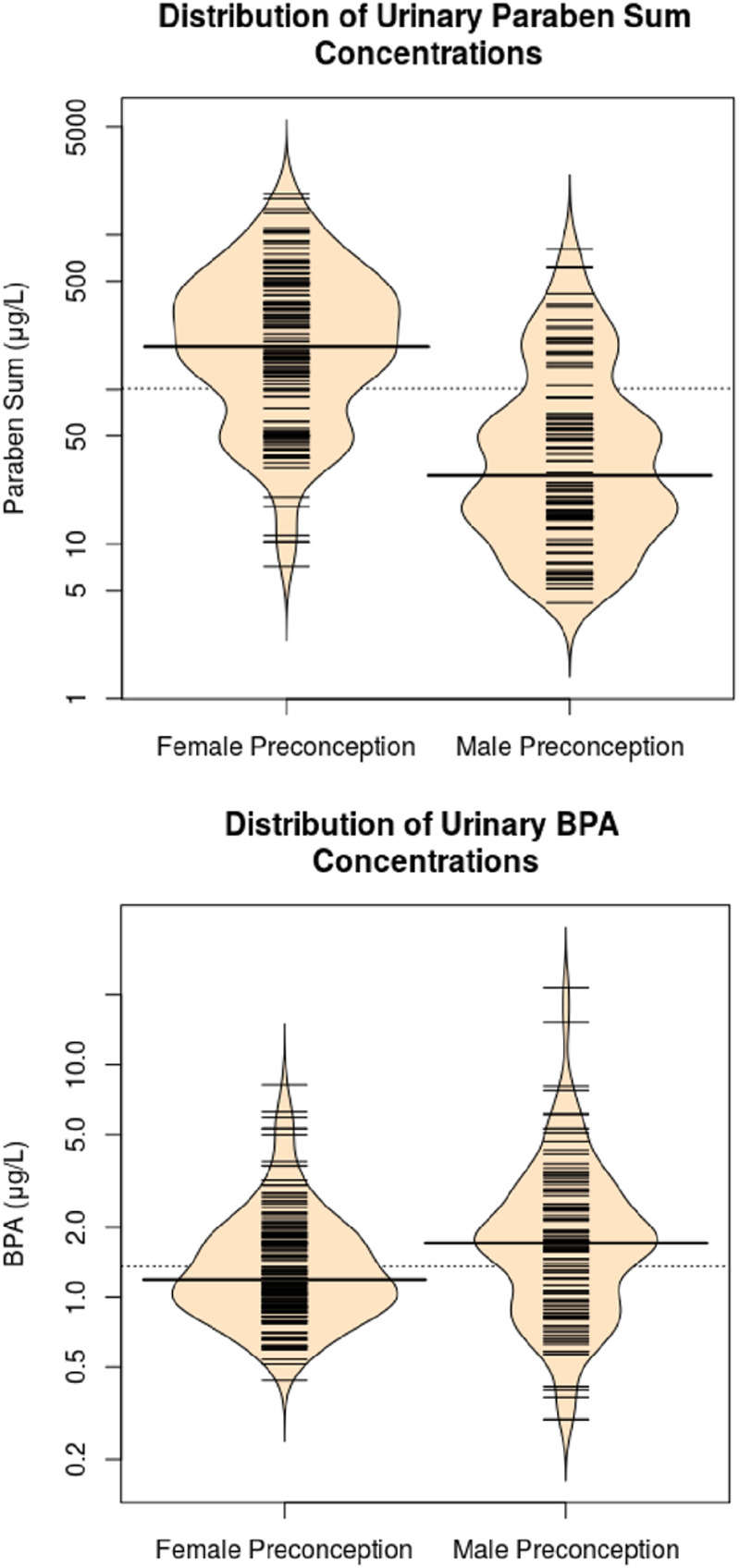
Median urinary BPA and Σparaben concentrations were 1.2 and 189 μg/L in mothers preconception and 1.7 and 25 μg/L in fathers preconception, respectively. Among all children, parental BPA and ∑paraben concentrations were not associated with BASC-2 behavioral symptoms index, internalizing, or externalizing problems scores. Point estimates ranged from -1.5 to 1.4 with wide 95% confidence intervals that included the null value.
In this fertility clinic cohort, parental preconception and maternal prenatal BPA and paraben concentrations were not associated with problem behaviors among children. However, our small sample sizes reduced the precision of our results.
流行病学研究表明,产前尿中双酚A(BPA)浓度与儿童行为问题有关,但关于产前对羟基苯甲酸酯浓度的研究有限。在啮齿动物后代中,孕前母体接触双酚A会导致行为问题,而接触对羟基苯甲酸酯会影响精子质量。然而,父母孕前和孕期接触双酚A和对羟基苯甲酸酯对儿童神经发育的影响尚不清楚。
环境与生殖健康(EARTH)研究是对来自麻省总医院一家生育诊所的夫妇进行的前瞻性队列研究。疾病控制与预防中心(CDC)对孕前和孕期收集的多个尿液样本中的双酚A、对羟基苯甲酸丁酯、对羟基苯甲酸乙酯、对羟基苯甲酸甲酯和对羟基苯甲酸丙酯浓度进行了量化。从符合条件的父母(N = 220)中,我们招募了158名2至9岁的儿童。父母完成了儿童行为评估系统第二版(BASC - 2)。我们使用广义估计方程的线性回归,估计了经协变量调整的父母孕前和产前对数转换后的尿双酚A以及对羟基苯甲酸酯浓度总和(∑对羟基苯甲酸酯)与BASC - 2评分之间的关联。
母亲孕前尿双酚A和∑对羟基苯甲酸酯浓度中位数分别为1.2和189μg/L,父亲孕前分别为1.7和25μg/L。在所有儿童中,父母双酚A和∑对羟基苯甲酸酯浓度与BASC - 行为症状指数、内化或外化问题评分均无关联。点估计值范围为 - 1.5至1.4,95%置信区间较宽且包含零值。
在这个生育诊所队列中,父母孕前以及母亲产前双酚A和对羟基苯甲酸酯浓度与儿童的问题行为无关。然而,我们的样本量较小,降低了结果的精确性。