Mehta Unnati, Dey Sagnik, Chowdhury Sourangsu, Ghosh Santu, Hart Jaime E, Kurpad Anura
Centre for Atmospheric Sciences, Indian Institute of Technology Delhi, New Delhi, India.
Harvard University T. H. Chan School of Public Health, Boston, Massachusetts.
Environ Epidemiol. 2021 Jan 7;5(1):e125. doi: 10.1097/EE9.0000000000000125. eCollection 2021 Feb.
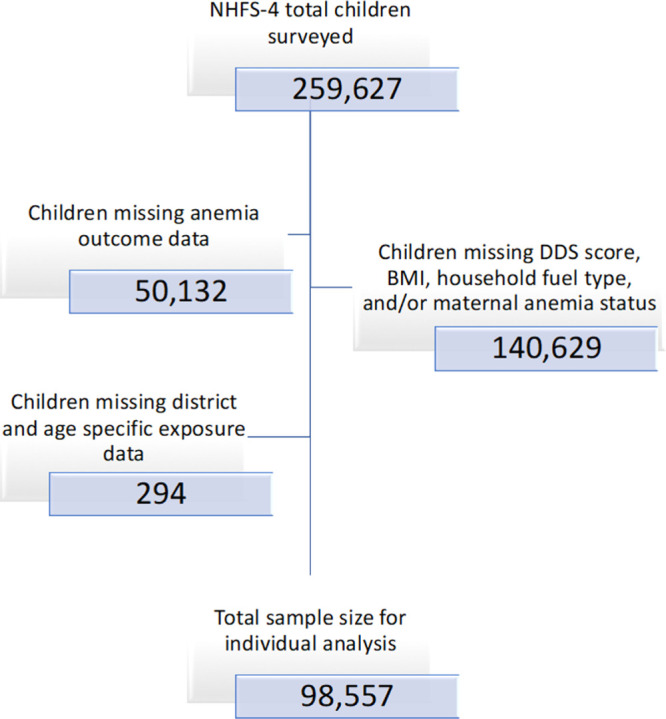
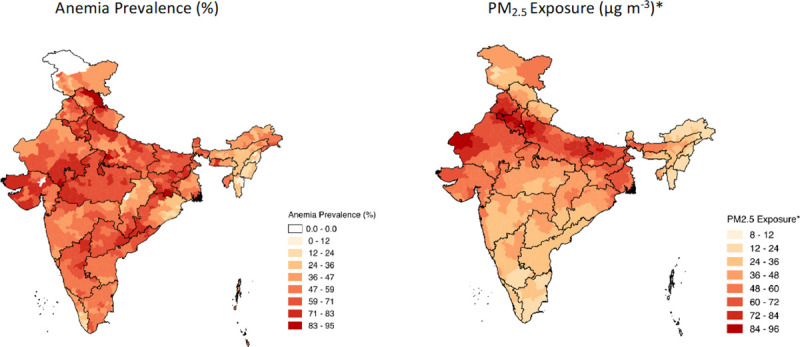
Anemia is highly prevalent in India, especially in children. Exposure to ambient fine particulate matter (PM) is a potential risk factor for anemia via. systemic inflammation. Using health data from the National Family and Health Survey 2015-2016, we examined the association between ambient PM exposure and anemia in children under five across India through district-level ecological and individual-level analyses.
The ecological analysis assessed average hemoglobin levels and anemia prevalence (hemoglobin < 11 g/dL considered anemic) by district using multiple linear regression models. The individual-level analysis assessed average individual hemoglobin level and anemia status (yes/no) using generalized linear mixed models to account for clustering by district. Ambient PM exposure data were derived from the Multiangle Imaging SpectroRadiometer (MISR) level 2 aerosol optical depth (AOD) data and averaged from birth date to date of interview.
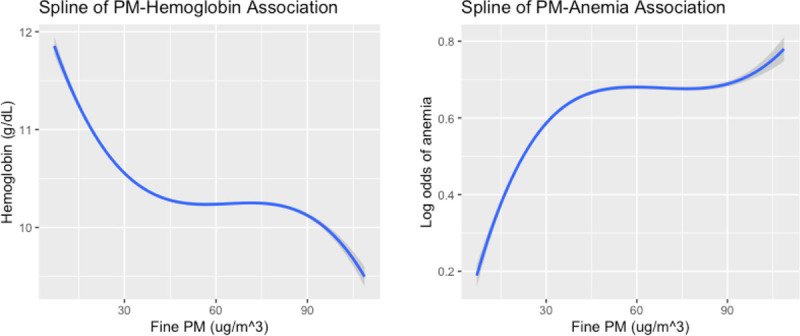
The district-level ecological analysis found that, for every 10 μg m increase in ambient PM exposure, average anemia prevalence increased by 1.90% (95% CI = 1.43, 2.36) and average hemoglobin decreased by 0.07 g/dL (95% CI = 0.09, 0.05). At the individual level, for every 10 μg m increase in ambient PM exposure, average hemoglobin decreased by 0.14 g/dL (95% CI = 0.12, 0.16). The odds ratio associated with a 10-μg m increase in ambient PM exposure was 1.09 (95% CI = 1.06, 1.11). There was evidence of effect modification by wealth index, maternal anemia status, and child BMI.
Our results suggest that ambient PM exposure could be linked to anemia in Indian children, although additional research on the underlying biologic mechanisms is needed. Future studies on this association should specifically consider interactions with dietary iron deficiency, maternal anemia status, and child BMI.Keywords: Anemia; Children; Ambient PM2.5 exposure; India; Association.
贫血在印度极为普遍,尤其是在儿童中。暴露于环境细颗粒物(PM)是通过全身炎症导致贫血的一个潜在风险因素。利用2015 - 2016年全国家庭健康调查的健康数据,我们通过地区层面的生态分析和个体层面的分析,研究了印度五岁以下儿童环境PM暴露与贫血之间的关联。
生态分析使用多元线性回归模型按地区评估平均血红蛋白水平和贫血患病率(血红蛋白<11 g/dL被视为贫血)。个体层面的分析使用广义线性混合模型评估个体平均血红蛋白水平和贫血状况(是/否),以考虑地区聚类情况。环境PM暴露数据来自多角度成像光谱辐射计(MISR)二级气溶胶光学厚度(AOD)数据,并从出生日期到访谈日期进行平均。
地区层面的生态分析发现,环境PM暴露每增加10 μg/m,平均贫血患病率增加1.90%(95% CI = 1.43, 2.36),平均血红蛋白水平降低0.07 g/dL(95% CI = 0.09, 0.05)。在个体层面,环境PM暴露每增加10 μg/m,平均血红蛋白水平降低0.14 g/dL(95% CI = 0.12, 0.16)。环境PM暴露增加10 μg/m的比值比为1.09(95% CI = 1.06, 1.11)。有证据表明财富指数、母亲贫血状况和儿童BMI存在效应修饰。
我们的结果表明,环境PM暴露可能与印度儿童贫血有关,尽管需要对潜在的生物学机制进行更多研究。关于这种关联的未来研究应特别考虑与膳食铁缺乏、母亲贫血状况和儿童BMI的相互作用。关键词:贫血;儿童;环境PM2.5暴露;印度;关联。