Arlt Heike, Besschetnova Tatiana, Ominsky Michael S, Fredericks Douglas C, Lanske Beate
Research & Development Radius Health, Inc. Waltham Massachusetts USA.
Department of Orthopedics and Rehabilitation University of Iowa Hospitals and Clinics Iowa City Iowa USA.
JOR Spine. 2020 Nov 25;4(1):e1132. doi: 10.1002/jsp2.1132. eCollection 2021 Mar.
Abaloparatide is a parathyroid hormone receptor agonist that increases bone formation and reduces vertebral and nonvertebral fracture risk in women with postmenopausal osteoporosis. Animal studies indicate abaloparatide stimulates vertebral bone formation and enhances bony bridging and biomechanical stability of fracture calluses.
The current study is evaluating the potential utility for abaloparatide as an adjunct therapy for spinal fusions.
The effects of 14 or 28 days of daily subcutaneous injections of abaloparatide (20 μg/kg/d) or vehicle were evaluated in 32 male Sprague-Dawley rats starting 1 day after noninstrumented posterolateral fusion (PLF) with bone autograft. Fusion mass microarchitecture was analyzed by micro-computed tomography (micro-CT) and serum markers of bone formation and bone resorption were evaluated. Motion segments were scored in a blinded manner as fused or unfused by postmortem radiography and manual palpation.
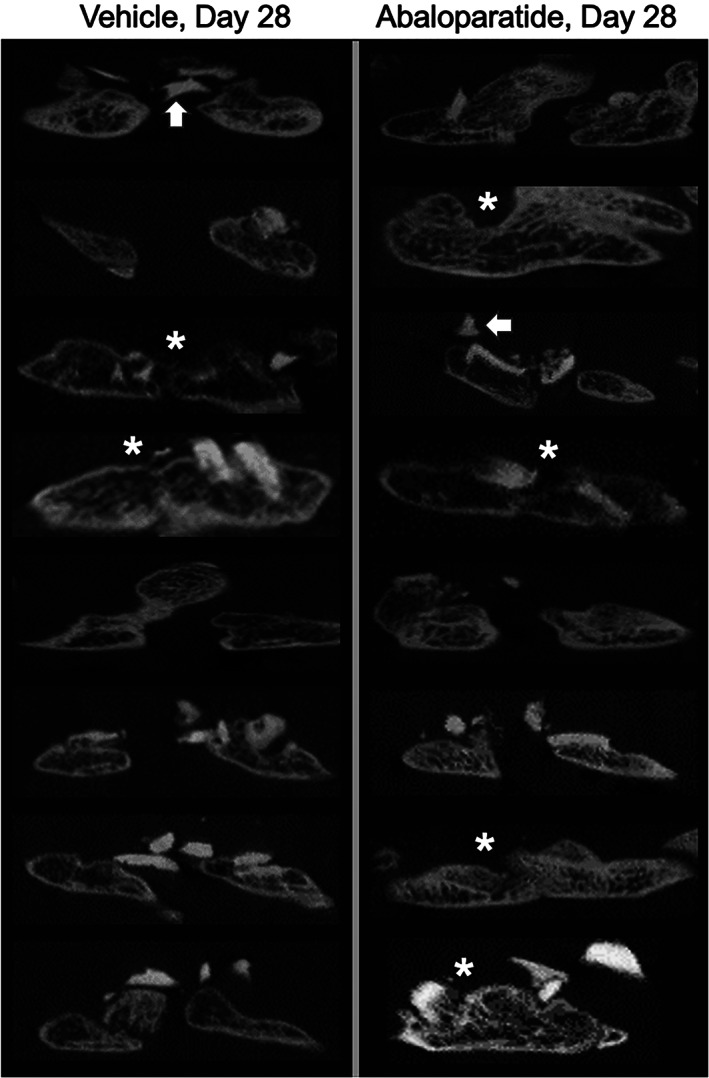
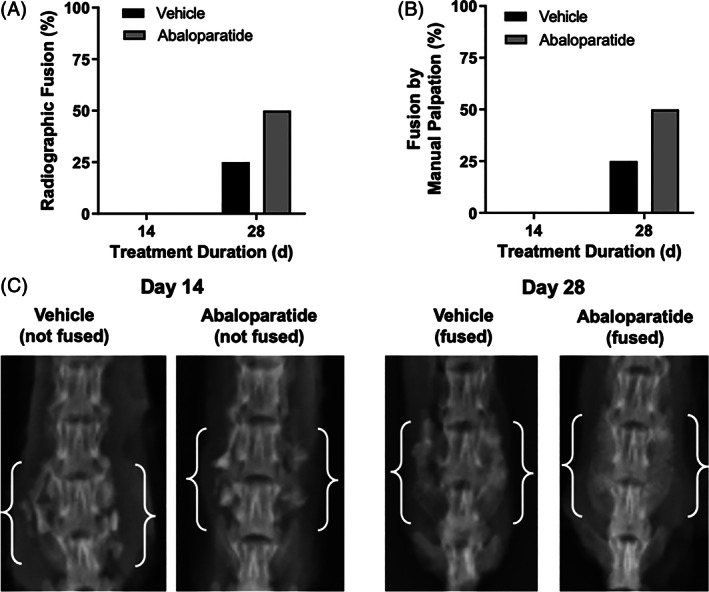
Abaloparatide-treated rats showed higher bone formation (serum osteocalcin) at day 14 and 28 compared with vehicle controls, without increases in the bone resorption marker serum TRACP-5b. Micro-CT showed greater trabecular number in fusion masses from the abaloparatide group vs vehicle controls at day 14. Manual palpation and radiography indicated no fusions in either group at day 14, whereas 25% of vehicle-treated rats and 50% of abaloparatide-treated rats had bilateral fusion at day 28.
In summary, this rat PLF model showed that abaloparatide treatment was associated with higher levels of the bone formation marker osteocalcin, improved fusion mass architecture, and a non- significant 2-fold higher fusion rate compared with vehicle.
阿巴洛肽是一种甲状旁腺激素受体激动剂,可增加绝经后骨质疏松症女性的骨形成,并降低椎体和非椎体骨折风险。动物研究表明,阿巴洛肽可刺激椎体骨形成,增强骨折痂的骨桥接和生物力学稳定性。
本研究旨在评估阿巴洛肽作为脊柱融合辅助治疗的潜在效用。
在32只雄性Sprague-Dawley大鼠非器械辅助后外侧融合(PLF)并自体骨移植1天后,开始每日皮下注射阿巴洛肽(20μg/kg/d)或赋形剂,持续14天或28天,评估其效果。通过微型计算机断层扫描(micro-CT)分析融合块的微观结构,并评估骨形成和骨吸收的血清标志物。通过死后放射摄影和手动触诊,以盲法对运动节段进行融合或未融合评分。
与赋形剂对照组相比,阿巴洛肽治疗的大鼠在第14天和第28天骨形成(血清骨钙素)更高,而骨吸收标志物血清抗酒石酸酸性磷酸酶5b(TRACP-5b)没有增加。Micro-CT显示,在第14天,阿巴洛肽组融合块中的小梁数量比赋形剂对照组更多。手动触诊和放射摄影表明,两组在第14天均未融合,而在第28天,25%的赋形剂治疗大鼠和50%的阿巴洛肽治疗大鼠出现双侧融合。
总之,该大鼠PLF模型表明,与赋形剂相比,阿巴洛肽治疗与更高水平的骨形成标志物骨钙素、改善的融合块结构以及非显著性的2倍更高融合率相关。