Han Ruixian, Hernández Álvarez Alan J, Maycock Joanne, Murray Brent S, Boesch Christine
Nutritional Sciences and Epidemiology, School of Food Science and Nutrition, University of Leeds, LS2 9JT, Leeds, UK.
Food Colloids and Bioprocessing, School of Food Science and Nutrition, University of Leeds, LS2 9JT, Leeds, UK.
Curr Res Food Sci. 2021 Mar 6;4:141-149. doi: 10.1016/j.crfs.2021.03.001. eCollection 2021.
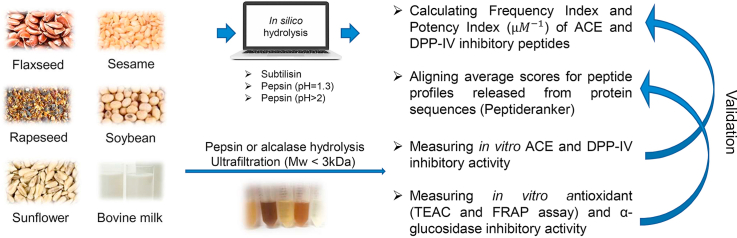
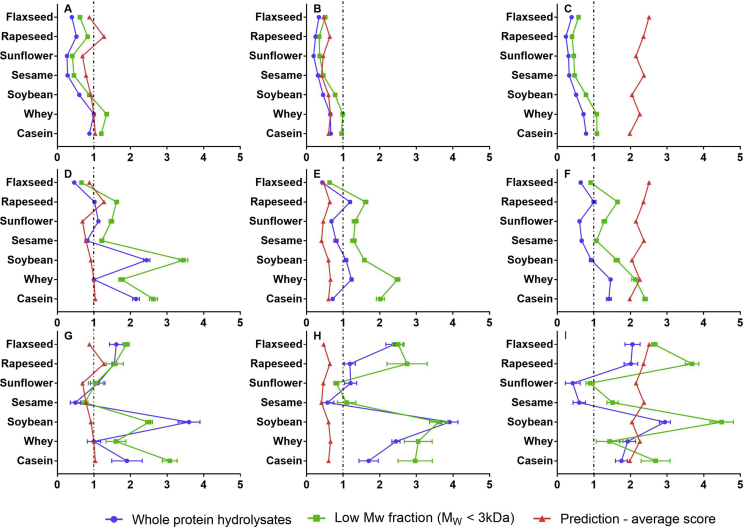
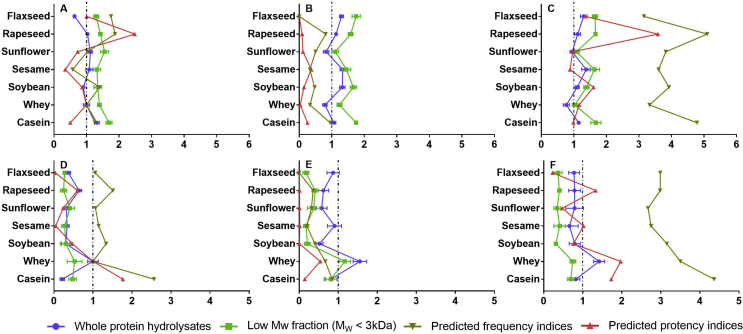
There is emerging evidence on the importance of food-derived bioactive peptides to promote human health. Compared with animal derived proteins, plant proteins, in particular oilseed proteins, are considered as affordable and sustainable sources of bioactive peptides. Based on our previous bioinformatic analysis, five oilseed proteins (flaxseed, rapeseed, sunflower, sesame and soybean) were enzymatically hydrolysed using alcalase and pepsin (pH 1.3 and pH 2.1). Further, low molecular weight (M < 3 kDa) fractions were generated using ultrafiltration. The protein hydrolysates and their low M fractions were evaluated for their antioxidant, antihypertensive and antidiabetic capabilities, in comparison with samples obtained from two dairy proteins (whey and casein). Apart from dipeptidyl-peptidase IV inhibition, significantly stronger bioactivities were detected for the low M fractions. In partial agreement with predictions, most oilseed hydrolysates exerted comparable angiotensin-converting enzyme inhibitory capability to dairy proteins, whilst whey protein was the most promising source of dipeptidyl-peptidase IV inhibitors. Apart from alcalase-treated soybean, dairy proteins were more efficient in releasing antioxidant peptides as compared to oilseed proteins. On the other hand, soybean protein hydrolysates showed the highest α-glucosidase inhibitory activity amongst all protein sources. Overall, there was limited correlation between predictions and experimental results. Nevertheless, our results indicate that oilseed proteins have potential as bioactive peptide sources, and they might therefore be suitable replacers for dairy proteins as well as good sources for development of functional foods.
越来越多的证据表明,食物来源的生物活性肽对促进人类健康具有重要意义。与动物源蛋白质相比,植物蛋白,特别是油籽蛋白,被认为是生物活性肽的经济且可持续的来源。基于我们之前的生物信息学分析,使用碱性蛋白酶和胃蛋白酶(pH 1.3和pH 2.1)对五种油籽蛋白(亚麻籽、油菜籽、向日葵、芝麻和大豆)进行酶解。此外,通过超滤产生低分子量(M < 3 kDa)组分。与从两种乳蛋白(乳清蛋白和酪蛋白)获得的样品相比,对蛋白水解物及其低M组分的抗氧化、抗高血压和抗糖尿病能力进行了评估。除了二肽基肽酶IV抑制作用外,低M组分检测到明显更强的生物活性。与预测部分一致,大多数油籽水解物对血管紧张素转换酶的抑制能力与乳蛋白相当,而乳清蛋白是最有前景的二肽基肽酶IV抑制剂来源。除了经碱性蛋白酶处理的大豆外,与油籽蛋白相比,乳蛋白在释放抗氧化肽方面更有效。另一方面,大豆蛋白水解物在所有蛋白质来源中显示出最高的α-葡萄糖苷酶抑制活性。总体而言,预测与实验结果之间的相关性有限。然而,我们的结果表明,油籽蛋白具有作为生物活性肽来源的潜力,因此它们可能是乳蛋白的合适替代品以及功能性食品开发的良好来源。