Department of Radiology, Linköping University, Linköping, Sweden.
Department of Health, Medicine & Caring Sciences, Linköping University, Linköping, Sweden.
Radiat Prot Dosimetry. 2021 Oct 12;195(3-4):177-187. doi: 10.1093/rpd/ncab020.
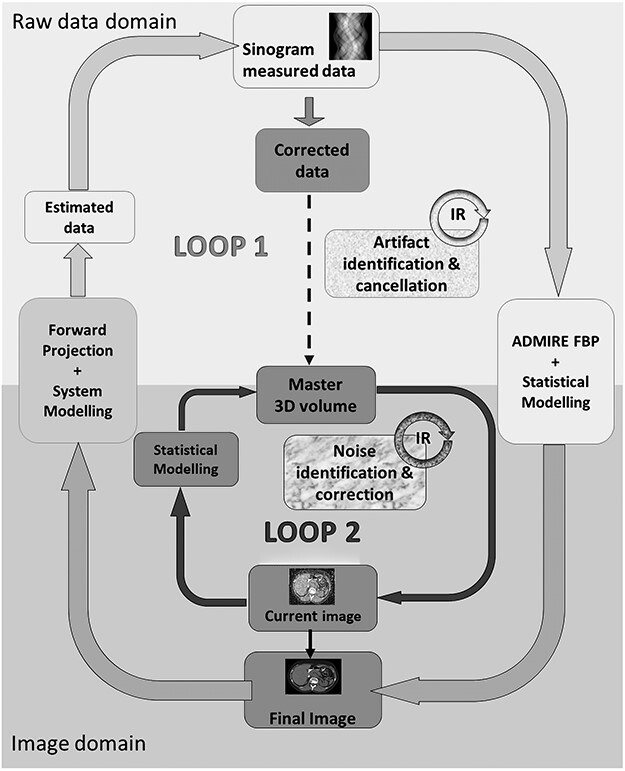
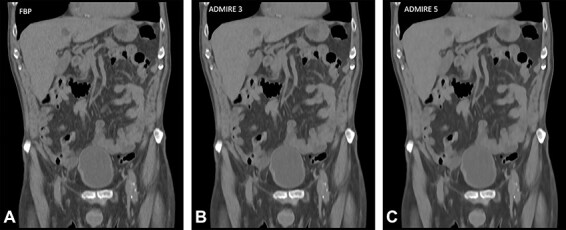
Traditional filtered back projection (FBP) reconstruction methods have served the computed tomography (CT) community well for over 40 years. With the increased use of CT during the last decades, efforts to minimise patient exposure, while maintaining sufficient or improved image quality, have led to the development of model-based iterative reconstruction (MBIR) algorithms from several vendors. The usefulness of the advanced modeled iterative reconstruction (ADMIRE) (Siemens Healthineers) MBIR in abdominal CT is reviewed and its noise suppression and/or dose reduction possibilities explored. Quantitative and qualitative methods with phantom and human subjects were used. Assessment of the quality of phantom images will not always correlate positively with those of patient images, particularly at the higher strength of the ADMIRE algorithm. With few exceptions, ADMIRE Strength 3 typically allows for substantial noise reduction compared to FBP and hence to significant (≈30%) patient dose reductions. The size of the dose reductions depends on the diagnostic task.
传统的滤波反投影(FBP)重建方法已经为 CT 社区服务了 40 多年。在过去几十年中,随着 CT 的广泛应用,人们努力尽量减少患者的辐射暴露,同时保持足够或改善图像质量,这导致了来自几家供应商的基于模型的迭代重建(MBIR)算法的发展。本文回顾了西门子医疗的先进模型迭代重建(ADMIRE)MBIR 在腹部 CT 中的应用,并探讨了其噪声抑制和/或剂量降低的可能性。使用了体模和人体受试者的定量和定性方法。体模图像的质量评估并不总是与患者图像的质量评估呈正相关,尤其是在 ADMIRE 算法的强度较高时。除了少数例外,ADMIRE 强度 3 通常可以与 FBP 相比显著降低噪声,从而显著(约 30%)降低患者的剂量。剂量降低的幅度取决于诊断任务。