Institute for Mental Health Policy Research, Centre for Addiction and Mental Health, Toronto, Canada.
Dalla Lana School of Public Health, University of Toronto, Toronto, Canada.
Drug Alcohol Rev. 2021 Nov;40(7):1377-1386. doi: 10.1111/dar.13286. Epub 2021 Mar 30.
Alcohol use has been shown to impact on various forms of liver disease, not restricted to alcoholic liver disease.
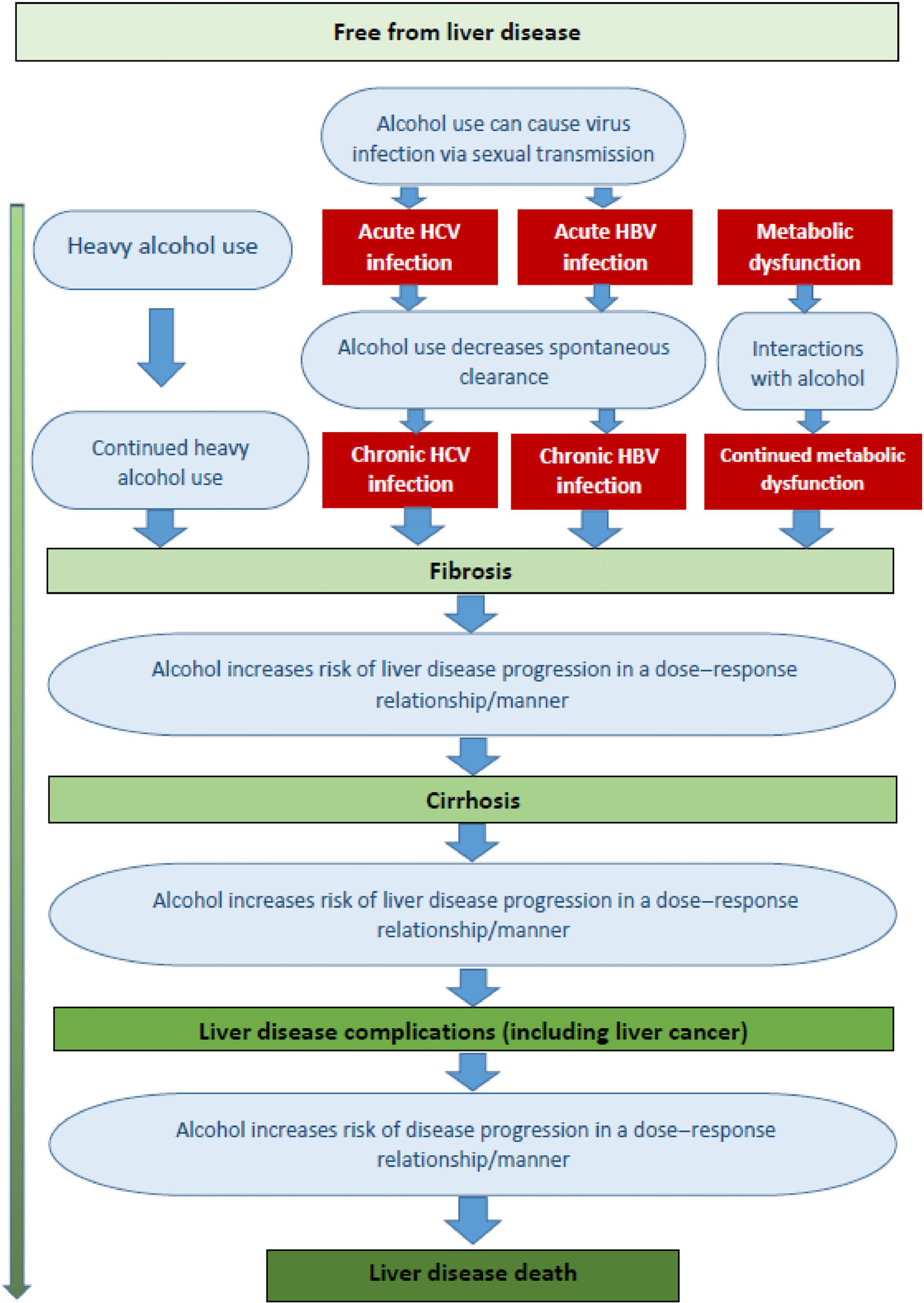
We developed a conceptual framework based on a narrative review of the literature to identify causal associations between alcohol use and various forms of liver disease including the complex interactions of alcohol with other major risk factors. Based on this framework, we estimate the identified relations for 2017 for the USA.
The following pathways were identified and modelled for the USA for the year 2017. Alcohol use caused 35 200 (95% uncertainty interval 32 800-37 800) incident cases of alcoholic liver cirrhosis. There were 1700 (uncertainty interval 1100-2500) acute hepatitis B and C virus (HBV and HCV) infections attributable to heavy-drinking occasions, and 14 000 (uncertainty interval 5900-19 500) chronic HBV and 1700 (uncertainty interval 700-2400) chronic HCV infections due to heavy alcohol use interfering with spontaneous clearance. Alcohol use and its interactions with other risk factors (HBV, HCV, obesity) led to 54 500 (uncertainty interval 50 900-58 400) new cases of liver cirrhosis. In addition, alcohol use caused 6600 (uncertainty interval 4200-9300) liver cancer deaths and 40 700 (uncertainty interval 36 600-44 600) liver cirrhosis deaths.
Alcohol use causes a substantial number of incident cases and deaths from chronic liver disease, often in interaction with other risk factors.
This additional disease burden is not reflected in the current alcoholic liver disease categories. Clinical work and prevention policies need to take this into consideration.
饮酒已被证实会对各种形式的肝病产生影响,而不仅仅局限于酒精性肝病。
我们基于文献综述构建了一个概念框架,以确定饮酒与各种形式的肝病(包括酒精与其他主要危险因素的复杂相互作用)之间的因果关系。基于该框架,我们对 2017 年美国的情况进行了估计。
为 2017 年美国确定并建立了以下途径:饮酒导致 35200 例(95%置信区间为 32800-37800)酒精性肝硬化新发病例。重度饮酒导致 1700 例(1100-2500 例)急性乙型肝炎病毒(HBV)和丙型肝炎病毒(HCV)感染,14000 例(5900-19500 例)慢性 HBV 和 1700 例(700-2400 例)慢性 HCV 感染归因于酒精干扰自发清除。饮酒及其与其他危险因素(HBV、HCV、肥胖)的相互作用导致 54500 例(50900-58400 例)新的肝硬化病例。此外,饮酒导致 6600 例(4200-9300 例)肝癌死亡和 40700 例(36600-44600 例)肝硬化死亡。
饮酒会导致大量慢性肝病的新发病例和死亡,通常与其他危险因素相互作用。
目前的酒精性肝病分类并未反映出这种额外的疾病负担。临床工作和预防政策需要考虑到这一点。