NO.1 Orthopedics Department, Cangzhou Central Hospital, Cangzhou, Hebei Province, China.
ECG Examination Department, Cangzhou Central Hospital, Cangzhou, Hebei Province, China.
J Orthop Surg Res. 2021 Mar 30;16(1):231. doi: 10.1186/s13018-021-02376-8.
Osteosarcoma is most common malignant bone tumors. OS patients with metastasis have a poor prognosis. There are few tools to assess metastasis; we want to establish a nomogram to evaluate metastasis of osteosarcoma.
Data from the Surveillance, Epidemiology, and End Results (SEER) database of patients with osteosarcoma were retrieved for retrospective analysis. We identify risk factors through univariate logistic regression and multivariate logistic regression analysis. Based on the results of multivariate analysis, we established a nomogram to predict metastasis of patients with osteosarcoma and used the concordance index (C-index) and calibration curves to test models.
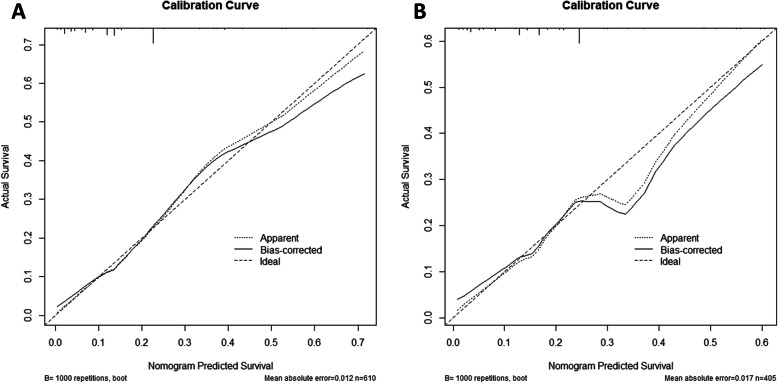
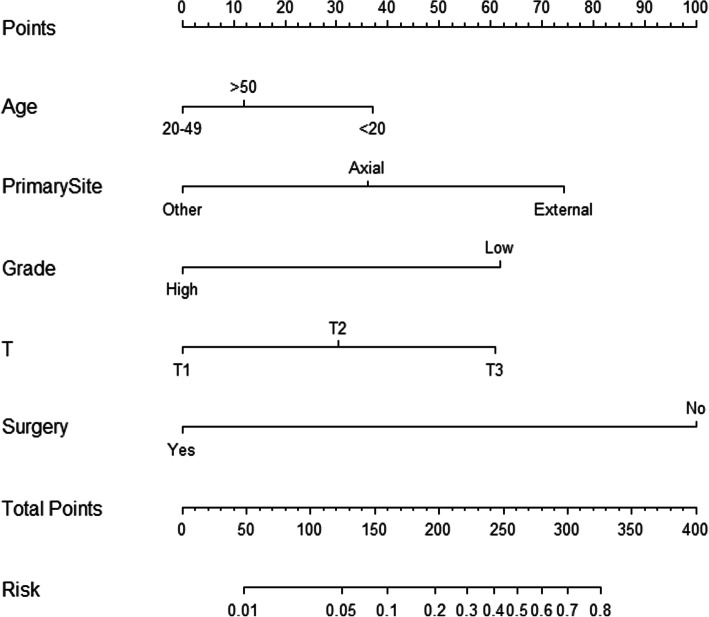
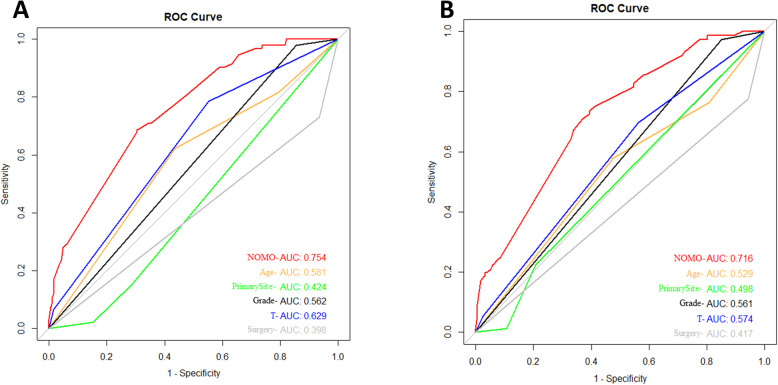
One thousand fifteen cases were obtained from the SEER database. In the univariate and multivariate logistic regression analysis, age, primary site, grade, T stage, and surgery are risk factors. The nomogram for metastasis was constructed based on these factors. The C-index of the training and validation cohort was 0.754 and 0.716. This means that the nomogram predictions of patients with metastasis are correct, and the calibration plots also show the good prediction performance of the nomogram.
We successfully develop the nomogram which can reliably predict metastasis in different patients with osteosarcoma and it only required basic information of patients. The nomogram that we developed can help clinicians better predict the metastasis with OS and determine postoperative treatment strategies.
骨肉瘤是最常见的恶性骨肿瘤。发生转移的骨肉瘤患者预后较差。目前评估转移的工具较少,我们希望建立一个列线图来评估骨肉瘤的转移。
从监测、流行病学和最终结果(SEER)数据库中检索骨肉瘤患者的数据进行回顾性分析。我们通过单因素逻辑回归和多因素逻辑回归分析确定危险因素。基于多因素分析的结果,我们建立了一个预测骨肉瘤患者转移的列线图,并使用一致性指数(C 指数)和校准曲线来测试模型。
从 SEER 数据库中获得了 1015 例病例。在单因素和多因素逻辑回归分析中,年龄、原发部位、分级、T 分期和手术是危险因素。基于这些因素构建了转移列线图。训练和验证队列的 C 指数分别为 0.754 和 0.716。这意味着该列线图对患者转移的预测是正确的,校准图也显示了该列线图的良好预测性能。
我们成功地开发了一个列线图,可以可靠地预测不同骨肉瘤患者的转移情况,而且只需要患者的基本信息。我们开发的列线图可以帮助临床医生更好地预测骨肉瘤的转移,并确定术后治疗策略。