Centre for Environmental Science, Faculty of Environment and Life Sciences, University of Southampton, University Road, Southampton, SO17 1BJ, UK.
Sci Rep. 2021 Mar 30;11(1):7155. doi: 10.1038/s41598-021-86569-5.
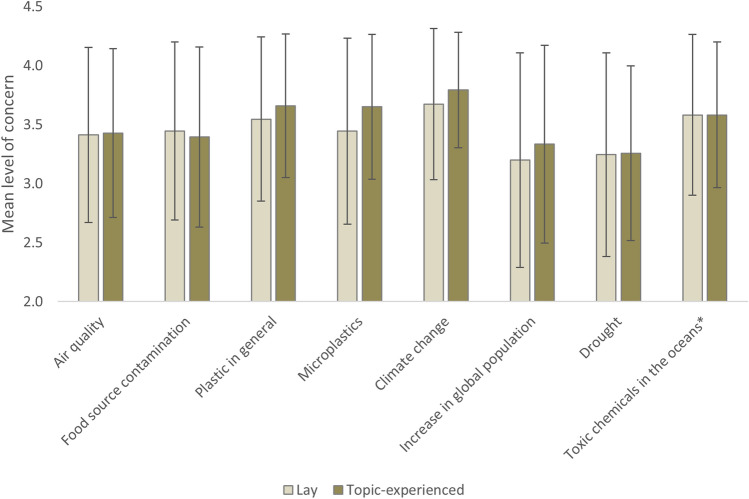
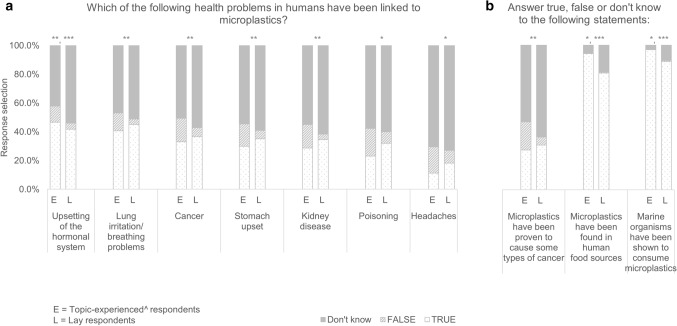
Microplastics are contaminants of emerging concern but there is currently a lack of evidence on actual risks relating to them, despite claims in media and scientific articles. Research on people's perceptions on microplastics is in its infancy. Here we present part of a larger survey about people's perceptions of issues with microplastics. Our analysis of 1681 responses across the globe to an online questionnaire demonstrates a certain level of uncertainty, not only in lay people but also respondents who study/work on the topic of plastics and microplastics as a pollutant. This uncertainty ranges from level of concern about microplastics as an environmental issue to existing evidence for effects. Further, there is some discrepancy between risk perception and state of the research. Some of this may be driven by scientific work with some serious limitations in reporting and methods. This highlights the need for fact-checking of circulating information about microplastics, but also for addressing the discordance between ecotoxicological risk and how risk is framed within the scientific community.
微塑料是新兴的关注污染物,但目前关于它们的实际风险的证据还很缺乏,尽管媒体和科学文章中有一些说法。关于人们对微塑料看法的研究还处于起步阶段。在这里,我们展示了一项关于人们对微塑料问题看法的大型调查的一部分内容。我们对全球范围内对在线问卷的 1681 份回复进行了分析,结果表明,不仅是普通民众,而且是研究/从事塑料和微塑料作为污染物这一课题的受访者,都存在一定程度的不确定性。这种不确定性不仅存在于对微塑料作为环境问题的关注程度上,也存在于现有的影响证据上。此外,风险感知和研究现状之间存在一些差异。其中一些可能是由一些在报告和方法上存在严重局限性的科学工作所驱动的。这凸显了对有关微塑料的信息进行事实核查的必要性,同时也需要解决生态毒理学风险与科学界对风险的描述之间的不和谐问题。