Ma Hainong, Song Xu, Li Jie, Wu Guorong
Hwa Mei Hospital, University of Chinese Academy of Sciences, Ningbo,, China.
Ningbo Institute of Life and Health Industry, University of Chinese Academy of Sciences, Ningbo, China.
Wideochir Inne Tech Maloinwazyjne. 2021 Mar;16(1):273-281. doi: 10.5114/wiitm.2020.99349. Epub 2020 Sep 25.
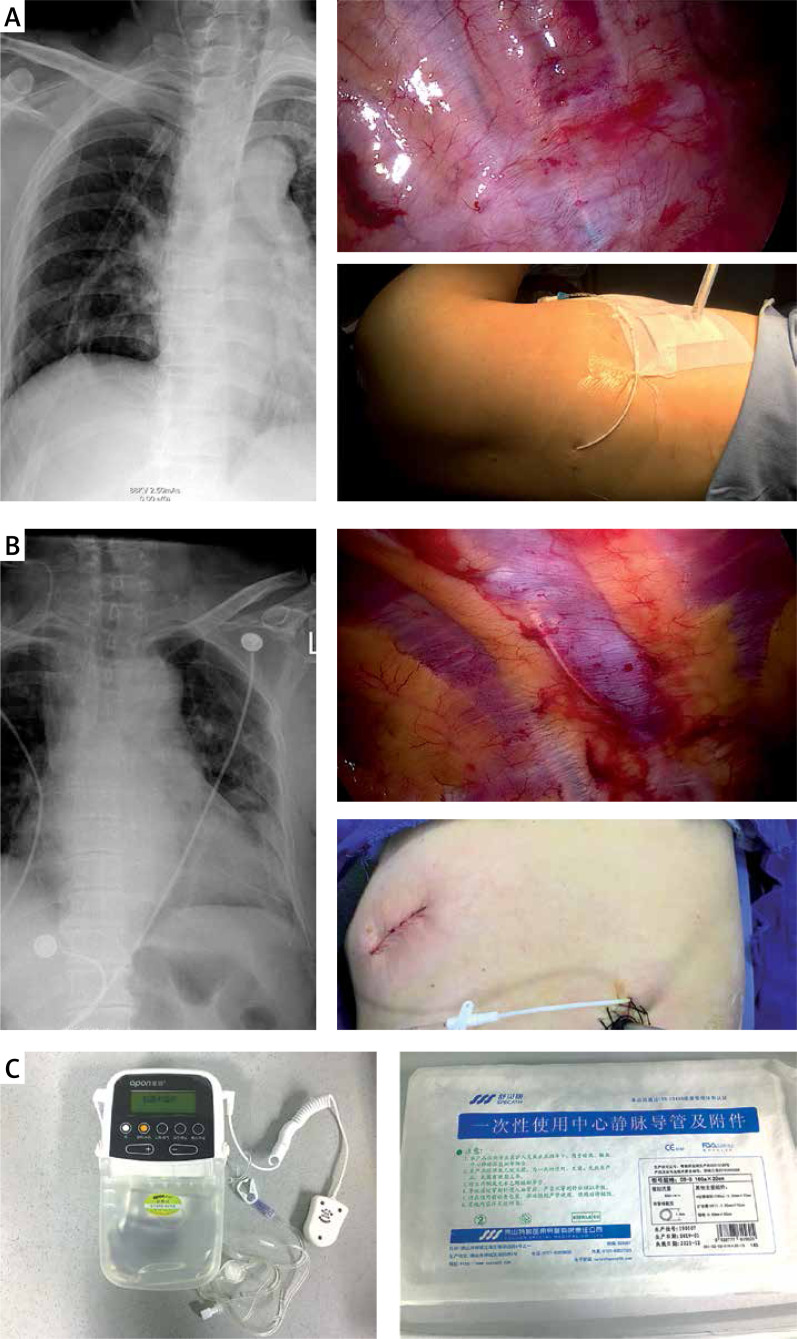
Effective pain control after video-assisted thoracic surgery (VATS) is critical because of the correlation between postoperative pain and recovery after surgery. Due to the limitations of traditional analgesic modalities, in this study, we present a method of placing a paravertebral catheter (PVC) or an intercostal catheter (ICC) in the sub-pleural space, followed by continuous ropivacaine injection by an infusion pump after surgery.
To investigate the impact of continuous paravertebral nerve block and intercostal nerve block on postoperative pain control in patients who underwent two-port thoracic surgery.
A total of 269 patients underwent various types of two-port VATS at Hwa Mei Hospital. Among them, we retrospectively compared paravertebral block versus intercostal nerve block to intravenous patient-controlled analgesia after VATS. Data regarding postoperative pain score on postoperative day 0, 1, 2, 3, and discharge day pain score, tramadol requirements, drainage duration, postoperative hospital stay, postoperative complications, and chronic pain 3 months after surgery were collected and analyzed.
Compared with the control group, patients who received a continuous nerve block, including the PVC group and ICC group, had a lower postoperative pain score (p < 0.001), shorter drainage duration (4.63 ±2.84 to 5.61 ±2.66 days, p = 0.004), reduced postoperative hospital stay (6.04 ±3.01 to 7.69 ±3.26 days, p < 0.001), and a reduced frequency of tramadol (0.95 ±1.27 1.79 ±2.13 times, p < 0.001). Additionally, there was no significant difference in chronic pain between groups.
In our study, PVC and ICC appeared to be safe and effective analgesic techniques to reduce postoperative pain, thus shortening the duration of postoperative hospital stay and improving the satisfaction of patients.
由于术后疼痛与手术恢复之间存在关联,因此电视辅助胸腔镜手术(VATS)后的有效疼痛控制至关重要。鉴于传统镇痛方式的局限性,在本研究中,我们提出一种在胸膜下间隙放置椎旁导管(PVC)或肋间导管(ICC)的方法,术后通过输液泵持续注射罗哌卡因。
探讨持续椎旁神经阻滞和肋间神经阻滞对接受两孔胸腔手术患者术后疼痛控制的影响。
共有269例患者在华美医院接受了各种类型的两孔VATS。其中,我们回顾性比较了VATS后椎旁阻滞与肋间神经阻滞与静脉自控镇痛的效果。收集并分析了术后第0、1、2、3天的术后疼痛评分、出院日疼痛评分、曲马多需求量、引流持续时间、术后住院时间、术后并发症以及术后3个月慢性疼痛的数据。
与对照组相比,接受持续神经阻滞的患者,包括PVC组和ICC组,术后疼痛评分更低(p < 0.001),引流持续时间更短(4.63±2.84至5.61±2.66天,p = 0.004),术后住院时间缩短(6.04±3.01至7.69±3.26天,p < 0.001),曲马多使用频率降低(0.95±1.27至1.79±2.13次,p < 0.001)。此外,各组之间慢性疼痛无显著差异。
在我们的研究中,PVC和ICC似乎是减轻术后疼痛的安全有效的镇痛技术,从而缩短了术后住院时间并提高了患者满意度。