Udofia Inemesit A, Gbayo Kofoworola O, Oloba-Whenu Oluwakemi A, Ogunbayo Taofeek B, Isanbor Chukwuemeka
Department of Chemistry, University of Lagos, Akoka, Lagos, Nigeria.
Netw Model Anal Health Inform Bioinform. 2021;10(1):22. doi: 10.1007/s13721-021-00299-2. Epub 2021 Mar 25.
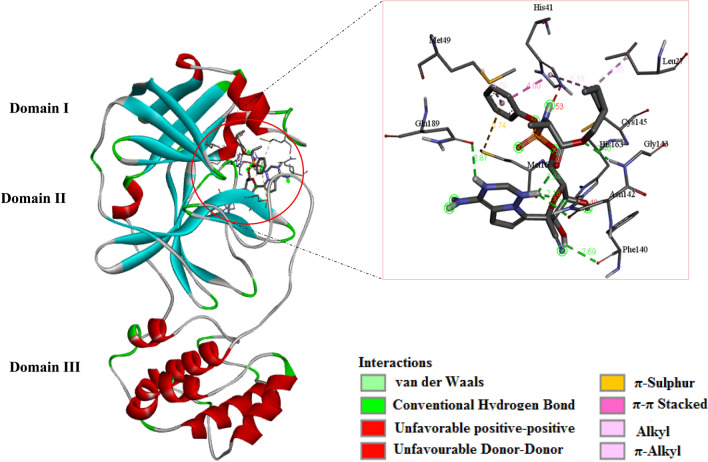
An outbreak of a cluster of viral pneumonia cases, subsequently identified as coronavirus disease 2019 (COVID-19), due to a novel SARS-CoV-2 necessitates an urgent need for a vaccine to prevent infection or an approved medication for a cure. In our in silico molecular docking study, a total of 173 compounds, including FDA-approved antiviral drugs, with good ADME descriptors, and some other nucleotide analogues were screened. The results show that these compounds demonstrate strong binding affinity for the residues at the active sites of RNA-dependent RNA-polymerase (RdRp) modelled structures and Chymotrypsinlike cysteine protease (3CLpro) of the HCoV proteins. Free energies (Δ's) of binding for SARS-CoV-2 and SARS-CoV RdRp range from - 5.4 to - 8.8 kcal/mol and - 4.9 to - 8.7 kcal/mol, respectively. Also, SARS-CoV-2 and SARS-CoV 3CLpro gave Δ values ranging from - 5.1 to - 8.4 kcal/mol and - 5.5 to - 8.6 kcal/mol, respectively. Interesting results are obtained for ivermectin, an antiparasitic agent with broad spectrum activity, which gave the highest binding energy value (- 8.8 kcal/mol) against the 3CLpro of SARS-CoV-2 and RdRps of both SARS-CoV and SARS-CoV-2. The reason for such high binding energy values is probably due to the presence of hydroxy, methoxy and sugar moieties in its structure. The stability of the protein-ligand complexes of polymerase inhibitors considered in this investigation, such as Sofosbuvir, Remdesivir, Tenofovir, Ribavirin, Galidesivir, 5c3, 5h1 and 7a1, show strong to moderate hydrogen bonding and hydrophobic interactions (π-π stacked, π-π T-shaped, π-sigma and π-alkyl). The stability provided from such interactions translate into greater antiviral activity or inhibitory effect of the ligands. Assessment of the average free energies of binding of the FDA approved drugs are highly comparable for conformers of a particular inhibitor, indicating similar modes of binding within the pockets.
The online version contains supplementary material available at 10.1007/s13721-021-00299-2.
一组病毒性肺炎病例爆发,随后被确定为2019冠状病毒病(COVID-19),病因是一种新型严重急性呼吸综合征冠状病毒2(SARS-CoV-2),这迫切需要一种预防感染的疫苗或一种已获批准的治疗药物。在我们的计算机分子对接研究中,共筛选了173种化合物,包括美国食品药品监督管理局(FDA)批准的具有良好药物代谢动力学(ADME)描述符的抗病毒药物以及其他一些核苷酸类似物。结果表明,这些化合物对人冠状病毒(HCoV)蛋白的RNA依赖性RNA聚合酶(RdRp)模拟结构和类胰凝乳蛋白酶样半胱氨酸蛋白酶(3CLpro)活性位点的残基具有很强的结合亲和力。SARS-CoV-2和SARS-CoV RdRp的结合自由能(Δ)分别为-5.4至-8.8千卡/摩尔和-4.9至-8.7千卡/摩尔。此外,SARS-CoV-2和SARS-CoV 3CLpro的Δ值分别为-5.1至-8.4千卡/摩尔和-5.5至-8.6千卡/摩尔。对于具有广谱活性的抗寄生虫药伊维菌素,获得了有趣的结果,它对SARS-CoV-2的3CLpro以及SARS-CoV和SARS-CoV-2的RdRp具有最高的结合能值(-8.8千卡/摩尔)。这种高结合能值的原因可能是其结构中存在羟基、甲氧基和糖基部分。本研究中考虑的聚合酶抑制剂,如索磷布韦、瑞德西韦、替诺福韦、利巴韦林、加利地韦、5c3、5h1和7a1的蛋白质-配体复合物的稳定性显示出强到中等的氢键和疏水相互作用(π-π堆积、π-π T形、π-σ和π-烷基)。这些相互作用提供的稳定性转化为配体更大的抗病毒活性或抑制作用。对FDA批准药物结合平均自由能的评估对于特定抑制剂构象具有高度可比性,表明在口袋内的结合模式相似。
在线版本包含可在10.1007/s13721-021-00299-2获取的补充材料。