Rizvi Mahrukh S, Gallo De Moraes Alice
Division of Pulmonary and Critical Care Medicine, Department of Medical Education, Weill Cornell Medicine, Doha, Qatar.
Division of Pulmonary and Critical Care Medicine, Mayo Clinic, Rochester, MN.
Crit Care Explor. 2021 Mar 23;3(3):e0364. doi: 10.1097/CCE.0000000000000364. eCollection 2021 Mar.
Our understanding of the immunopathogenesis of coronavirus disease 2019 is evolving; however, a "cytokine storm" has been implicated. Ongoing clinical trials are evaluating the value of anticytokine therapies to treat patients with coronavirus disease 2019. This review summarizes the existing literature evaluating the efficacy and safety of anticytokine therapy to tackle the dysregulated immune response to infectious pathogens, discusses potential reasons for failure, applicability to coronavirus disease 2019, and future direction.
Medline, PubMed, ClinicalTrials.gov, and media reports.
The studies were included by author consensus.
Data were selected for inclusion after reviewing each study by author consensus.
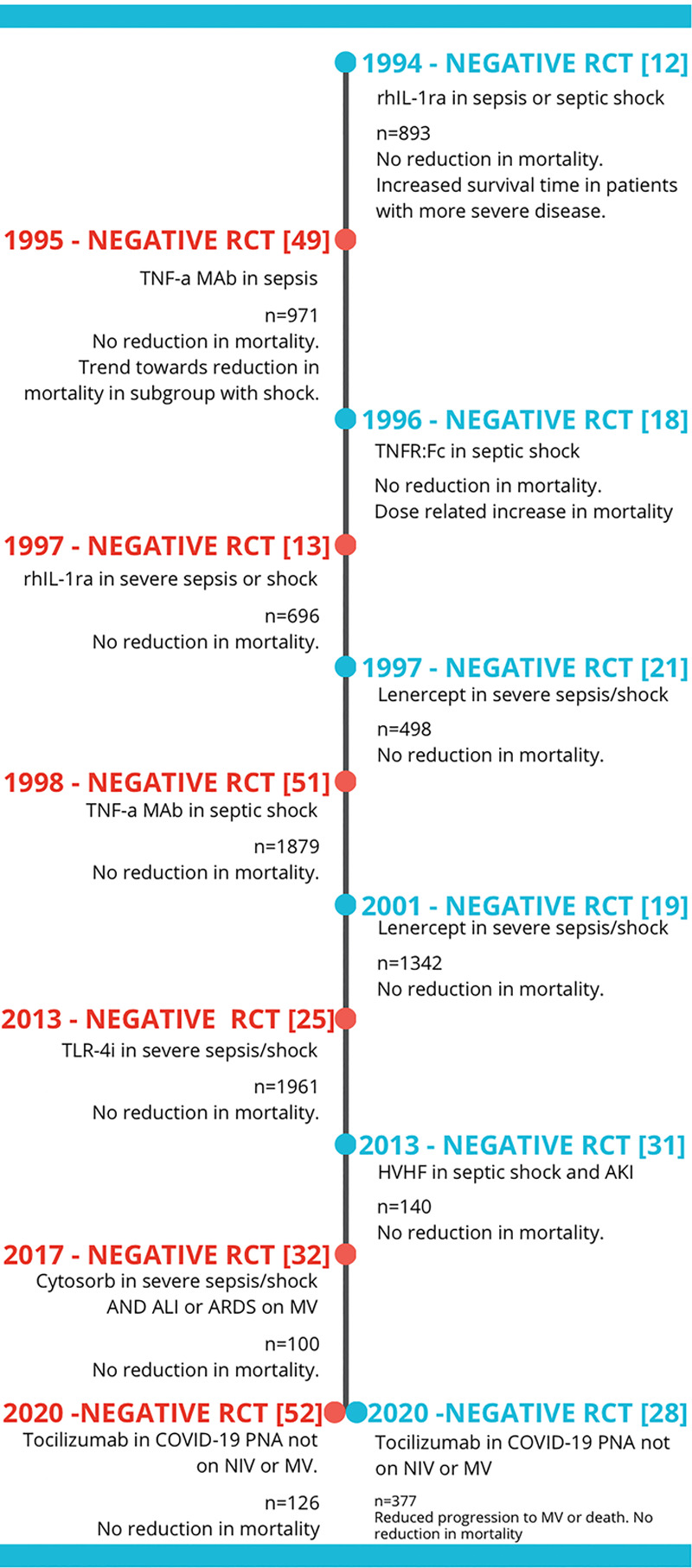
"Cytokine storm" is a nonspecific term, encompassing systemic inflammatory response to infectious pathogens, autoimmune conditions, cancers, trauma, and various chemotherapies. Like bacterial sepsis, viral pathogens may fuel immunopathogenesis by inducing a dysregulated autoamplifying cytokine cascade, ultimately leading to organ injury. This narrative review discusses what we know of the immune milieu of coronavirus disease 2019 versus noncoronavirus disease 2019 sepsis and/or acute respiratory distress syndrome, summarizes the existing literature on cytokine inhibitors in patients with sepsis and/or acute respiratory distress syndrome, and discusses possible reasons for recurrent failure. In doing so, it aims to assist decisions regarding the use of anticytokine therapy in patients with coronavirus disease 2019, as many regions of the world confront the second wave of the pandemic.
As ongoing clinical trials determine the efficacy and safety of anticytokine therapy in patients with coronavirus disease 2019, clinicians should uphold caution when incorporating it into treatment protocols, while maintaining focus on established evidence-based practices and the mantra of "less is more."
我们对2019冠状病毒病免疫发病机制的理解正在不断发展;然而,“细胞因子风暴”已被认为与之相关。正在进行的临床试验正在评估抗细胞因子疗法治疗2019冠状病毒病患者的价值。本综述总结了现有文献,评估了抗细胞因子疗法应对感染病原体失调免疫反应的疗效和安全性,讨论了失败的潜在原因、对2019冠状病毒病的适用性以及未来方向。
医学文献数据库、PubMed、美国国立医学图书馆临床试验注册库及媒体报道。
经作者一致同意纳入研究。
经作者一致同意,在审查每项研究后选择纳入数据。
“细胞因子风暴”是一个非特异性术语,包括对感染病原体、自身免疫性疾病、癌症、创伤和各种化疗的全身炎症反应。与细菌性败血症一样,病毒病原体可能通过诱导失调的自放大细胞因子级联反应来推动免疫发病机制,最终导致器官损伤。本叙述性综述讨论了我们对2019冠状病毒病与非2019冠状病毒病败血症和/或急性呼吸窘迫综合征免疫环境的了解,总结了败血症和/或急性呼吸窘迫综合征患者细胞因子抑制剂的现有文献,并讨论了反复失败的可能原因。在此过程中,其旨在协助做出关于在2019冠状病毒病患者中使用抗细胞因子疗法的决策,因为世界许多地区正面临第二波疫情。
随着正在进行的临床试验确定抗细胞因子疗法在2019冠状病毒病患者中的疗效和安全性,临床医生在将其纳入治疗方案时应保持谨慎,同时专注于既定的循证实践和“少即是多”的理念。