Gulf Coast Research and Education Center, Institute of Food and Agricultural Sciences, University of Florida, 14625 CR 672, Wimauma, FL, 33598-6101, USA.
Horticultural Sciences Department, University of Florida, Gainesville, FL, 32611, USA.
Theor Appl Genet. 2021 Jul;134(7):2129-2140. doi: 10.1007/s00122-021-03810-5. Epub 2021 Mar 30.
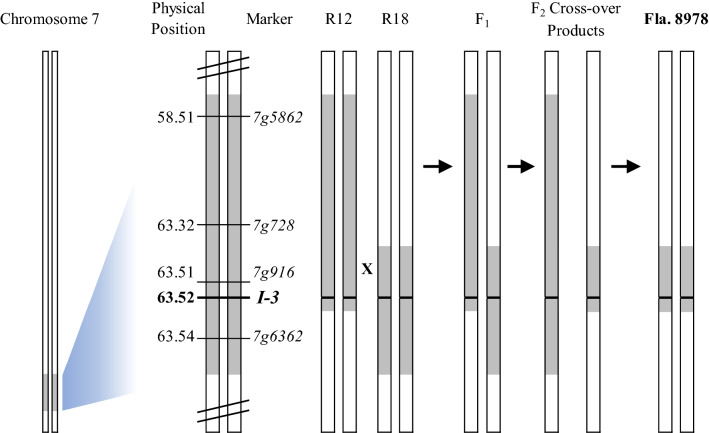
Reducing the size of the I-3 introgression resulted in eliminating linkage-drag contributing to increased sensitivity to bacterial spot and reduced fruit size. The I-7 gene was determined to have no effect on bacterial spot or fruit size, and germplasm is now available with both the reduced I-3 introgression and I-7. Tomato (Solanum lycopersicum) production is increasingly threatened by Fusarium wilt race 3 (Fol3) caused by the soilborne fungus, Fusarium oxysporum f. sp. lycopersici. Although host resistance based on the I-3 gene is the most effective management strategy, I-3 is associated with detrimental traits including reduced fruit size and increased bacterial spot sensitivity. Previous research demonstrated the association with bacterial spot is not due to the I-3 gene, itself, and we hypothesize that reducing the size of the I-3 introgression will remedy this association. Cultivars with I-7, an additional Fol3 resistance gene, are available but are not widely used commercially, and it is unclear whether I-7 also has negative horticultural associations. To characterize the effect of I-3 on fruit size, segregating populations were developed and evaluated, revealing that the large I-3 introgression decreased fruit size by approximately 21%. We reduced the I-3 introgression from 5 to 140 kb through successive recombinant screening and crossing efforts. The reduced I-3 introgression and I-7 were then separately backcrossed into elite Florida breeding lines and evaluated for effects on bacterial spot sensitivity and fruit size across multiple seasons. The reduced I-3 introgression resulted in significantly less bacterial spot and larger fruit size than the large introgression, and it had no effect on these horticultural characteristics compared with Fol3 susceptibility. I-7 was also found to have no effect on these traits compared to Fol3 susceptibility. Together, these efforts support the development of superior Fol3-resistant cultivars and more durable resistance against this pathogen.
缩小 I-3 基因导入片段的大小导致与增加对细菌性斑点病的敏感性和减少果实大小有关的连锁累赘被消除。I-7 基因被确定对细菌性斑点病或果实大小没有影响,现在有同时具有缩小的 I-3 基因导入片段和 I-7 的种质。番茄(Solanum lycopersicum)生产越来越受到由土壤传播的真菌茄镰刀菌(Fusarium oxysporum f. sp. lycopersici)引起的枯萎病 3 号(Fol3)的威胁。虽然基于 I-3 基因的宿主抗性是最有效的管理策略,但 I-3 与有害特征相关,包括果实变小和对细菌性斑点病的敏感性增加。先前的研究表明,与细菌性斑点病的关联不是由于 I-3 基因本身,我们假设缩小 I-3 基因导入片段的大小将纠正这种关联。具有 I-7 的品种,一个额外的 Fol3 抗性基因,是可用的,但在商业上没有广泛使用,目前还不清楚 I-7 是否也有负面的园艺关联。为了表征 I-3 对果实大小的影响,开发并评估了分离群体,结果表明,大的 I-3 基因导入片段使果实大小减小了约 21%。我们通过连续的重组筛选和杂交努力,将 I-3 基因导入片段从 5 减少到 140 kb。然后,将缩小的 I-3 基因导入片段和 I-7 分别回交到佛罗里达州的优秀育成系中,并在多个季节评估它们对细菌性斑点病敏感性和果实大小的影响。与大的导入片段相比,缩小的 I-3 基因导入片段导致细菌性斑点病显著减少,果实更大,与 Fol3 敏感性相比,对这些园艺特性没有影响。与 Fol3 敏感性相比,I-7 也被发现对这些性状没有影响。总之,这些努力支持了 Fol3 抗性优良品种的开发和对这种病原体更持久的抗性。