University of Zagreb School of Medicine, Andrija Štampar School of Public Health, Zagreb, Croatia.
Ivana Kerner, Bonifarm zdravlje, Zagreb, Croatia.
Arh Hig Rada Toksikol. 2021 Mar 30;72(1):36-41. doi: 10.2478/aiht-2021-72-3530. Print 2021 Mar 1.
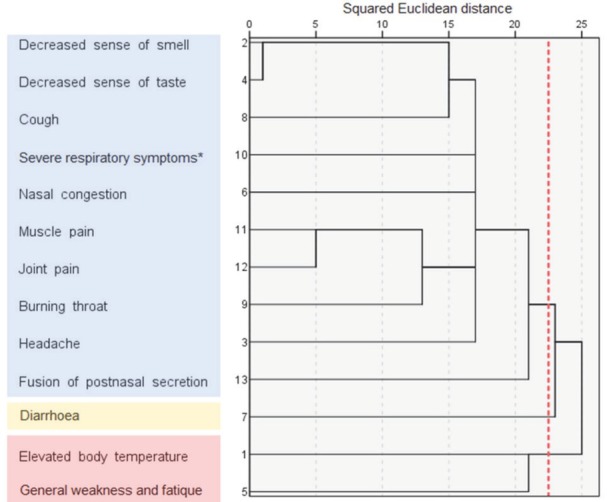
Healthcare workers (HCWs) are considered to run a higher occupational risk of becoming infected with severe acute respiratory syndrome coronavirus 2 (SARS-CoV-2), and develop coronavirus disease (COVID-19) than the rest of the population. The aim of this study was to describe and analyse the characteristics of work-related COVID-19 in Croatian HCWs. Study participants were HCWs who contacted their occupational physician between 1 May 2020 and 12 November 2020 with a request for the registration of COVID-19 as an occupational disease. All participants filled out our online Occupational COVID-19 in Healthcare Workers Questionnaire. The study included 59 HCWs (median age 45.0, interquartile range 36.0-56.0 years). Most (78 %) were nurses or laboratory technicians, and almost all (94.9 %) worked in hospitals. Hierarchical cluster analysis revealed three clusters of COVID-19-related symptoms: 1) elevated body temperature with general weakness and fatigue, 2) diarrhoea, and 3) headache, muscle and joint pain, anosmia, ageusia, and respiratory symptoms (nasal symptoms, burning throat, cough, dyspnoea, tachypnoea). Almost half (44.6 %) reported comorbidities. Only those with chronic pulmonary conditions were more often hospitalised than those without respiratory disorders (57.1 % vs. 2.5 %, respectively; P=0.001). Our findings suggest that work-related COVID-19 among Croatian HCWs is most common in hospital nurses/laboratory technicians and takes a mild form, with symptoms clustering around three clinical phenotypes: general symptoms of acute infection, specific symptoms including neurological (anosmia, ageusia) and respiratory symptoms, and diarrhoea as a separate symptom. They also support evidence from other studies that persons with chronic pulmonary conditions are at higher risk for developing severe forms of COVID-19.
医护人员(HCWs)被认为比其他人群面临更高的职业感染严重急性呼吸综合征冠状病毒 2(SARS-CoV-2)和发生冠状病毒病(COVID-19)的风险。本研究旨在描述和分析克罗地亚 HCWs 与工作相关的 COVID-19 的特征。研究参与者是在 2020 年 5 月 1 日至 2020 年 11 月 12 日期间与职业医生联系,要求将 COVID-19 登记为职业病的 HCWs。所有参与者都填写了我们的在线医护人员职业 COVID-19 调查问卷。该研究包括 59 名 HCWs(中位数年龄 45.0,四分位距 36.0-56.0 岁)。大多数(78%)是护士或实验室技术员,几乎所有人(94.9%)都在医院工作。层次聚类分析显示 COVID-19 相关症状有三个聚类:1)体温升高伴全身乏力和疲劳,2)腹泻,3)头痛、肌肉和关节痛、嗅觉丧失、味觉丧失和呼吸道症状(鼻部症状、咽喉烧灼感、咳嗽、呼吸困难、呼吸急促)。近一半(44.6%)报告有合并症。只有慢性肺部疾病患者住院的可能性高于无呼吸系统疾病的患者(分别为 57.1%和 2.5%;P=0.001)。我们的研究结果表明,克罗地亚 HCWs 的工作相关 COVID-19 最常见于医院护士/实验室技术员,且呈轻度形式,症状集中在三种临床表型周围:急性感染的全身症状、包括神经病变(嗅觉丧失、味觉丧失)和呼吸道症状在内的特定症状以及单独的腹泻症状。它们还支持其他研究的证据,即患有慢性肺部疾病的人患严重 COVID-19 的风险更高。