Department of Neurology, Inha University Hospital, Incheon, South Korea.
Department of Neurology, Seoul National University-Seoul Metropolitan Government Boramae Medical Center, Seoul National University College of Medicine, Seoul, South Korea.
Mov Disord. 2021 Aug;36(8):1889-1898. doi: 10.1002/mds.28592. Epub 2021 Mar 31.
It remains unclear whether and how the isolated rapid eye movement (REM) sleep behavior disorder (iRBD)-related metabolic pattern (RBDRP) changes with disease progression in iRBD.
To examine longitudinal changes in RBDRP expression in iRBD patients and to explore trajectories of relative metabolic activities of individual brain regions constituting RBDRP.
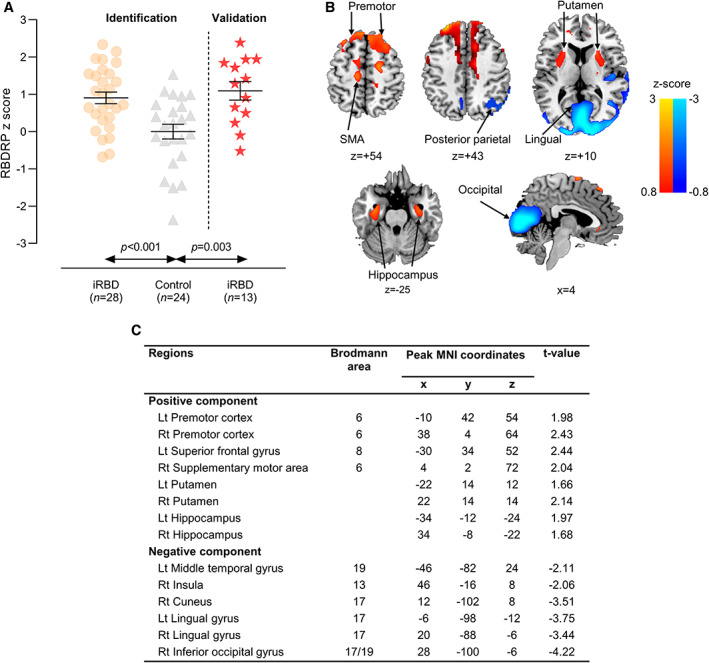
In this cohort study, 25 iRBD patients (mean age [±standard deviation], 69.2 ± 5.3 years; 12 [48%] patients were men) and 24 age-matched healthy controls were included. The patients underwent at least two F-fluorodeoxyglucose positron emission tomography scans at baseline and at the 2-year and/or 4-year follow-ups. We measured the RBDRP expression of the patients and controls which was validated by reproduction in a separate iRBD cohort (n = 13).
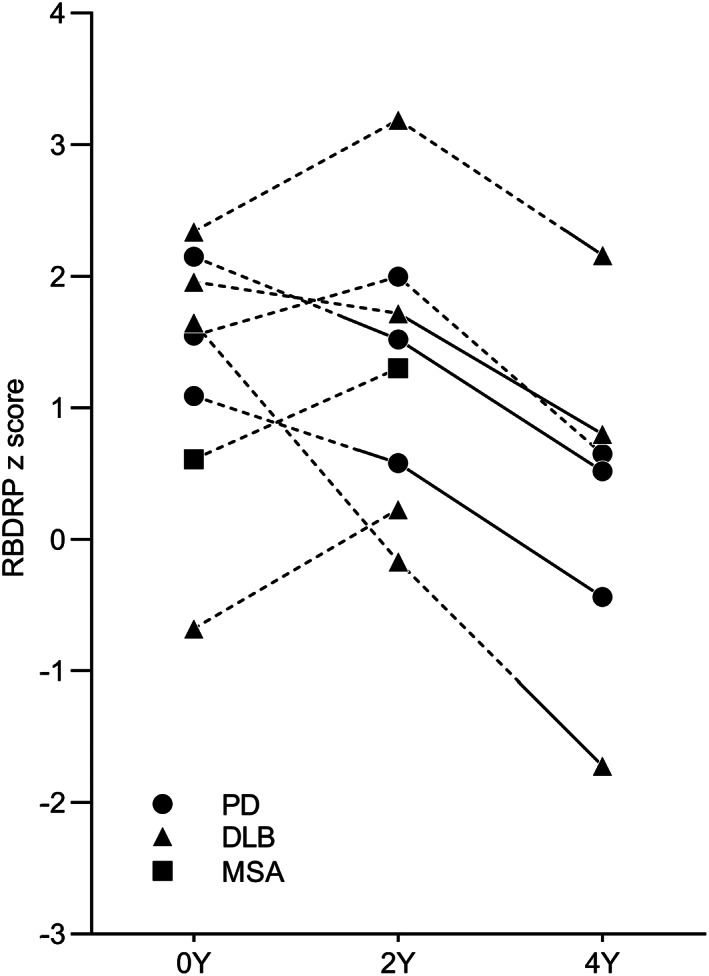
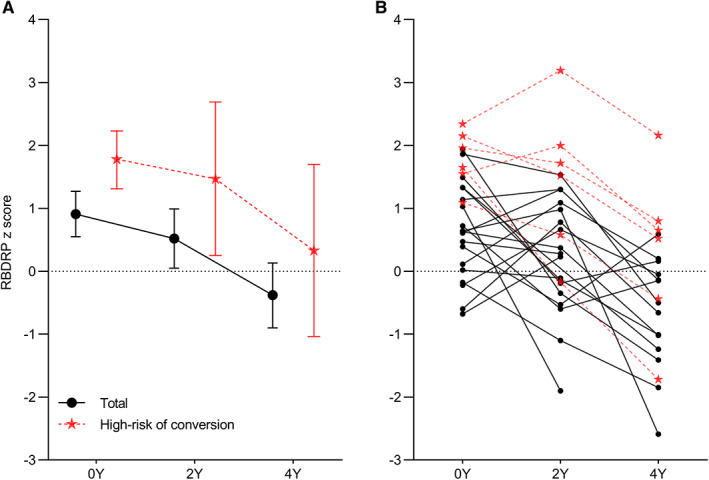
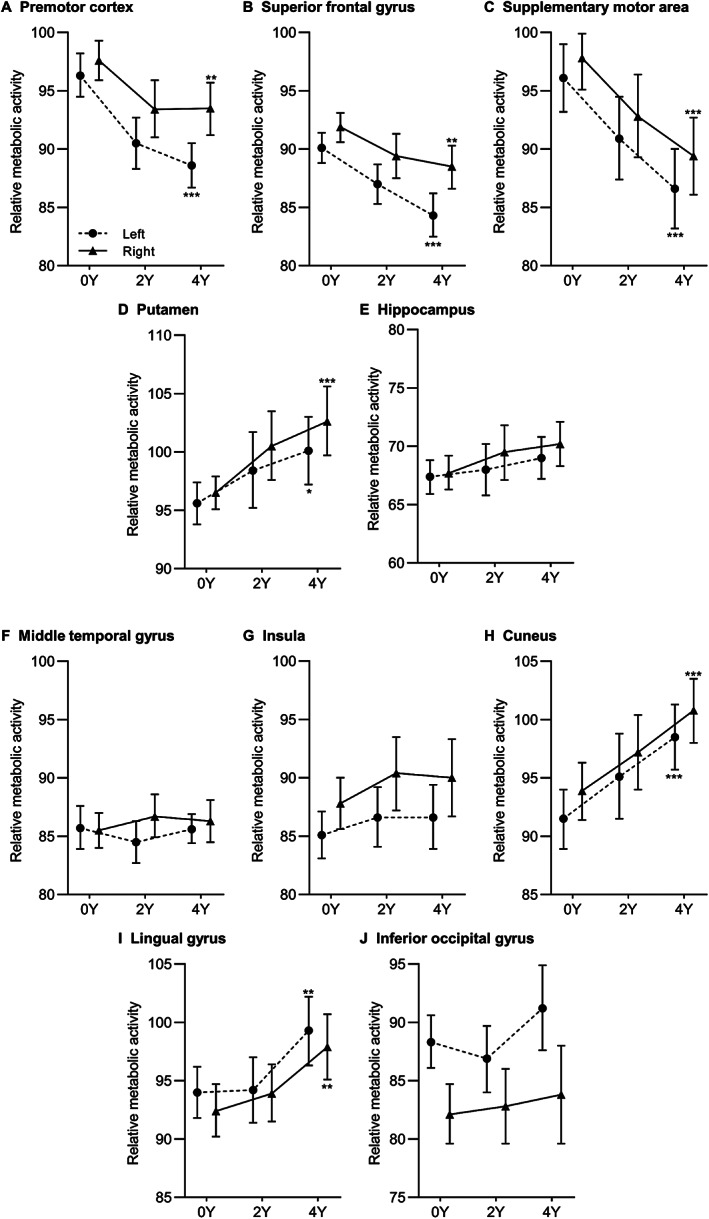
At baseline, the RBDRP expression discriminated iRBD patients from healthy controls. However, the RBDRP expression z scores tended to decrease over time in the patients, especially with longer follow-ups, and this tendency was observed even in patients with high-risk of phenoconversion. Furthermore, the degree of RBDRP expression at baseline did not predict the disease conversion. The RBDRP breakdown was mainly provoked by the attenuation of relative hypermetabolism in the frontal cortex including premotor areas and relative hypometabolism in the occipital cortex. The putaminal metabolic activity increased steadily with the disease progression.
The RBDRP expression in iRBD patients was altered significantly over time. Some of the brain metabolic changes seem to represent attempted functional compensation against ongoing neurodegeneration. The RBDRP expression measurement at one time point may not be a reliable biomarker for predicting disease conversion. © 2021 The Authors. Movement Disorders published by Wiley Periodicals LLC on behalf of International Parkinson and Movement Disorder Society.
孤立性快速眼动(REM)睡眠行为障碍(iRBD)相关代谢模式(RBDRP)在 iRBD 中的疾病进展是否以及如何变化尚不清楚。
检查 iRBD 患者 RBDRP 表达的纵向变化,并探讨构成 RBDRP 的个体脑区相对代谢活动的轨迹。
在这项队列研究中,纳入了 25 名 iRBD 患者(平均年龄[±标准差],69.2±5.3 岁;12[48%]名患者为男性)和 24 名年龄匹配的健康对照者。患者在基线和 2 年及/或 4 年随访时至少接受了两次 F-氟脱氧葡萄糖正电子发射断层扫描检查。我们测量了患者和对照组的 RBDRP 表达,在另一个 iRBD 队列(n=13)中得到了验证。
在基线时,RBDRP 表达可区分 iRBD 患者和健康对照组。然而,患者的 RBDRP 表达 z 分数随时间推移呈下降趋势,尤其是随访时间较长时,即使是有表型转换高风险的患者也存在这种趋势。此外,基线时 RBDRP 表达的程度并不能预测疾病的转化。RBDRP 的破坏主要是由于额皮质(包括运动前区)相对高代谢和枕皮质相对低代谢的衰减引起的。纹状体的代谢活性随着疾病的进展而稳步增加。
iRBD 患者的 RBDRP 表达随时间显著改变。一些脑代谢变化似乎代表了对进行性神经退行性变的功能代偿。在一个时间点测量 RBDRP 表达可能不是预测疾病转化的可靠生物标志物。