Department of Psychology, University of Illinois at Urbana-Champaign, Urbana, IL, USA.
Carl R. Woese Institute for Genomic Biology, Urbana, IL, USA.
Clin Epigenetics. 2021 Mar 31;13(1):68. doi: 10.1186/s13148-021-01056-y.
Poor family emotional health (FEH) during childhood is prevalent and impactful, and likely confers similar neurodevelopmental risks as other adverse social environments. Pointed FEH study efforts are underdeveloped, and the mechanisms by which poor FEH are biologically embedded are unclear. The current exploratory study examined whether variability in 5-methyl-cytosine (5mC) and fronto-limbic grey matter volume may represent pathways through which FEH may become biologically embedded.
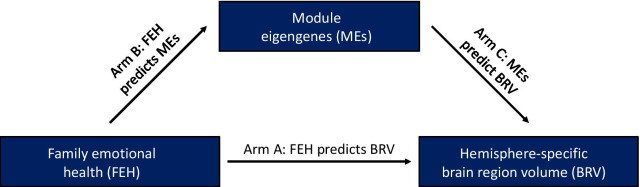
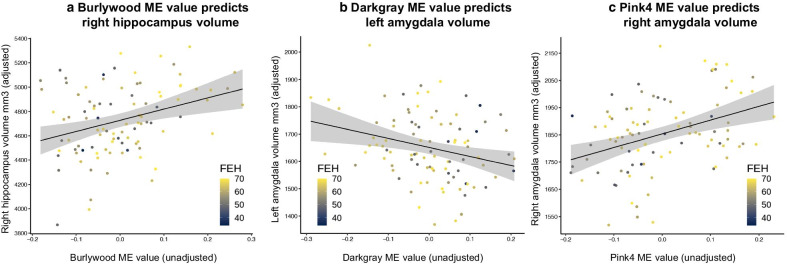
In 98 university students aged 18-22 years, retrospective self-reported childhood FEH was associated with right hemisphere hippocampus (b = 10.4, p = 0.005), left hemisphere amygdala (b = 5.3, p = 0.009), and right hemisphere amygdala (b = 5.8, p = 0.016) volumes. After pre-processing and filtering to 5mC probes correlated between saliva and brain, analyses showed that childhood FEH was associated with 49 5mC principal components (module eigengenes; MEs) (p = 3 × 10 to 0.047). Saliva-derived 5mC MEs partially mediated the association between FEH and right hippocampal volume (Burlywood ME indirect effect b = - 111, p = 0.014), and fully mediated the FEH and right amygdala volume relationship (Pink4 ME indirect effect b = - 48, p = 0.026). Modules were enriched with probes falling in genes with immune, central nervous system (CNS), cellular development/differentiation, and metabolic functions.
Findings extend work highlighting neurodevelopmental variability associated with adverse social environment exposure during childhood by specifically implicating poor FEH, while informing a mechanism of biological embedding. FEH-associated epigenetic signatures could function as proxies of altered fronto-limbic grey matter volume associated with poor childhood FEH and inform further investigation into primarily affected tissues such as endocrine, immune, and CNS cell types.
儿童时期不良的家庭情感健康(FEH)普遍存在且影响深远,可能带来与其他不利社会环境相似的神经发育风险。针对不良 FEH 的研究工作尚不成熟,而 FEH 不良如何在生物学上产生影响的机制尚不清楚。本探索性研究旨在检验 5-甲基胞嘧啶(5mC)和额-边缘灰质体积的变异性是否可以作为 FEH 可能在生物学上产生影响的途径。
在 98 名 18-22 岁的大学生中,回顾性自我报告的儿童期 FEH 与右侧海马体(b=10.4,p=0.005)、左侧杏仁核(b=5.3,p=0.009)和右侧杏仁核(b=5.8,p=0.016)体积有关。在对唾液和大脑之间相关的 5mC 探针进行预处理和筛选后,分析表明儿童期 FEH 与 49 个 5mC 主成分(模块特征基因;MEs)(p=3×10-0.047)有关。唾液衍生的 5mC MEs 部分介导了 FEH 与右侧海马体体积之间的关联(Burlywood ME 间接效应 b=-111,p=0.014),并完全介导了 FEH 与右侧杏仁核体积的关系(Pink4 ME 间接效应 b=-48,p=0.026)。这些模块富含探针,这些探针落在具有免疫、中枢神经系统(CNS)、细胞发育/分化和代谢功能的基因中。
这些发现扩展了强调儿童期不良社会环境暴露与神经发育变异性相关的工作,特别强调了不良 FEH,同时为生物学嵌入机制提供了信息。FEH 相关的表观遗传特征可以作为与不良儿童期 FEH 相关的额-边缘灰质体积变化的替代指标,并为进一步研究主要受影响的组织(如内分泌、免疫和中枢神经系统细胞类型)提供信息。