Pisaniak Paulina, Konarska Milena, Tarczon Aleksander, Stawowy Bartłomiej, Bejster Karolina, Piórek Weronika, Mędrzycka-Dąbrowska Wioletta, Ozga Dorota
EMS Students Association, Medical College, Rzeszów University, Rzeszów, Poland.
Department of Pathophysiology, Jessenius Faculty of Medicine in Martin, Comenius University in Bratislava, Bratislava, Slovakia.
Risk Manag Healthc Policy. 2021 Mar 23;14:1241-1254. doi: 10.2147/RMHP.S283796. eCollection 2021.
Relations between penal responsibility and vaccination obligation can be essential for raising the vaccination rate. Social media play a vital role in distributing information. The attitude towards vaccination consists of many factors, including the criminal law situation in the field of vaccination in a given country. The aim of the study was to assess the impact of criminal law liability and other social factors such as age and education on mothers' desire to vaccinate their children.
Survey target: mothers from nine European countries (Poland, Germany, Slovakia, France, Norway, Serbia, Romania, Greece, Italy). Response count: 2205. Questionnaire content: adjusted to country-specific legal regulations concerning vaccinations - considering whether vaccines are mandatory, recommended, additional, and how to cover costs. The way of dissemination of the questionnaire: general parental groups on Facebook.
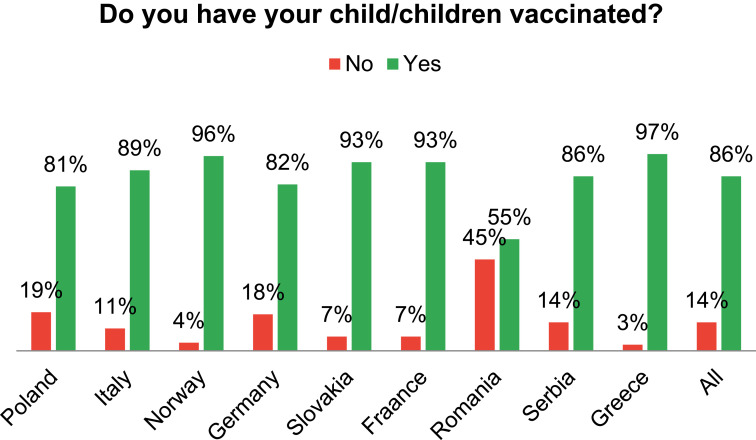
The respondents: Poles (30%), Italians, Germans, Slovaks, Greeks (10% each), Norwegians, Frenchwomen, Romanians, Serbians (5% each). The average respondent age: highest: Norway (38.14±10.08) and Italy (37.35±8.12), lowest: Slovakia (30.22±6.19). Respondents with higher, secondary, vocational, primary education represent 58%, 27%, 12%, 3%, respectively, of the group. Countries with above 90% rate of answers that they vaccinate their children: Greece, Norway, Slovakia, France. The lowest rate (55%) recorded for Romania. Sixty-seven percent aware of the existence of anti-vaccination movements. High rates were recorded for Norway (88%), Romania (82%), Poland (78%), Serbia (71%), Greece (67%), Germany (66%). The lowest rate for France (31%). Countries without vaccination at all (Germany, Norway, Romania, Greece), the rest of the countries mentioned above - have some mandatory, recommended and additional vaccinations.
In countries with mandatory vaccinations parents have their children vaccinated less willingly than in countries with voluntary vaccinations. The rising level of education and providing information about complications following infectious diseases appear to increase the vaccination rate.
刑事责任与疫苗接种义务之间的关系对于提高疫苗接种率可能至关重要。社交媒体在信息传播中发挥着重要作用。对疫苗接种的态度由多种因素构成,包括特定国家疫苗接种领域的刑法情况。本研究的目的是评估刑法责任以及年龄和教育程度等其他社会因素对母亲为子女接种疫苗意愿的影响。
调查对象:来自九个欧洲国家(波兰、德国、斯洛伐克、法国、挪威、塞尔维亚、罗马尼亚、希腊、意大利)的母亲。回复数量:2205份。问卷内容:根据各国关于疫苗接种的法律法规进行调整——考虑疫苗是否为强制性、推荐性、补充性,以及如何支付费用。问卷发放方式:脸书上的一般家长群组。
受访者:波兰人(30%)、意大利人、德国人、斯洛伐克人、希腊人(各占10%)、挪威人、法国女性、罗马尼亚人、塞尔维亚人(各占5%)。受访者的平均年龄:最高:挪威(38.14±10.08)和意大利(37.35±8.12),最低:斯洛伐克(30.22±6.19)。接受高等教育、中等教育、职业教育、初等教育的受访者分别占该群体的58%、27%、12%、3%。子女接种疫苗率超过90%的国家:希腊、挪威、斯洛伐克、法国。罗马尼亚的接种率最低(55%)。67%的人知晓反疫苗运动的存在。挪威(88%)、罗马尼亚(82%)、波兰(78%)、塞尔维亚(71%)、希腊(67%)、德国(66%)的知晓率较高。法国的知晓率最低(31%)。完全不进行疫苗接种的国家(德国、挪威、罗马尼亚、希腊),上述其他国家——有一些强制性、推荐性和补充性疫苗接种。
在实行强制疫苗接种的国家,父母让子女接种疫苗的意愿低于实行自愿疫苗接种的国家。教育水平的提高以及提供传染病后并发症的信息似乎会提高疫苗接种率。