Enticott Joanne C, Shawyer Frances, Brophy Lisa Mary, Russell Grant, Mazza Danielle, Wilson-Evered Elisabeth, Weller Penelope June, Slade Mike, Edan Vrinda, Meadows Graham Nicholas
Southern Synergy, Department of Psychiatry, Monash University, Melbourne, VIC, Australia.
Monash Centre for Health Research and Implementation, Monash University, Clayton, VIC, Australia.
Front Psychiatry. 2021 Mar 11;12:625408. doi: 10.3389/fpsyt.2021.625408. eCollection 2021.
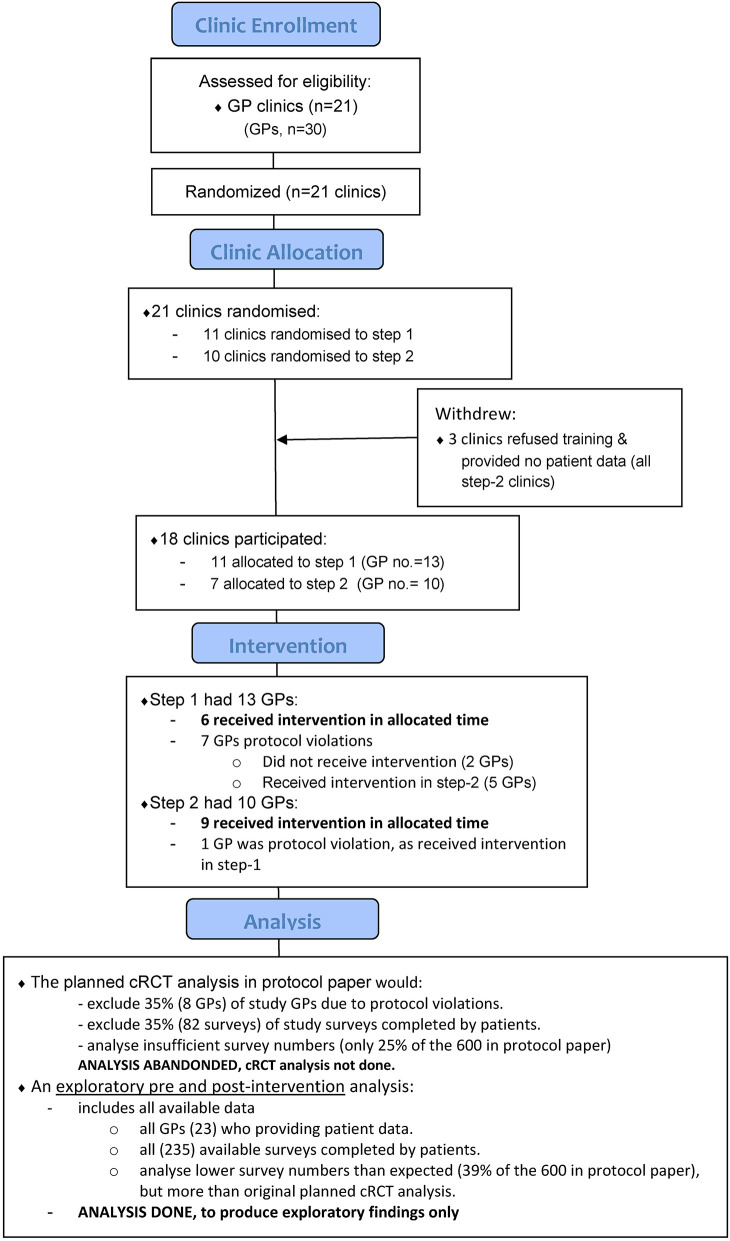
Australian general practitioners (GPs) are pivotal in mental health care. The REFOCUS-PULSAR (Principles Unite Local Services Assisting Recovery) primary care study aimed to improve personal recovery outcomes in adults with mental health problems consulting GPs. Modified from an intended stepped-wedge cluster study, an exploratory (pre- and post-intervention) design employed cross-sectional surveys of patients consulting GPs. Eighteen primary care sites (clusters) in Victoria, Australia in 2013-2017. From 30 GPs recruited, 23 participated (76%), with 235 patient surveys returned from adults aged <75 years receiving mental health care. A co-delivered face-to-face training intervention for GPs in recovery-oriented practice (ROP), with personal recovery a key focus, used multimedia, mnemonics, and targeted interview schedules to encourage ROP-with availability of support sessions for 1 year. Primary: the Questionnaire about the Process of Recovery full-scale score (outcome). Secondary: INSPIRE (experience), Warwick-Edinburgh Mental Well-being Scale (WEMWBS) and Kessler Psychological Distress Scale (K10) (outcomes). Other: General-practice-Users Perceived-need Inventory (experience). Small positive significant effects indicated primary-outcome post-intervention improvements [-test (233) = -2.23, = 0.01], also improvement in two secondary outcomes (WEMWBS (233) = -2.12, = 0.02 and K10 (233) = 2.44, = 0.01). More patients post-intervention reported "no need" for further help from their GP; but in those reporting needs, there was greater unmet need for counseling. ROP implementation, internationally influential in specialist mental health care, here is explored in primary care where it has had less attention. These exploratory findings suggest better patient outcomes followed introducing GPs to ROP in routine practice conditions. Higher unmet need for counseling post-intervention reported by patients might be a sign of limited supply despite ROP facilitating better identification of needs. Challenges in project implementation means that these findings carry risks of bias and flag the importance establishing research infrastructure in primary care. www.clinicaltrials.gov/, The Australian and New Zealand Clinical Trial Registry Identifier: ACTRN12614001312639.
澳大利亚全科医生在精神卫生保健中起着关键作用。REFOCUS - PULSAR(原则统一地方服务促进康复)初级保健研究旨在改善向全科医生咨询的有心理健康问题的成年人的个人康复结果。该研究在原本计划的阶梯式楔形整群研究基础上进行了修改,采用了对向全科医生咨询的患者进行横断面调查的探索性(干预前和干预后)设计。2013 - 2017年期间,在澳大利亚维多利亚州的18个初级保健机构(群组)开展研究。从招募的30名全科医生中,23名参与研究(参与率76%),共收到235份来自年龄小于75岁且接受精神卫生保健的成年人的患者调查问卷。针对全科医生开展了一项关于以康复为导向的实践(ROP)的联合面对面培训干预,重点是个人康复,采用多媒体、记忆法和有针对性的访谈日程来鼓励实施ROP,并提供为期1年的支持课程。主要指标:康复过程问卷的全量表得分(结果)。次要指标:INSPIRE(体验)、沃里克 - 爱丁堡心理健康量表(WEMWBS)和凯斯勒心理困扰量表(K10)(结果)。其他指标:全科医疗用户感知需求量表(体验)。干预后主要指标有小的显著正向改善[检验(233)= -2.23,P = 0.01],两个次要指标也有改善(WEMWBS(233)= -2.12,P = 0.02;K10(233)= 2.44,P = 0.01)。干预后更多患者表示“不需要”全科医生进一步帮助;但在表示有需求的患者中,咨询需求未得到满足的情况更多。ROP在专科精神卫生保健领域具有国际影响力,本研究在较少受到关注的初级保健领域对其进行了探索。这些探索性研究结果表明,在常规实践条件下向全科医生介绍ROP后患者的结果更好。患者报告干预后咨询需求未得到满足的情况较多,这可能表明尽管ROP有助于更好地识别需求,但供应有限。项目实施中的挑战意味着这些研究结果存在偏差风险,并凸显了在初级保健中建立研究基础设施的重要性。www.clinicaltrials.gov/,澳大利亚和新西兰临床试验注册标识符:ACTRN12614001312639。