Orlacchio Antonio, Roma Silvia, dell'Olio Vito, Crociati Sara, Lenci Ilaria, Francioso Simona
Department of Diagnostic and Interventional Radiology, University Hospital Tor Vergata, Viale Oxford 81, 00133 Rome, Italy.
Liver Unit, University Hospital Tor Vergata, Viale Oxford 81, 00133 Rome, Italy.
J Oncol. 2021 Mar 19;2021:8856998. doi: 10.1155/2021/8856998. eCollection 2021.
To assess the ability of Cone-Beam CT (CBCT), performed during the Transcatheter Arterial Chemoembolization (TACE), in predicting the response to treatment of hepatocellular carcinoma (HCC).
We evaluated fifty patients (M/F = 40/10, mean age: 66.7 years ± 8.22) with hepatocellular carcinoma (HCC), for a total of 82 nodules evaluated (mean diameter: 21.4 ± 11 mm). All patients performed a CT scan one month before and one month after TACE. After TACE is completed, a CBCT was performed to assess the degree of drug retention in the lesions. For each lesion, the major diameter, volume, and density of the vital portion were evaluated. The response to TACE was assessed using the mRECIST criteria on the CT scan carried out one month after the procedure. The receiver operating characteristic (ROC) curves were performed to assess the accuracy of the CBCT in predicting the response to treatment and to identify the cut-off points for each parameter under examination.
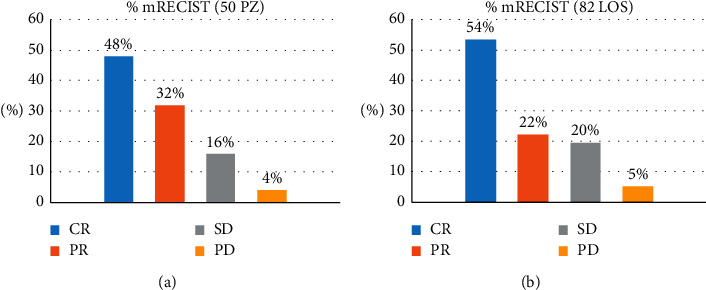
A complete response (CR) was observed in 24/50 patients (48%), a partial response (PR) in 16/50 (32%), stable disease (SD) in 8/50 (16%), and progressive disease (PD) in 2/50 (4%). Evaluation of the area under the ROC curve showed that the diameter, volume, and density of the lesion, measured with CBTC, had an accuracy of 94%, 96%, and 98%, respectively, in discriminating a complete response from a not complete response.
CBCT is effective in predicting short-term response at 1-month follow-up of HCC treated by chemoembolization.
评估在经动脉化疗栓塞术(TACE)期间进行的锥形束CT(CBCT)预测肝细胞癌(HCC)治疗反应的能力。
我们评估了50例肝细胞癌(HCC)患者(男/女 = 40/10,平均年龄:66.7岁±8.22),共评估了82个结节(平均直径:21.4±11mm)。所有患者在TACE前1个月和TACE后1个月进行了CT扫描。TACE完成后,进行CBCT以评估病变中药物滞留的程度。对于每个病变,评估其主要直径、体积和活性部分的密度。使用术后1个月进行的CT扫描上的改良RECIST标准评估TACE的反应。绘制受试者操作特征(ROC)曲线以评估CBCT在预测治疗反应方面的准确性,并确定每个检查参数的切点。
24/50例患者(48%)观察到完全缓解(CR),16/50例(32%)部分缓解(PR),8/50例(16%)疾病稳定(SD),2/50例(4%)疾病进展(PD)。ROC曲线下面积评估显示,用CBTC测量的病变直径、体积和密度在区分完全缓解和不完全缓解方面的准确率分别为94%、96%和98%。
CBCT在预测经化疗栓塞治疗的HCC 1个月随访时的短期反应方面是有效的。