Shao Guo-Liang, Zheng Jia-Ping, Guo Li-Wen, Chen Yu-Tang, Zeng Hui, Yao Zheng
Department of Radiology, Zhejiang Cancer Hospital, Hangzhou, P. R. China.
Medicine (Baltimore). 2017 Jan;96(3):e5518. doi: 10.1097/MD.0000000000005518.
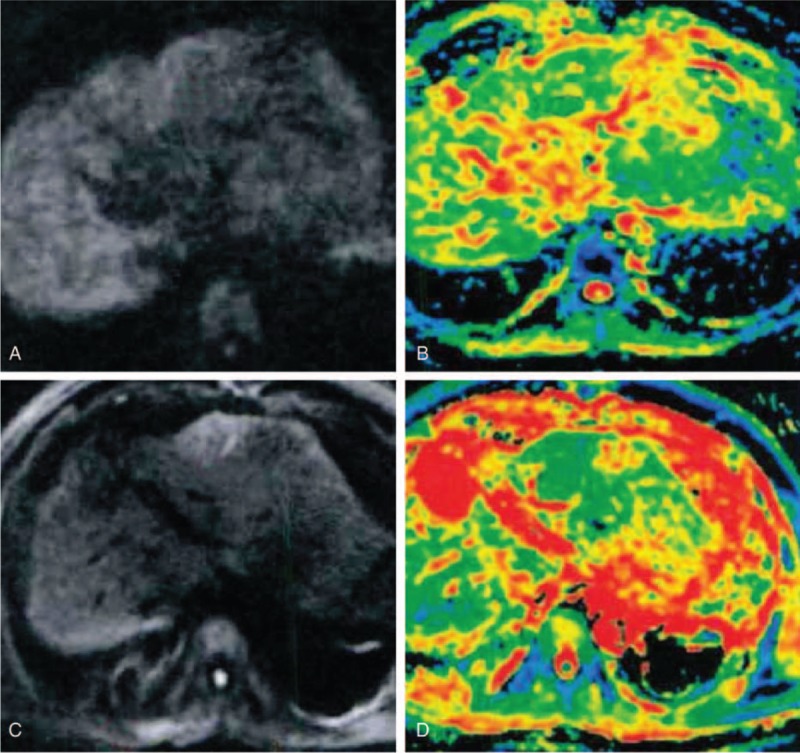
The purpose of this study is to evaluate the efficacy of transcatheter arterial chemoembolization (TACE) combined with computed tomography-guided radiofrequency ablation (CT-RFA) in the treatment of hepatocellular carcinoma (HCC) using magnetic resonance diffusion weighted imaging (MR-DWI) and CT perfusion imaging (CT-PI).
From January 2008 to January 2014, a total of 522 HCC patients receiving TACE combined with CT-RFA were included in this study. All patients underwent TACE followed by CT-RFA, and 1 day before treatment and 1 month after treatment they received MR-DWI and CT-PI. Enzyme-linked immunosorbent assay (ELISA) was performed to detect the concentration of alpha-fetoprotein (AFP). Tumor response was evaluated using the revised RECIST criteria. One-year follow-up was conducted on all patients. Receiver-operating characteristic (ROC) curve was drawn to evaluate the efficacy of TACE combined with CT-RFA for HCC using MR-DWI and CT-PI.
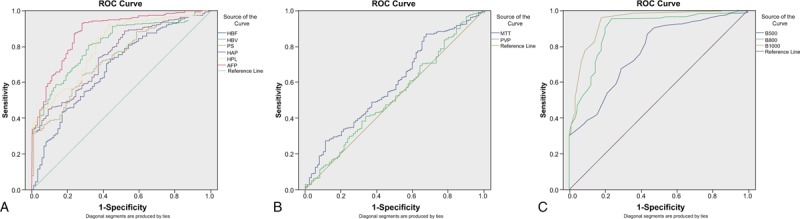
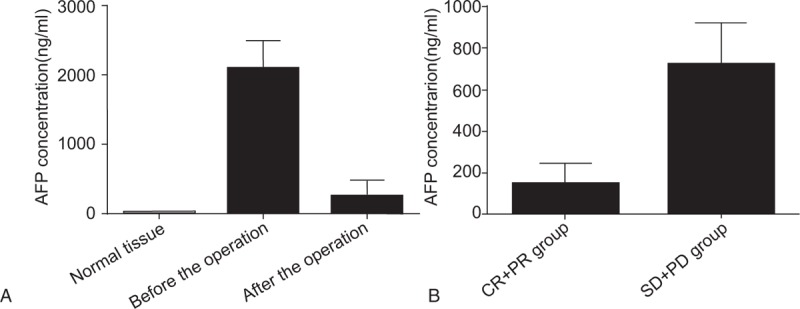
Total effective rate (complete remission [CR] + partial remission [PR]) of TACE combined with CT-RFA for HCC was 82.95%. HCC patients of CR + PR had lower hepatic blood flow (HBF), hepatic blood volume (HBV), permeability surface (PS), hepatic arterial perfusion (HAP), and hepatic perfusion index (HPI) levels than those of SD + PD, but HCC patients of CR + PR had higher mean transit time (MTT) level than those of SD + PD. The patients of PR + CR had higher apparent diffusion coefficient (ADC) values than those of SD + PD. The patients of PR + CR showed lower AFP concentration than those of SD + PD. ROC curve analysis indicated that the area under the curve (AUC) of AFP, HBV, PS, HAP, HPI, and ADC was more than 0.7, but the AUC of HBF, MTT, and PVP were less than 0.7. After treatment, the AFP, HBF, HBV, PS, HAP, and HPI in the HCC patients with recurrence were higher than those in the HCC patients without, but MTT and ADC in the HCC patients with recurrence were lower than those in the HCC patients without.
These findings indicate that MR-DWI and CT-PI can effectively evaluate the efficacy of TACE combined with CT-RFA and postoperative recurrence of HCC.
本研究旨在利用磁共振扩散加权成像(MR-DWI)和CT灌注成像(CT-PI)评估经动脉化疗栓塞术(TACE)联合CT引导下射频消融术(CT-RFA)治疗肝细胞癌(HCC)的疗效。
2008年1月至2014年1月,本研究共纳入522例行TACE联合CT-RFA治疗的HCC患者。所有患者均先行TACE,然后行CT-RFA,在治疗前1天和治疗后1个月接受MR-DWI和CT-PI检查。采用酶联免疫吸附测定(ELISA)法检测甲胎蛋白(AFP)浓度。采用修订的RECIST标准评估肿瘤反应。对所有患者进行为期1年的随访。绘制受试者操作特征(ROC)曲线,以评估TACE联合CT-RFA利用MR-DWI和CT-PI治疗HCC的疗效。
TACE联合CT-RFA治疗HCC的总有效率(完全缓解[CR] + 部分缓解[PR])为82.95%。CR + PR的HCC患者的肝血流量(HBF)、肝血容量(HBV)、通透表面积(PS)、肝动脉灌注(HAP)和肝灌注指数(HPI)水平低于疾病稳定(SD) + 疾病进展(PD)的患者,但CR + PR的HCC患者的平均通过时间(MTT)水平高于SD + PD的患者。PR + CR的患者的表观扩散系数(ADC)值高于SD + PD的患者。PR + CR的患者的AFP浓度低于SD + PD的患者。ROC曲线分析表明,AFP、HBV、PS、HAP、HPI和ADC的曲线下面积(AUC)大于0.7,但HBF、MTT和门静脉灌注(PVP)的AUC小于0.7。治疗后,复发的HCC患者的AFP、HBF、HBV、PS、HAP和HPI高于未复发的HCC患者,但复发的HCC患者的MTT和ADC低于未复发的HCC患者。
这些研究结果表明,MR-DWI和CT-PI能够有效评估TACE联合CT-RFA治疗HCC的疗效以及HCC术后复发情况。