Rosas-Carrasco Oscar, Ruiz-Valenzuela Roxana E, López-Teros Miriam T
Health Department, Ibero American University, Mexico City, Mexico.
Instituto Nacional de Geriatría, Mexico City, Mexico.
Front Med (Lausanne). 2021 Mar 15;8:617126. doi: 10.3389/fmed.2021.617126. eCollection 2021.
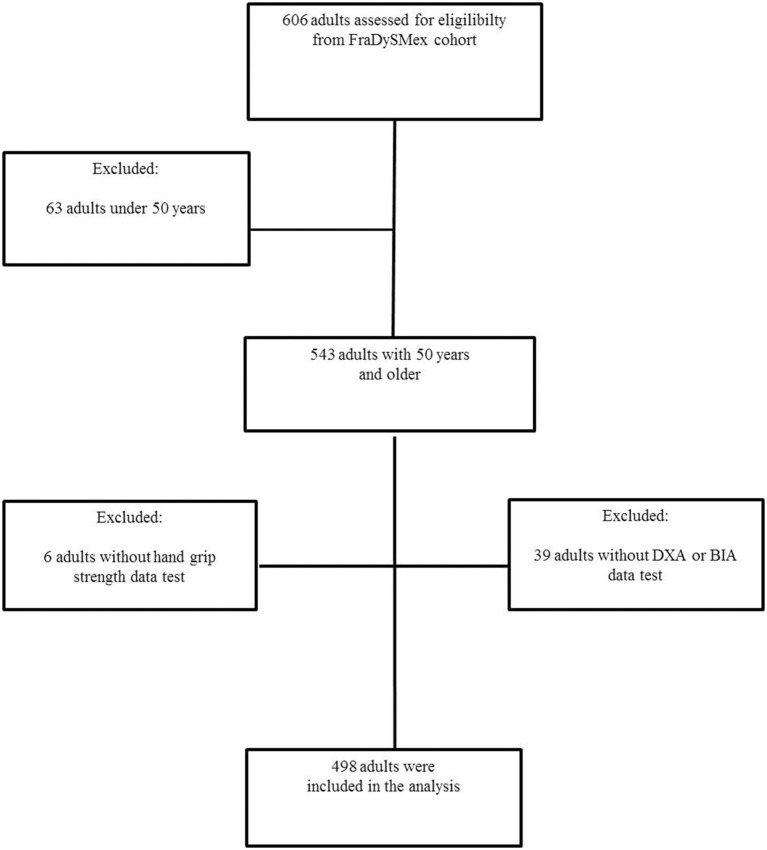
In recent studies, the usefulness of the phase angle (PA) to assess geriatric conditions such as sarcopenia and frailty has been evaluated. However, there are no useful cut-off points for clinical research and/or practice. To analyze PA cut-off points associated with sarcopenia and frailty in adults of 50-64 years old and older adults in Mexico City. Cross-sectional analysis of the FraDySMex cohort study (Frailty, Dynapenia, and Sarcopenia in Mexican Adults). 498 people were included, 78.7% women, aged 71.1 ± 9.5 years. Methods: The sarcopenia measurements were made according to the European Working Group on Sarcopenia in Older People (EWGSOP) (2019) (by dynamometer to evaluate hand grip strength and dual energy X-ray absorptiometry (DXA) for appendicular muscle mass), and the frailty through the physical frailty phenotype with cut-off points adjusted to the Mexican population. The PA was evaluated by bioelectrical impedance analysis (BIA), tetrapolar to 50 Hz, other variables such as socio-demographic, comorbidity, cognitive status, and functional dependence were evaluated. The prevalence of frailty was 10.6% and sarcopenia 10.0%. The mean of the PA was 4.6° ± 0.70°. The PA cut-off point for frailty in adults 50 to 64 years was ≤4.3° [sensitivity (S) = 91.95%, specificity (Sp) 66.77%, AUROC (Area Under the Receiver Operating Characteristic) curve = 0.9273 95% CI (0.8720-0.9825)]; the PA cut-off point for sarcopenia was ≤4.3 [S = 91.95%, Sp = 66.77%, AUROC = 0.9306 95% CI (0.8508-1.000)]. The PA cut-off for frailty in adults ≥ 65 years was ≤4.1° [S = 72.37%, Sp 71.43%, AUROC = 0.7925 95%, CI (0.7280-0.8568)] for sarcopenia was ≤4.1° [S = 72.76%, Sp 73.81%, AUROC = 0.7930 95% CI (0.7272-0.8587)]. These cut-off points showed a significant association between PA with frailty (OR 4.84; 95% CI 2.61-8.99) and sarcopenia (OR 8.44; 95% CI 3.85-18.4) after adjusted by age, sex, BMI, comorbidity index and cognitive impairment. These cut-off points of PA could be useful for the screening of sarcopenia and frailty in Mexican adults of 50 years and older in centers that have BIA.
在最近的研究中,已经评估了相位角(PA)在评估诸如肌肉减少症和衰弱等老年疾病方面的有用性。然而,对于临床研究和/或实践而言,尚无有用的临界点。旨在分析墨西哥城50 - 64岁成年人及老年人中与肌肉减少症和衰弱相关的PA临界点。对FraDySMex队列研究(墨西哥成年人的衰弱、肌肉减少和肌少症)进行横断面分析。纳入了498人,其中78.7%为女性,年龄为71.1±9.5岁。方法:根据老年人肌肉减少症欧洲工作组(EWGSOP)(2019年)进行肌肉减少症测量(通过测力计评估握力,通过双能X线吸收法(DXA)测量四肢肌肉量),并通过根据墨西哥人群调整了临界点的身体衰弱表型评估衰弱情况。通过生物电阻抗分析(BIA),以四极法在50Hz频率下评估PA,还评估了其他变量,如社会人口统计学、合并症、认知状态和功能依赖情况。衰弱的患病率为10.6%,肌肉减少症的患病率为10.0%。PA的平均值为4.6°±0.70°。50至64岁成年人衰弱的PA临界点为≤4.3°[敏感度(S)= 91.95%,特异度(Sp)= 66.77%,受试者工作特征曲线下面积(AUROC)= 0.9273,95%置信区间(CI)(0.8720 - 0.9825)];肌肉减少症的PA临界点为≤4.3°[S = 91.95%,Sp = 66.77%,AUROC = 0.9306,9�%CI(0.8508 - 1.000)]。65岁及以上成年人衰弱的PA临界点为≤4.1°[S = 72.37%,Sp = 71.43%,AUROC = 0.7925,95%CI(0.7280 - 0.8568)],肌肉减少症的PA临界点为≤4.1°[S = 72.76%,Sp = 73.81%,AUROC = 0.7930,95%CI(0.7272 - 0.8587)]。在根据年龄、性别、体重指数、合并症指数和认知障碍进行调整后,这些临界点显示PA与衰弱(比值比(OR)4.84;95%CI 2.61 - 8.99)和肌肉减少症(OR 8.44;95%CI 3.劜5 - 18.4)之间存在显著关联。这些PA临界点对于在拥有BIA设备的中心对50岁及以上墨西哥成年人进行肌肉减少症和衰弱的筛查可能是有用的。