Tay Nicholas E S, Chen Wei, Levens Alison, Pistritto Vincent A, Huang Zeng, Wu Zhanhong, Li Zibo, Nicewicz David A
Department of Chemistry, University of North Carolina at Chapel Hill, Venable Laboratories, Chapel Hill, North Carolina, 27599-3290, USA.
Biomedical Research Imaging Center, Department of Radiology, and UNC Lineberger Comprehensive Cancer Center, University of North Carolina- Chapel Hill, Chapel Hill, NC 27514, USA.
Nat Catal. 2020 Sep;3(9):734-742. doi: 10.1038/s41929-020-0495-0. Epub 2020 Aug 24.
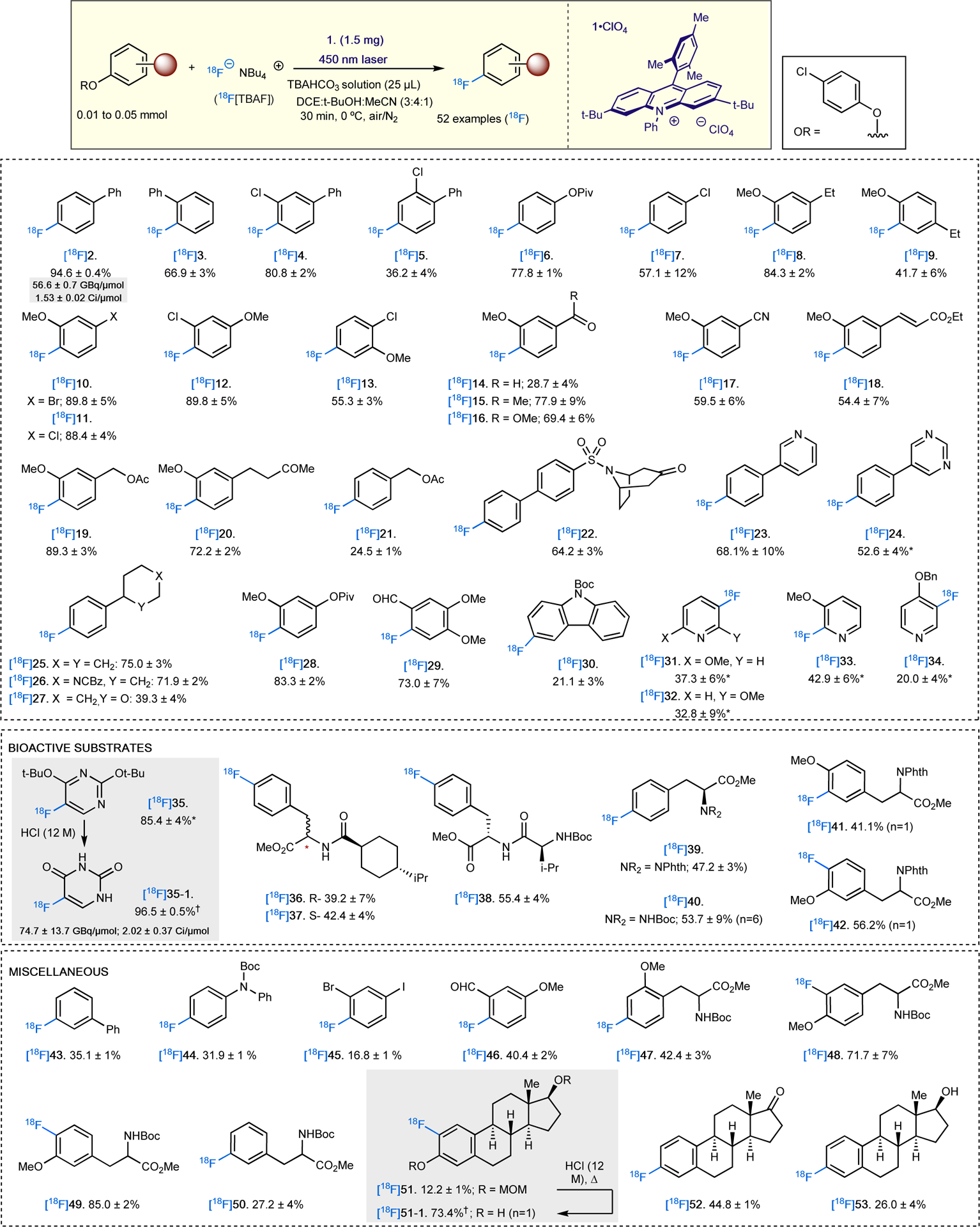
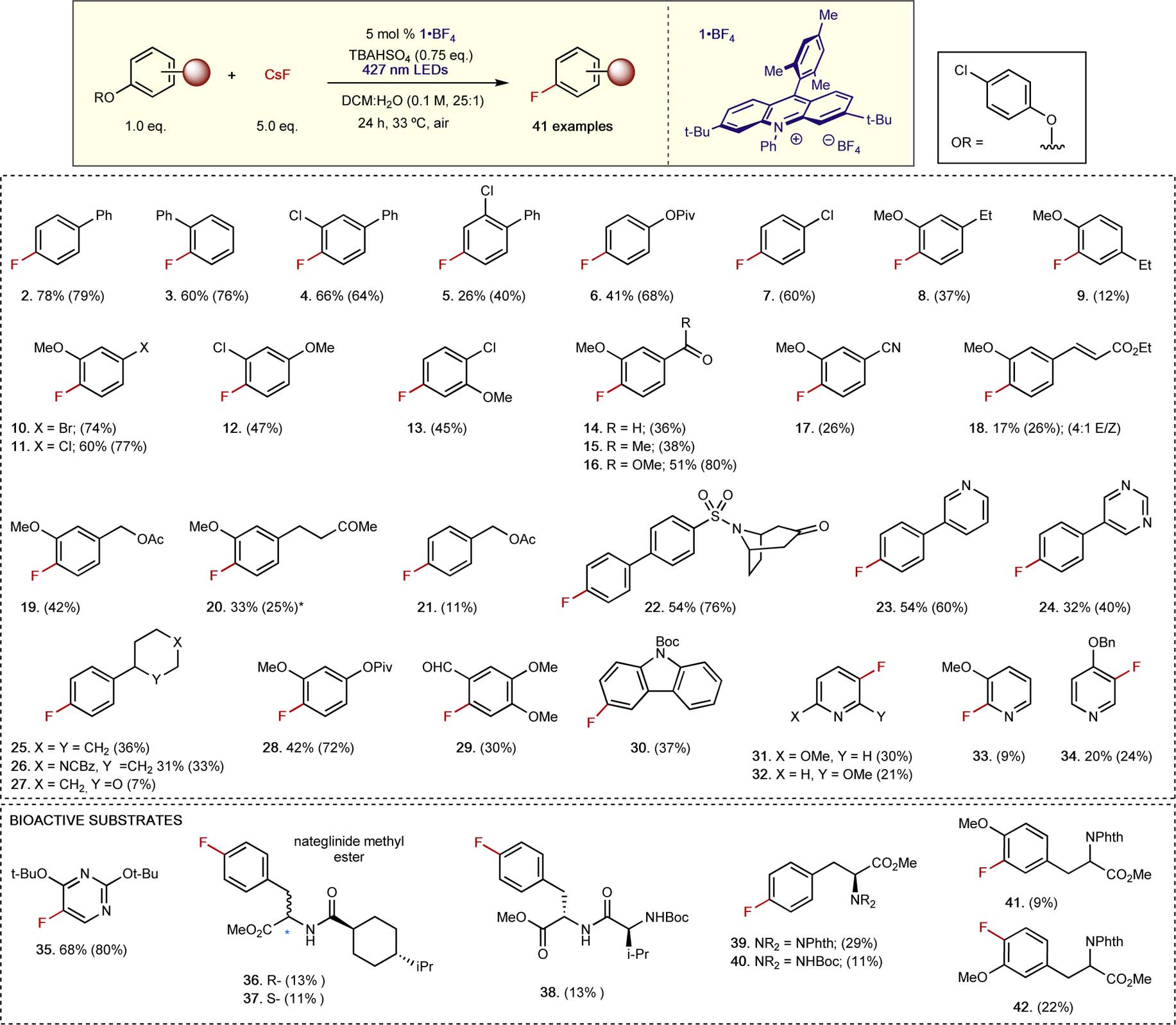
Nucleophilic aromatic substitution (SAr) is routinely used to install F and F in aromatic molecules, but is typically limited to electron-deficient arenes due to kinetic barriers associated with C-F bond formation. Here we demonstrate that a polarity-reversed photoredox-catalysed arene deoxyfluorination operating via cation radical-accelerated nucleophilic aromatic substitution (CRA-SAr) enables the fluorination of electron-rich arenes with F and F under mild conditions, thus complementing the traditional arene polarity requirements necessary for SAr-based fluorination. The utility of our radiofluorination strategy is highlighted by short reaction times, compatibility with multiple nucleofuges, and high radiofluorination yields, especially that of an important cancer positron emission tomography (PET) agent [F]5-fluorouracil ([F]FU). Taken together, our fluorination approach enables the development of fluorinated and radiofluorinated compounds that can be difficult to access by classical SAr strategies, with the potential for use in the synthesis and discovery of PET radiopharmaceuticals.
亲核芳香取代反应(SAr)通常用于在芳香分子中引入氟原子,但由于与碳-氟键形成相关的动力学障碍,该反应通常仅限于缺电子芳烃。在此,我们证明了一种通过阳离子自由基加速亲核芳香取代反应(CRA-SAr)进行的极性反转光氧化还原催化芳烃脱氧氟化反应,能够在温和条件下用氟原子对富电子芳烃进行氟化,从而补充了基于SAr氟化反应所需的传统芳烃极性要求。我们的放射性氟化策略具有反应时间短、与多种离去基团兼容以及放射性氟化产率高的特点,特别是对于一种重要的癌症正电子发射断层扫描(PET)剂[F]5-氟尿嘧啶([F]FU)而言。综上所述,我们的氟化方法能够开发出经典SAr策略难以获得的氟化和放射性氟化化合物,具有用于PET放射性药物合成与发现的潜力。