Worhach Jennifer, Boduch Madeline, Zhang Bo, Maski Kiran
Department of Neurology, Boston Children's Hospital, Boston, Massachusetts, USA.
Biostatistics and Research Design Center, Institutional Centers for Clinical and Translational Research, Boston Children's Hospital, Boston, Massachusetts, USA.
medRxiv. 2021 Mar 26:2021.03.24.21254190. doi: 10.1101/2021.03.24.21254190.
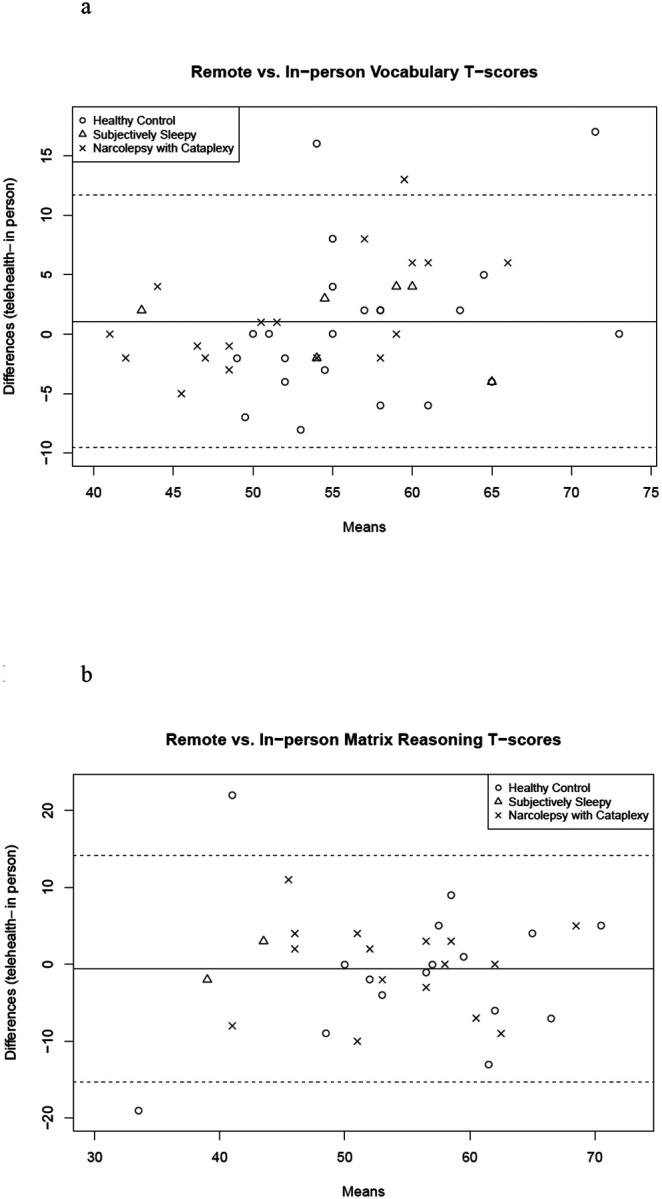
In this pilot study, we assessed the reliability of cognitive testing for kids and adolescents ages 8-19 years of age with narcolepsy or subjective daytime sleepiness compared to healthy controls. Forty-six participants took part in the study (n=18 with narcolepsy type 1, n=6 with subjective daytime sleepiness, and n= 22 healthy controls recruited from the community). Participants completed verbal (vocabulary testing) and non-verbal intelligence quotient (IQ) tasks (block design, matrix reasoning) from the Weschler Abbreviated Scale of Intelligence-Second Edition (WASI-II) in-person or remotely in their home through a HIPAA compliant telehealth web platform with conditions counterbalanced. We found that vocabulary T-scores showed good reliability with intraclass correlation coefficient (ICC) of 0.76 (95% CI: 0.64, 0.85) between remote and in-person testing conditions. Matrix Reasoning T-scores showed moderate reliability (ICC 0.69, 95% CI: 0.68, 0.90) and Block Design T-scores was poor between testing conditions. Bland-Altman plots showed outliers on vocabulary and matrix reasoning tasks performed better on remote assessments. Overall, the results of this pilot study support the feasibility and reliability of verbal and non-verbal IQ scores collected by telehealth. Use of telehealth to collect verbal and non-verbal IQ scores may offer a means to acquire cognitive data for pediatric sleep research through the COVID-19 pandemic and beyond.
在这项初步研究中,我们评估了8至19岁发作性睡病或主观日间嗜睡的儿童和青少年与健康对照相比进行认知测试的可靠性。46名参与者参与了该研究(发作性睡病1型18名,主观日间嗜睡6名,从社区招募的健康对照22名)。参与者通过符合HIPAA标准的远程医疗网络平台,亲自或在家中远程完成韦氏儿童智力量表第二版(WASI-II)的言语(词汇测试)和非言语智商(IQ)任务(积木设计、矩阵推理),测试条件相互平衡。我们发现,词汇T分数显示出良好的可靠性,远程测试和现场测试条件之间的组内相关系数(ICC)为0.76(95%CI:0.64,0.85)。矩阵推理T分数显示出中等可靠性(ICC 0.69,95%CI:0.68,0.90),而积木设计T分数在测试条件之间较差。Bland-Altman图显示,在远程评估中,词汇和矩阵推理任务的异常值表现更好。总体而言,这项初步研究的结果支持通过远程医疗收集言语和非言语智商分数的可行性和可靠性。利用远程医疗收集言语和非言语智商分数可能为在COVID-19大流行期间及之后的儿科睡眠研究获取认知数据提供一种手段。