Linder Grace E, Chou Stella T
Department of Pathology and Lab Medicine, Children's Hospital of Philadelphia.
Department of Pediatrics, Children's Hospital of Philadelphia, Philadelphia, PA.
Haematologica. 2021 Jul 1;106(7):1805-1815. doi: 10.3324/haematol.2020.270546.
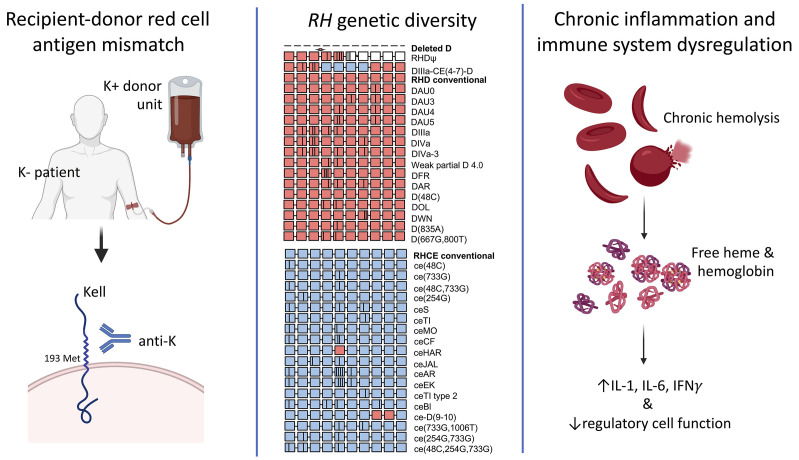
Red cell transfusion remains a critical component of care for acute and chronic complications of sickle cell disease. Randomized clinical trials demonstrated the benefits of transfusion therapy for prevention of primary and secondary strokes and postoperative acute chest syndrome. Transfusion for splenic sequestration, acute chest syndrome, and acute stroke are guided by expert consensus recommendations. Despite overall improvements in blood inventory safety, adverse effects of transfusion are prevalent among patients with sickle cell disease and include alloimmunization, acute and delayed hemolytic transfusion reactions, and iron overload. Judicious use of red cell transfusions, optimization of red cell antigen matching, and the use of erythrocytapheresis and iron chelation can minimize adverse effects. Early recognition and management of hemolytic transfusion reactions can avert poor clinical outcomes. In this review, we discuss transfusion methods, indications, and complications in sickle cell disease with an emphasis on alloimmunization.
红细胞输血仍然是镰状细胞病急慢性并发症治疗的关键组成部分。随机临床试验证明了输血疗法在预防原发性和继发性中风以及术后急性胸部综合征方面的益处。针对脾隔离症、急性胸部综合征和急性中风的输血遵循专家共识建议。尽管血液库存安全性总体有所改善,但输血的不良反应在镰状细胞病患者中仍然普遍存在,包括同种免疫、急性和迟发性溶血性输血反应以及铁过载。明智地使用红细胞输血、优化红细胞抗原匹配以及使用红细胞单采术和铁螯合可以将不良反应降至最低。早期识别和处理溶血性输血反应可以避免不良临床后果。在本综述中,我们讨论镰状细胞病的输血方法、适应证和并发症,重点是同种免疫。