MRC Centre for Global Infectious Disease Analysis, Jameel Institute for Disease and Emergency Analytics, Imperial College, London, United Kingdom.
Department of Medicine, University of California, San Francisco, California, United States of America.
PLoS Comput Biol. 2021 Apr 1;17(4):e1008830. doi: 10.1371/journal.pcbi.1008830. eCollection 2021 Apr.
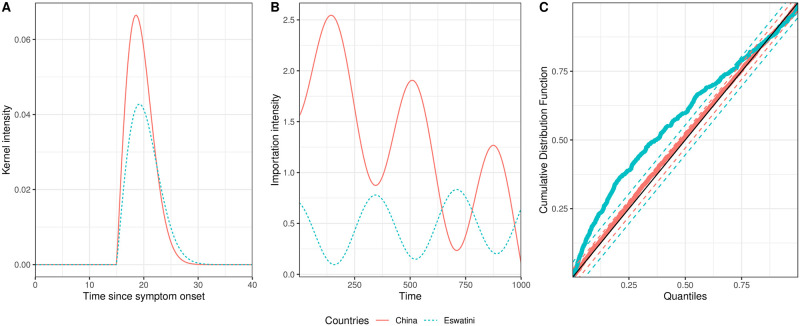
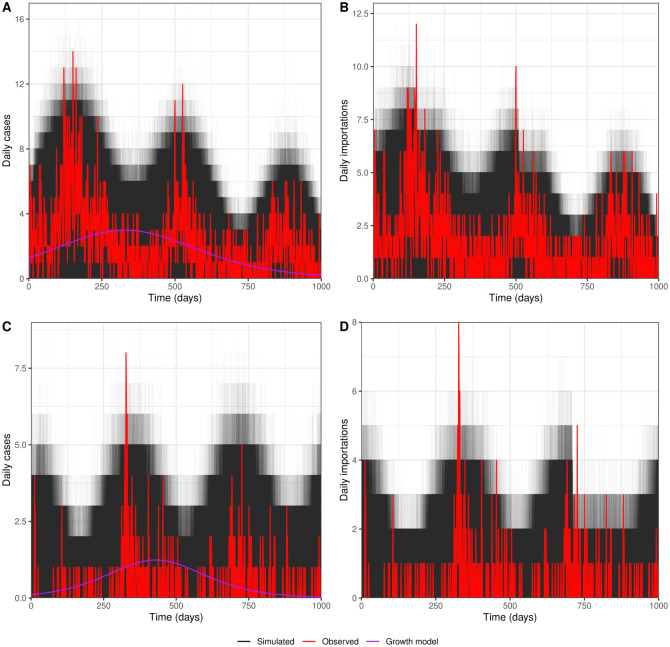
Developing new methods for modelling infectious diseases outbreaks is important for monitoring transmission and developing policy. In this paper we propose using semi-mechanistic Hawkes Processes for modelling malaria transmission in near-elimination settings. Hawkes Processes are well founded mathematical methods that enable us to combine the benefits of both statistical and mechanistic models to recreate and forecast disease transmission beyond just malaria outbreak scenarios. These methods have been successfully used in numerous applications such as social media and earthquake modelling, but are not yet widespread in epidemiology. By using domain-specific knowledge, we can both recreate transmission curves for malaria in China and Eswatini and disentangle the proportion of cases which are imported from those that are community based.
开发新的传染病暴发模型方法对于监测传播和制定政策非常重要。本文提出使用半机械的 Hawkes 过程来模拟接近消除的疟疾传播情况。Hawkes 过程是一种有充分依据的数学方法,使我们能够结合统计和机械模型的优点,不仅重现和预测疟疾爆发情景之外的疾病传播,还可以预测未来的传播情况。这些方法已在社交媒体和地震建模等多个领域得到成功应用,但在流行病学领域尚未广泛应用。通过利用特定领域的知识,我们不仅可以重现中国和斯威士兰的疟疾传播曲线,还可以区分输入病例和社区传播病例的比例。