Masumoto Natsumi, Suzuki Yuki, Cui Songkui, Wakazaki Mayumi, Sato Mayuko, Kumaishi Kie, Shibata Arisa, Furuta Kaori M, Ichihashi Yasunori, Shirasu Ken, Toyooka Kiminori, Sato Yoshinobu, Yoshida Satoko
Division of Biological Science, Graduate School of Science and Technology, Nara Institute of Science and Technology, Nara, 630-0192, Japan.
Division of Information Science, Graduate School of Science and Technology, Nara Institute of Science and Technology, Nara, 630-0192, Japan.
Plant Physiol. 2021 Apr 23;185(4):1429-1442. doi: 10.1093/plphys/kiab005.
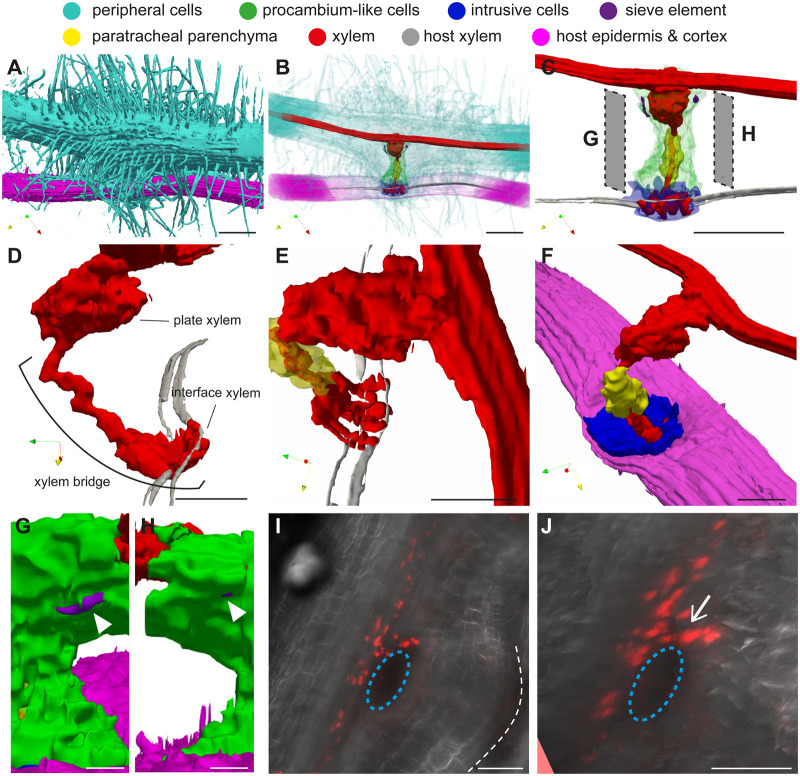
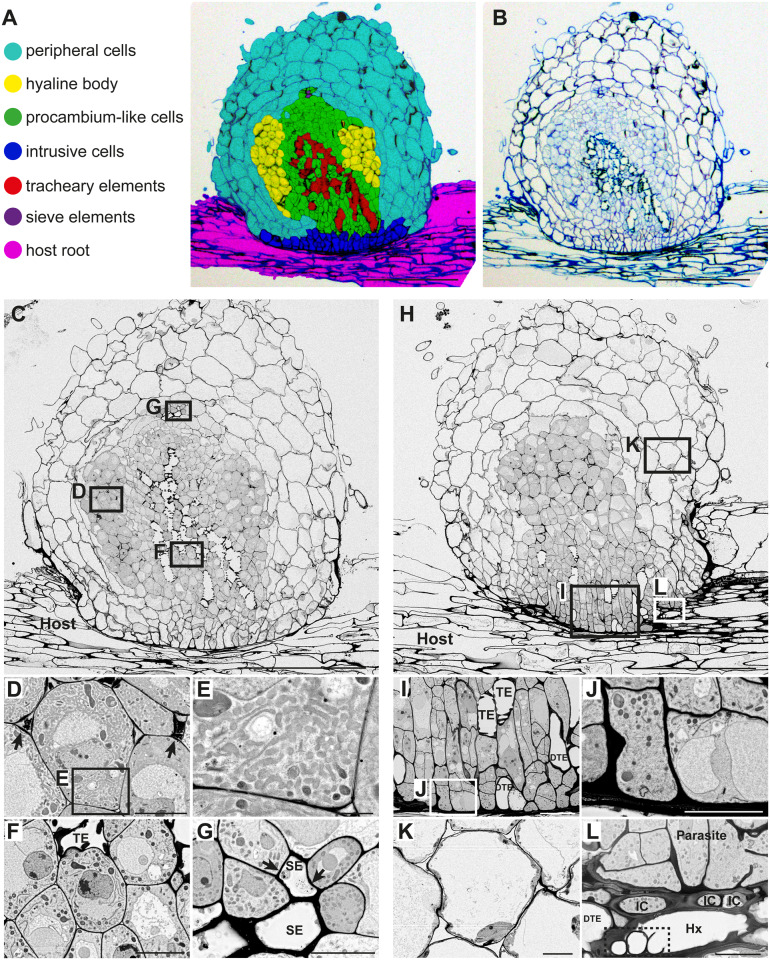
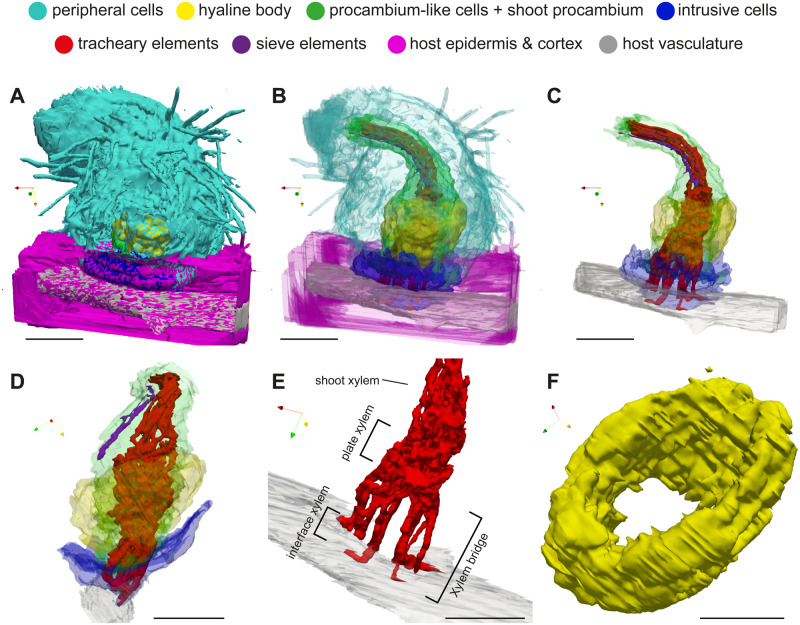
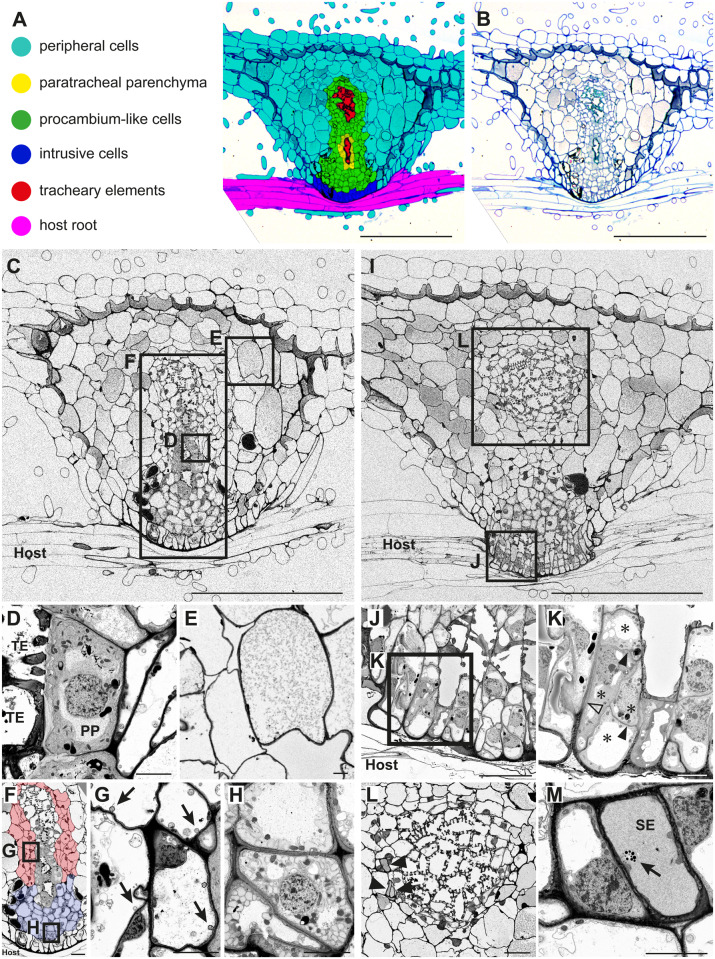
Parasitic plants infect other plants by forming haustoria, specialized multicellular organs consisting of several cell types, each of which has unique morphological features and physiological roles associated with parasitism. Understanding the spatial organization of cell types is, therefore, of great importance in elucidating the functions of haustoria. Here, we report a three-dimensional (3-D) reconstruction of haustoria from two Orobanchaceae species, the obligate parasite Striga hermonthica infecting rice (Oryza sativa) and the facultative parasite Phtheirospermum japonicum infecting Arabidopsis (Arabidopsis thaliana). In addition, field-emission scanning electron microscopy observation revealed the presence of various cell types in haustoria. Our images reveal the spatial arrangements of multiple cell types inside haustoria and their interaction with host roots. The 3-D internal structures of haustoria highlight differences between the two parasites, particularly at the xylem connection site with the host. Our study provides cellular and structural insights into haustoria of S. hermonthica and P. japonicum and lays the foundation for understanding haustorium function.
寄生植物通过形成吸器来感染其他植物,吸器是由几种细胞类型组成的特化多细胞器官,每种细胞类型都具有与寄生相关的独特形态特征和生理作用。因此,了解细胞类型的空间组织对于阐明吸器的功能至关重要。在此,我们报告了两种列当科植物吸器的三维(3-D)重建,专性寄生植物独脚金感染水稻(Oryza sativa)以及兼性寄生植物日本地黄感染拟南芥(Arabidopsis thaliana)。此外,场发射扫描电子显微镜观察揭示了吸器中存在多种细胞类型。我们的图像揭示了吸器内部多种细胞类型的空间排列及其与宿主根的相互作用。吸器的三维内部结构突出了这两种寄生虫之间的差异,特别是在与宿主的木质部连接部位。我们的研究为独脚金和日本地黄的吸器提供了细胞和结构方面的见解,并为理解吸器功能奠定了基础。