Department of Gastroenterology, Zibo Central Hospital, No. 54 Gongqingtuan West Road, Zhangdian District, Zibo, 255000, Shandong, China.
Cell Mol Biol Lett. 2021 Apr 1;26(1):12. doi: 10.1186/s11658-021-00256-x.
The purpose of this study was to explore the clinical value of miR-378c and its target gene YY1 in gastric cancer.
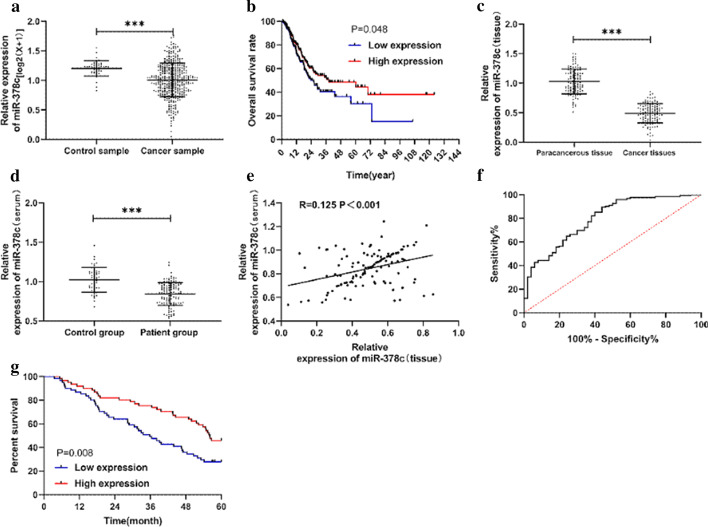
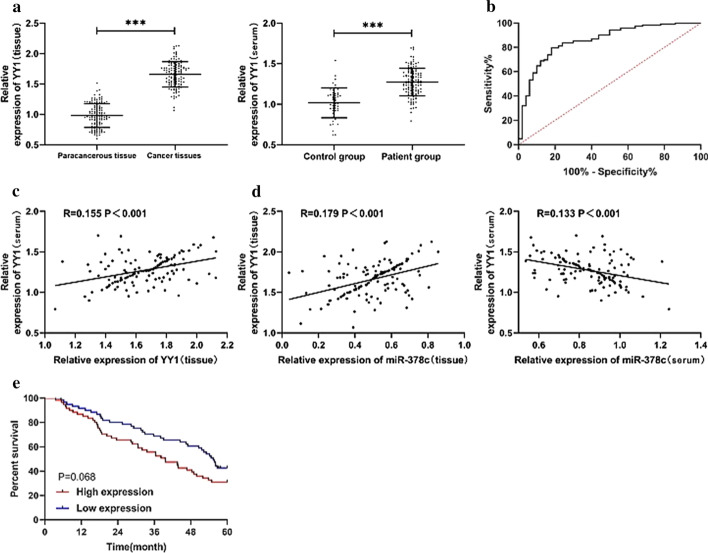
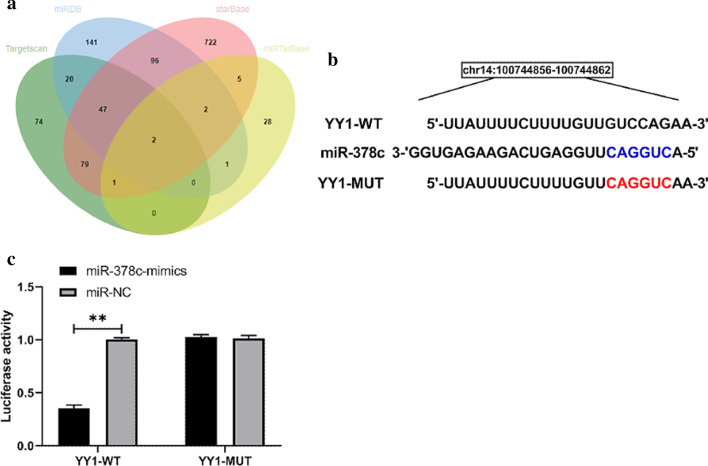
The TCGA database was employed to analyse miR-378c expression in gastric cancer. qRT-PCR was applied to identify miR-378c and YY1 in tissues and serum of patients suffering from gastric cancer. The association of miR-378c with the clinical data of patients with gastric cancer was analysed. Receiver operating characteristics (ROC) curve analysis was used to determine the diagnostic value of miR-378c and YY1 in gastric cancer, and analyse the relationship between miR-378c and YY1 and patients' survival. Pearson's test was applied to determine the association between miR-378c and YY1 in tissue and serum of patients. Dual-Luciferase Reporter assay was employed to examine the targeting association between miR-378c and YY1. Finally, independent prognostic factors was determined in patients with gastric cancer using Cox regression analysis.
In the TCGA database, miR-378c was weakly expressed in gastric cancer. Overall, patients with low expression had a lower survival rate. The expression of miR-378c decreased and the expression of YY1 increased in cancer tissues and serum of tumour patients. In patients with low expression of miR-378c the tumour size was ≥ 5 cm. Low differentiation, high TNM staging and lymph node invasion rate increased significantly, but the 5-year survival rate decreased in the patients. miR-378c and YY1 had better diagnostic value in gastric cancer. TargetScan, miRDB, starBase and miRTarBase predicted that YY1 was a potential gene of miR-378c, and the Dual-Luciferase Reporter assay revealed that there was a targeting relationship between the two, which was proved by correlation analysis. Multivariate Cox analysis revealed that differentiation, TNM staging and miR-378c were independent prognostic factors for patients.
MiR-378c is weakly expressed in gastric cancer patients and may be considered as a promising diagnostic and prognostic indicator for gastric cancer.
本研究旨在探讨 miR-378c 及其靶基因 YY1 在胃癌中的临床价值。
利用 TCGA 数据库分析胃癌中 miR-378c 的表达。采用 qRT-PCR 检测胃癌患者组织和血清中 miR-378c 和 YY1 的表达。分析 miR-378c 与胃癌患者临床资料的相关性。采用受试者工作特征(ROC)曲线分析 miR-378c 和 YY1 对胃癌的诊断价值,并分析 miR-378c 与 YY1 与患者生存的关系。采用 Pearson 检验分析 miR-378c 在组织和血清中的相关性。采用双荧光素酶报告基因实验检测 miR-378c 与 YY1 的靶向关系。最后,采用 Cox 回归分析确定胃癌患者的独立预后因素。
在 TCGA 数据库中,miR-378c 在胃癌中表达较弱。总体而言,低表达患者的生存率较低。肿瘤组织和肿瘤患者血清中 miR-378c 表达降低,YY1 表达升高。在 miR-378c 低表达的患者中,肿瘤大小≥5cm。低分化、高 TNM 分期和淋巴结侵犯率显著增加,而患者的 5 年生存率下降。miR-378c 和 YY1 对胃癌具有更好的诊断价值。TargetScan、miRDB、starBase 和 miRTarBase 预测 YY1 是 miR-378c 的潜在靶基因,双荧光素酶报告基因实验证实了两者之间存在靶向关系,相关性分析进一步证实了这一点。多因素 Cox 分析显示,分化、TNM 分期和 miR-378c 是患者的独立预后因素。
miR-378c 在胃癌患者中表达较弱,可能是一种有前途的胃癌诊断和预后指标。