Neuropsychiatry, Department of Neurosciences, Leuven Brain Institute, Leuven, Belgium.
Department of Neurology, University Hospitals Leuven, Leuven, Belgium.
Transl Psychiatry. 2021 Apr 1;11(1):199. doi: 10.1038/s41398-021-01314-w.
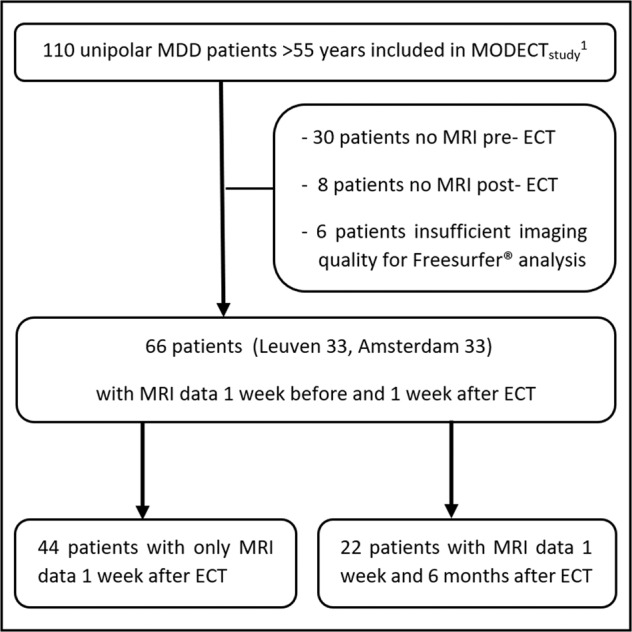
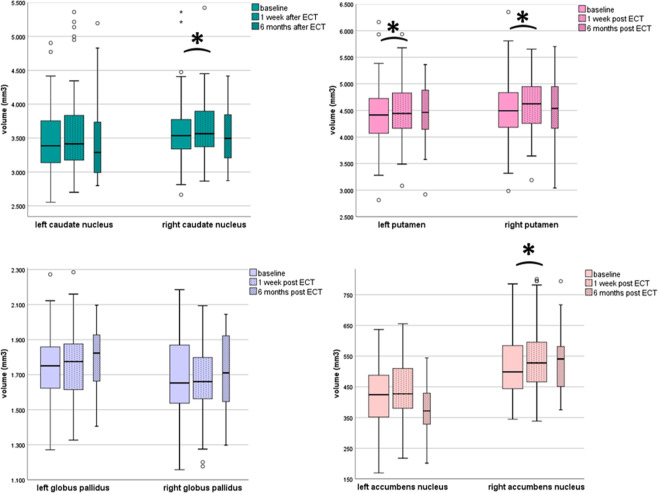
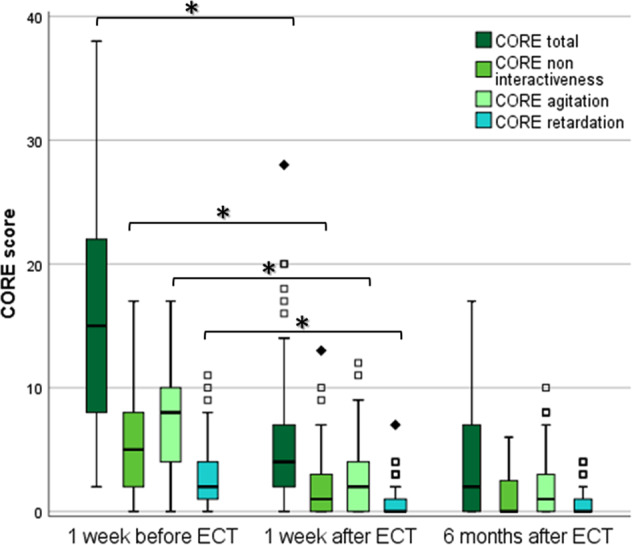
Psychomotor dysfunction (PMD) is a core element and key contributor to disability in late life depression (LLD), which responds well to electroconvulsive therapy (ECT). The neurobiology of PMD and its response to ECT are not well understood. We hypothesized that PMD in LLD is associated with lower striatal volume, and that striatal volume increase following ECT explains PMD improvement. We analyzed data from a two-center prospective cohort study of 110 LLD subjects (>55 years) receiving ECT. Brain MRI and assessment of mood, cognition, and PMD was performed 1 week before, 1 week after, and 6 months after ECT. Volumetry of the caudate nucleus, putamen, globus pallidus, and nucleus accumbens was derived from automatically segmented brain MRIs using Freesurfer®. Linear multiple regression analyses were used to study associations between basal ganglia volume and PMD. Brain MRI was available for 66 patients 1 week post ECT and in 22 patients also six months post ECT. Baseline PMD was associated with a smaller left caudate nucleus. One week after ECT, PMD improved and volume increases were detected bilaterally in the caudate nucleus and putamen, and in the right nucleus accumbens. Improved PMD after ECT did not relate to the significant volume increases in these structures, but was predicted by a nonsignificant volume change in the right globus pallidus. No volume differences were detected 6 months after ECT, compared to baseline. Although PMD is related to lower striatal volume in LLD, ECT-induced increase of striatal volume does not explain PMD improvement.
精神运动功能障碍 (PMD) 是老年期抑郁症 (LLD) 残疾的核心要素和主要原因,其对电抽搐治疗 (ECT) 反应良好。PMD 的神经生物学及其对 ECT 的反应尚不清楚。我们假设 LLD 中的 PMD 与纹状体体积降低有关,并且 ECT 后纹状体体积增加可以解释 PMD 的改善。我们分析了来自两个中心前瞻性队列研究的 110 名 LLD 患者(>55 岁)的数据,这些患者接受了 ECT。在 ECT 前 1 周、后 1 周和 6 个月时进行了 MRI 脑部扫描以及情绪、认知和 PMD 评估。使用 Freesurfer®从自动分割的脑部 MRI 中得出尾状核、壳核、苍白球和伏隔核的容积。线性多元回归分析用于研究基底节体积与 PMD 之间的关系。66 名患者在 ECT 后 1 周时可进行脑部 MRI,22 名患者也可在 ECT 后 6 个月时进行脑部 MRI。基线 PMD 与左侧尾状核体积较小有关。ECT 后 1 周,PMD 改善,双侧尾状核和壳核以及右侧伏隔核体积增加。ECT 后 PMD 的改善与这些结构的显著体积增加无关,但与右侧苍白球的非显著体积变化有关。与基线相比,ECT 后 6 个月未检测到脑结构体积差异。尽管 PMD 与 LLD 中的纹状体体积降低有关,但 ECT 诱导的纹状体体积增加并不能解释 PMD 的改善。