Faculty of Psychology and Cognitive Science, Adam Mickiewicz University, 61-664, Poznan, Poland.
University College London, Interaction Centre, London, WC1E 6EA, UK.
Sci Rep. 2021 Apr 1;11(1):7405. doi: 10.1038/s41598-021-86841-8.
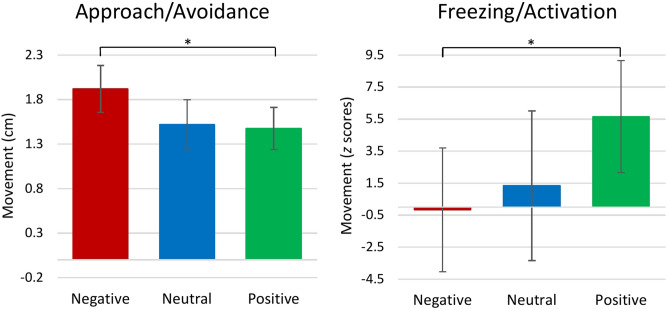
Individuals tend to approach positive stimuli and avoid negative stimuli. Furthermore, emotions influence whether individuals freeze or move more. These two kinds of motivated behavior refer to the approach/avoidance behavior and behavioral freezing/activation. Previous studies examined (e.g., using forced platforms) whether individuals' behavior depends on stimulus' valence; however, the results were mixed. Thus, we aimed to test whether emotions' effects on spontaneous whole-body behavior of standing individuals also occur in the seated position. We used a computer vision method to measure the head sway in video recordings that offers ease of use, replicability, and unobtrusiveness for the seated research participant. We analyzed behavior recorded in the laboratory during emotion manipulations across five studies totaling 932 participants. We observed that individuals leaned more forward and moved more when watching positive stimuli than when watching negative stimuli. However, individuals did not behave differently when watching positive or negative stimuli than in the neutral condition. Our results indicate that head movements extracted from seated individuals' video recordings can be useful in detecting robust differences in emotional behavior (positive vs. negative emotions).
个体倾向于接近积极刺激,回避消极刺激。此外,情绪也会影响个体是冻结还是更多地移动。这两种动机行为分别是趋近/回避行为和行为冻结/激活。之前的研究(例如,使用强制平台)检验了个体的行为是否取决于刺激的效价;然而,结果却是混杂的。因此,我们旨在测试情绪对站立个体的自发全身行为的影响是否也会发生在坐姿中。我们使用计算机视觉方法来测量视频记录中的头部摆动,这种方法对坐姿研究参与者来说具有易用性、可重复性和非侵入性。我们分析了在五个研究中记录的行为,共有 932 名参与者参与了情绪操纵。我们观察到,个体在观看积极刺激时比观看消极刺激时前倾更多,移动更多。然而,与中性条件相比,个体在观看积极或消极刺激时的行为没有差异。我们的结果表明,从坐姿个体的视频记录中提取的头部运动可以有效地检测到情绪行为(积极情绪与消极情绪)中的显著差异。