Wu Guoxin, Cheney Carol, Huang Qian, Hazuda Daria J, Howell Bonnie J, Zuck Paul
Department of Infectious Disease and Vaccines, Merck & Co. Inc., Kenilworth, NJ, United States.
Front Microbiol. 2021 Mar 16;12:636703. doi: 10.3389/fmicb.2021.636703. eCollection 2021.
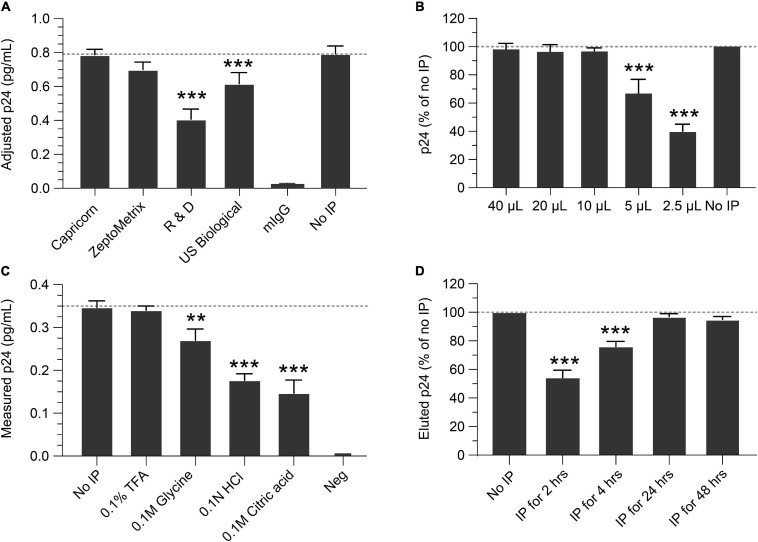
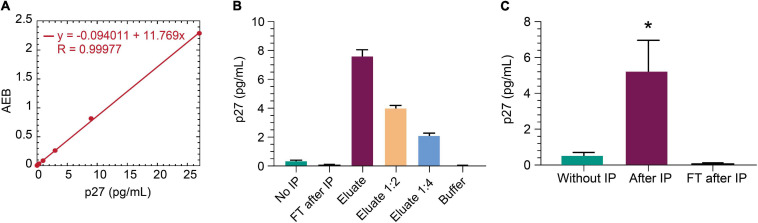
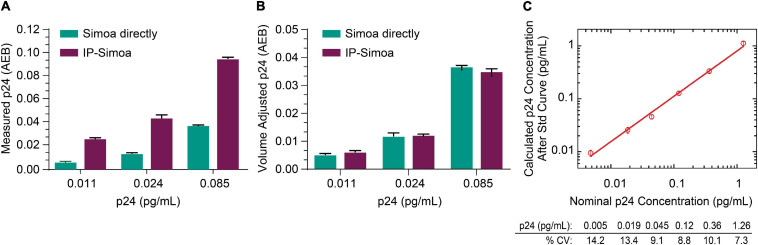
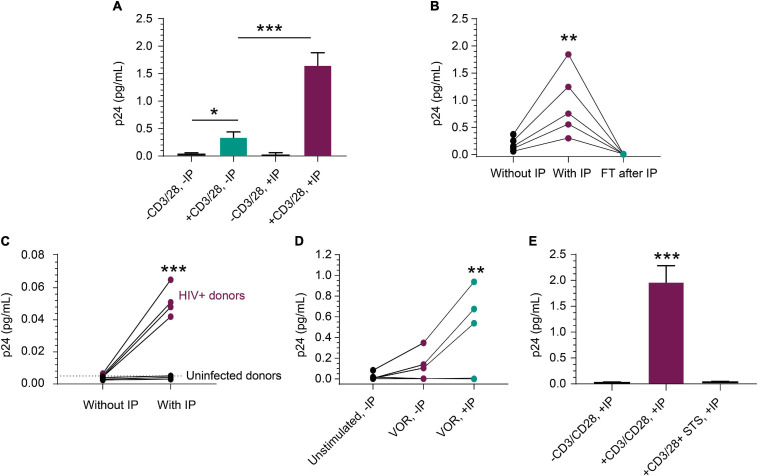
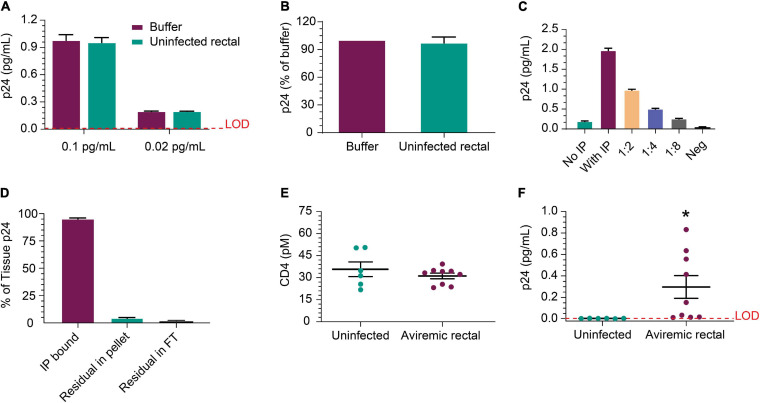
Greater than 90% of HIV-1 proviruses are thought to be defective and incapable of viral replication. While replication competent proviruses are of primary concern with respect to disease progression or transmission, studies have shown that even defective proviruses are not silent and can produce viral proteins, which may contribute to inflammation and immune responses. Viral protein expression also has implications for immune-based HIV-1 clearance strategies, which rely on antigen recognition. Thus, sensitive assays aimed at quantifying both replication-competent proviruses and defective, yet translationally competent proviruses are needed to understand the contribution of viral protein to HIV-1 pathogenesis and determine the effectiveness of HIV-1 cure interventions. Previously, we reported a modified HIV-1 gag p24 digital enzyme-linked immunosorbent assay with single molecule array (Simoa) detection of cell-associated viral protein. Here we report a novel p24 protein enrichment method coupled with the digital immunoassay to further extend the sensitivity and specificity of viral protein detection. Immunocapture of HIV gag p24 followed by elution in a Simoa-compatible format resulted in higher protein recovery and lower background from various biological matrices and sample volumes. Quantification of as little as 1 fg of p24 protein from cell lysates from cells isolated from peripheral blood or tissues from ART-suppressed HIV participants, as well as simian-human immunodeficiency virus-infected non-human primates (NHPs), with high recovery and reproducibility is demonstrated here. The application of these enhanced methods to patient-derived samples has potential to further the study of the persistent HIV state and examine response to therapies, as well as study of translationally competent cells from a variety of donors.
超过90%的HIV-1前病毒被认为是有缺陷的,无法进行病毒复制。虽然具有复制能力的前病毒是疾病进展或传播的主要关注点,但研究表明,即使是有缺陷的前病毒也并非沉默无声,它们可以产生病毒蛋白,这可能会导致炎症和免疫反应。病毒蛋白表达对基于免疫的HIV-1清除策略也有影响,这些策略依赖于抗原识别。因此,需要灵敏的检测方法来量化具有复制能力的前病毒以及有缺陷但具有翻译能力的前病毒,以了解病毒蛋白对HIV-1发病机制的作用,并确定HIV-1治愈干预措施的有效性。此前,我们报道了一种改良的HIV-1 gag p24数字酶联免疫吸附测定法,采用单分子阵列(Simoa)检测细胞相关病毒蛋白。在此,我们报告一种新型的p24蛋白富集方法,结合数字免疫测定法,以进一步提高病毒蛋白检测的灵敏度和特异性。通过免疫捕获HIV gag p24,然后以与Simoa兼容的形式洗脱,可从各种生物基质和样本体积中获得更高的蛋白回收率和更低的背景。本文证明了从接受抗逆转录病毒治疗的HIV感染者外周血或组织中分离的细胞裂解物以及感染猿猴免疫缺陷病毒的非人灵长类动物(NHP)的细胞裂解物中,能够对低至1 fg的p24蛋白进行定量,且回收率高、重现性好。将这些增强方法应用于患者来源的样本,有可能进一步推动对持续HIV状态的研究,并检测对治疗的反应,以及研究来自各种供体的具有翻译能力的细胞。