King Abdullah Petroleum Studies and Research Center (KAPSARC), PO Box 88550, Riyadh, 11672, Saudi Arabia.
Economics and Finance, University of Portsmouth, Richmond Building, Portsmouth, PO1 3DE, UK.
Environ Sci Pollut Res Int. 2021 Aug;28(31):41965-41987. doi: 10.1007/s11356-021-13463-y. Epub 2021 Apr 1.
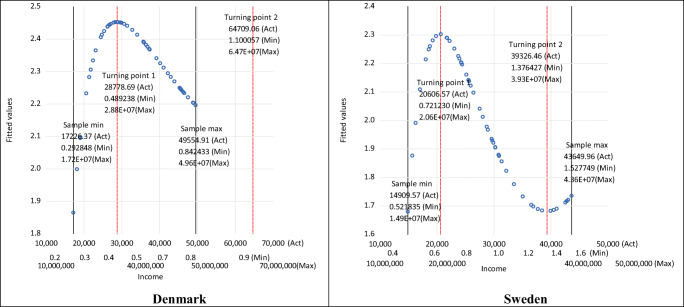
This paper contributes to the environmental literature by (i) demonstrating that the estimated coefficients and the statistical significance of the non-leading terms in quadratic, cubic, and quartic logarithmic environmental Kuznets curve (EKC) specifications are arbitrary and should therefore not be used to choose the preferred specification and (ii) detailing a proposed general-to-specific type methodology for choosing the appropriate specifications when attempting to estimate higher-order polynomials such as cubic and quartic logarithmic EKC relationships. Testing for the existence and shape of the well-known EKC phenomenon is a hot topic in the environmental economics literature. The conventional approach widely employs quadratic and cubic specifications and more recently also the quartic specification, where the variables are in logarithmic form. However, it is important that researchers understand whether the estimated EKC coefficients, turning points, and elasticities are statistically acceptable, economically interpretable, and comparable. In addition, it is vital that researchers have a clear structured non-arbitrary methodology for determining the preferred specification and hence shape of the estimated EKC. We therefore show mathematically and empirically the arbitrary nature of estimated non-leading coefficients in quadratic, cubic, and quartic logarithmic EKC specifications, being dependent upon the units of measurement chosen for the independent variables (e.g. dependent upon a rescaling of the variables such as moving from $m to $bn). Consequently, the practice followed in many previously papers, whereby the estimates of the non-leading terms are used in the decision to choose the preferred specification of an estimated EKC relationship, is incorrect and should not be followed since it potentially could lead to misleading conclusions. Instead, it should be based upon the sign and statistical significance of the estimated coefficients of the leading terms, the location of turning point(s), and the sign and statistical significance of the estimated elasticities. Furthermore, we suggest that researchers should follow a proposed general-to-specific type methodology for choosing the appropriate order of polynomials when attempting to estimate higher-order polynomial logarithmic EKCs.
(i)证明二次、三次和四次对数环境库兹涅茨曲线(EKC)规范中非主导项的估计系数和统计显著性是任意的,因此不应该用于选择首选规范;(ii)详细说明了一种拟议的通用到特定类型的方法,用于在尝试估计更高阶多项式(如三次和四次对数 EKC 关系)时选择适当的规范。检验众所周知的 EKC 现象的存在和形状是环境经济学文献中的热门话题。传统方法广泛采用二次和三次规范,最近也采用四次规范,其中变量为对数形式。然而,研究人员是否理解估计的 EKC 系数、转折点和弹性是否在统计上可接受、经济上可解释和可比较是很重要的。此外,研究人员必须有一个清晰的、非任意的方法来确定首选规范,从而确定估计的 EKC 的形状。因此,我们从数学和实证两个方面展示了二次、三次和四次对数 EKC 规范中估计的非主导系数的任意性质,取决于为自变量选择的度量单位(例如,取决于变量的重新缩放,例如从 $m 到 $bn)。因此,许多先前的论文中所遵循的做法,即使用非主导项的估计值来决定选择估计的 EKC 关系的首选规范,是不正确的,不应该遵循,因为它可能会导致误导性的结论。相反,应该基于主导项的估计系数的符号和统计显著性、转折点的位置以及估计弹性的符号和统计显著性。此外,我们建议研究人员在尝试估计更高阶多项式对数 EKC 时,应遵循一种拟议的通用到特定类型的方法来选择适当的多项式阶数。