Department of Epidemiology, School of Public Health, University of Washington (UW), Seattle, Washington, USA.
Department of Biostatistics, School of Public Health, UW, Seattle, Washington, USA.
Environ Health Perspect. 2021 Apr;129(4):47004. doi: 10.1289/EHP7486. Epub 2021 Apr 2.
Limited data suggest air pollution exposures may contribute to pediatric high blood pressure (HBP), a known predictor of adult cardiovascular diseases.
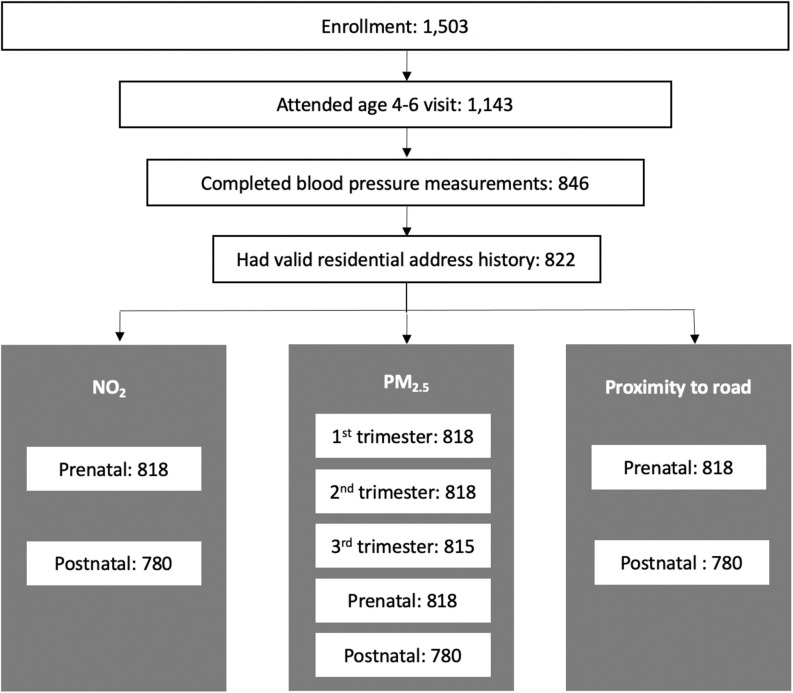
We investigated this association in the Conditions Affecting Neurocognitive Development and Learning in Early Childhood (CANDLE) study, a sociodemographically diverse pregnancy cohort in the southern United States with participants enrolled from 2006 to 2011. We included 822 mother-child dyads with available address histories and a valid child blood pressure measurement at 4-6 y. Systolic (SBP) and diastolic blood pressures (DBP) were converted to age-, sex-, and height-specific percentiles for normal-weight U.S. children. HBP was classified based on SBP or DBP percentile. Nitrogen dioxide () and particulate matter in aerodynamic diameter () estimates in both pre- and postnatal windows were obtained from annual national models and spatiotemporal models, respectively. We fit multivariate Linear and Poisson regressions and explored multiplicative joint effects with maternal nutrition, child sex, and maternal race using interaction terms.
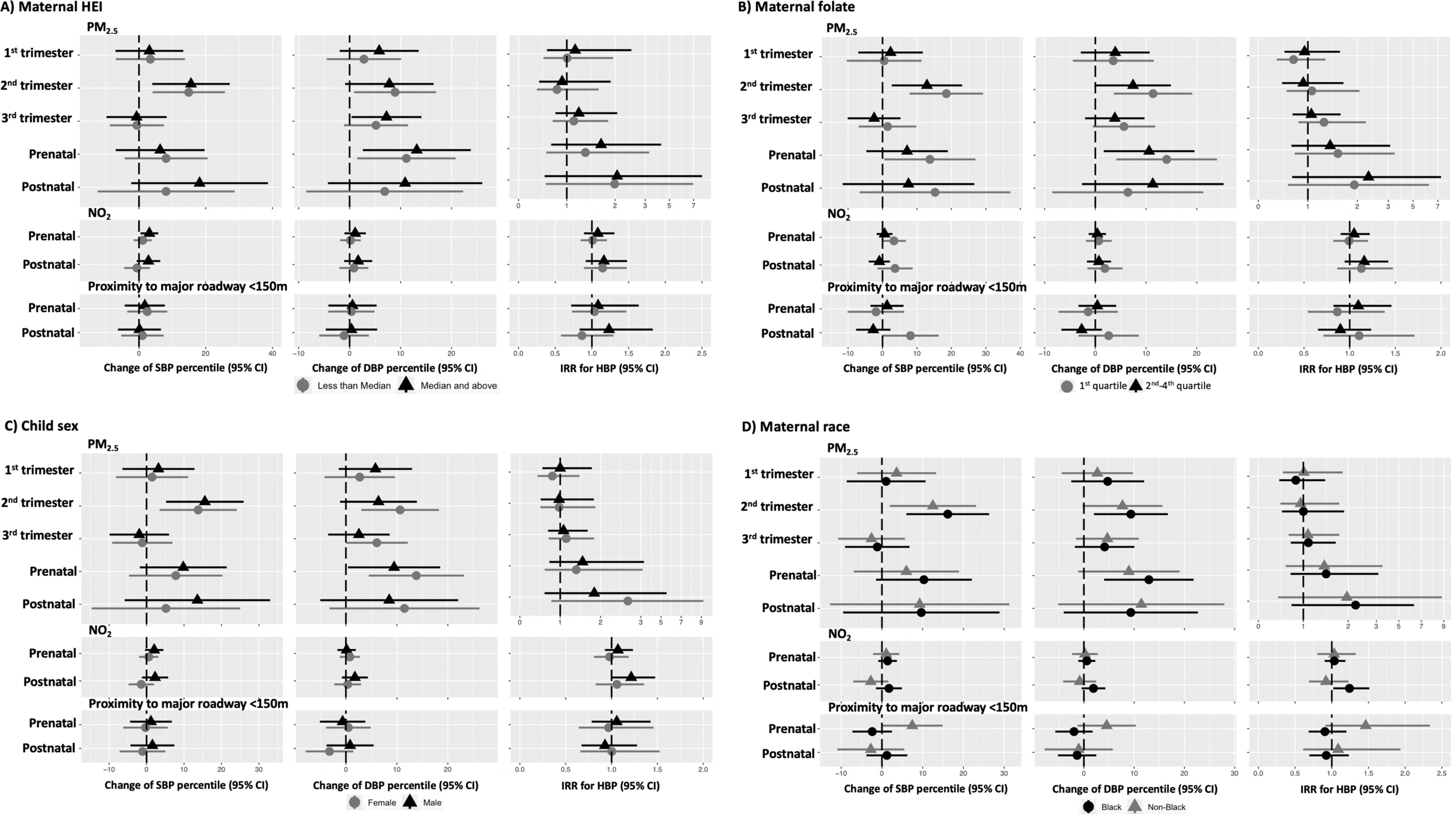
Mean and in the prenatal period were 10.8 [standard deviation (SD): 0.9] and 10.0 (SD: 2.4) ppb, respectively, and 9.9 (SD: 0.6) and 8.8 (SD: 1.9) ppb from birth to the 4-y-old birthday. On average, SBP percentile increased by 14.6 (95% CI: 4.6, 24.6), and DBP percentile increased by 8.7 (95% CI: 1.4, 15.9) with each increase in second-trimester . averaged over the prenatal period was only significantly associated with higher DBP percentiles [ 11.6 (95% CI: 2.9, 20.2)]. Positive associations of second-trimester with SBP and DBP percentiles were stronger in children with maternal folate concentrations in the lowest quartile ( 0.05 and 0.07, respectively) and associations with DBP percentiles were stronger in female children ( 0.05). We did not detect significant association of , road proximity, and postnatal with any outcomes.
The findings suggest that higher prenatal exposure, particularly in the second trimester, is associated with elevated early childhood blood pressure. This adverse association could be modified by pregnancy folate concentrations. https://doi.org/10.1289/EHP7486.
有限的数据表明,空气污染暴露可能导致儿童高血压(HBP),这是成人心血管疾病的已知预测因子。
我们在 Conditions Affecting Neurocognitive Development and Learning in Early Childhood(CANDLE)研究中调查了这种关联,这是美国南部一个社会人口统计学多样化的妊娠队列,参与者于 2006 年至 2011 年期间入组。我们纳入了 822 对母婴对子,这些母婴对子有可用的地址史和 4-6 岁时的有效儿童血压测量值。收缩压(SBP)和舒张压(DBP)转换为正常体重美国儿童的年龄、性别和身高特定百分位数。HBP 的分类基于 SBP 或 DBP 百分位数。分别从年度国家模型和时空模型中获得了产前和产后窗内的二氧化氮()和空气动力学直径()的估计值。我们拟合了多元线性和泊松回归,并使用交互项探索了与母体营养、儿童性别和母体种族的乘法联合效应。
平均产前 为 10.8 [标准差(SD):0.9] ppb, 为 10.0(SD:2.4)ppb,从出生到 4 岁生日, 为 9.9(SD:0.6)ppb, 为 8.8(SD:1.9)ppb。平均而言,SBP 百分位增加了 14.6(95%置信区间:4.6,24.6),DBP 百分位增加了 8.7(95%置信区间:1.4,15.9),与第二个三个月 增加了每 。整个产前期间的 平均仅与较高的 DBP 百分位显著相关[11.6(95%置信区间:2.9,20.2)]。在母体叶酸浓度处于最低四分位(0.05 和 0.07)的儿童中,第二个三个月 与 SBP 和 DBP 百分位的正相关更强,而与 DBP 百分位的相关性在女性儿童中更强(0.05)。我们没有发现 、道路接近度和产后 与任何结果有显著关联。
研究结果表明,较高的产前 暴露,尤其是在第二个三个月,与儿童早期血压升高有关。这种不利的关联可能会被妊娠叶酸浓度所修饰。https://doi.org/10.1289/EHP7486.