Unit of Psychiatry, Department of Public Health and Medicinal Administration, & Institute of Translational Medicine, Faculty of Health Sciences, University of Macau, Macao SAR, China; Centre for Cognitive and Brain Sciences, University of Macau, Macao SAR, China; Institute of Advanced Studies in Humanities and Social Sciences, University of Macau, Macao SAR, China.
College of Education for the Future, Beijing Normal University, Zhuhai, Guangdong province, China.
J Affect Disord. 2021 May 15;287:145-157. doi: 10.1016/j.jad.2021.03.016. Epub 2021 Mar 11.
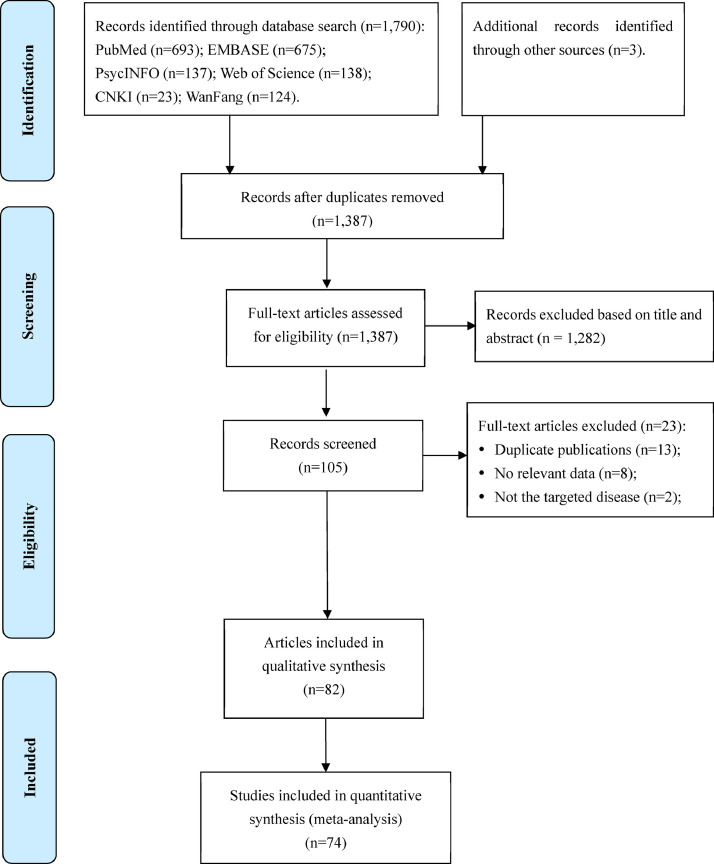
The coronavirus disease 2019 (COVID-19) and Severe Acute Respiratory Syndrome (SARS) are associated with various psychiatric comorbidities. This is a systematic review and meta-analysis comparing the prevalence of psychiatric comorbidities in all subpopulations during the SARS and COVID-19 epidemics. A systematic literature search was conducted in major international (PubMed, EMBASE, Web of Science, PsycINFO) and Chinese (China National Knowledge Internet [CNKI] and Wanfang) databases to identify studies reporting prevalence of psychiatric comorbidities in all subpopulations during the SARS and COVID-19 epidemics. Data analyses were conducted using the Comprehensive Meta-Analysis Version 2.0 (CMA V2.0). Eighty-two studies involving 96,100 participants were included. The overall prevalence of depressive symptoms (depression hereinafter), anxiety symptoms (anxiety hereinafter), stress, distress, insomnia symptoms, post-traumatic stress symptoms (PTSS) and poor mental health during the COVID-19 epidemic were 23.9% (95% CI: 18.4%-30.3%), 23.4% (95% CI: 19.9%-27.3%), 14.2% (95% CI: 8.4%-22.9%), 16.0% (95% CI: 8.4%-28.5%), 26.5% (95% CI: 19.1%-35.5%), 24.9% (95% CI: 11.0%-46.8%), and 19.9% (95% CI: 11.7%-31.9%), respectively. Prevalence of poor mental health was higher in general populations than in health professionals (29.0% vs. 11.6%; Q=10.99, p=0.001). The prevalence of depression, anxiety, PTSS and poor mental health were similar between SARS and COVID-19 epidemics (all p values>0.05). Psychiatric comorbidities were common in different subpopulations during both the SARS and COVID-19 epidemics. Considering the negative impact of psychiatric comorbidities on health and wellbeing, timely screening and appropriate interventions for psychiatric comorbidities should be conducted for subpopulations affected by such serious epidemics.
新型冠状病毒病 2019(COVID-19)和严重急性呼吸系统综合征(SARS)与各种精神科合并症相关。这是一项系统评价和荟萃分析,比较了 SARS 和 COVID-19 流行期间所有亚人群的精神科合并症患病率。在主要的国际(PubMed、EMBASE、Web of Science、PsycINFO)和中文(中国国家知识互联网[CNKI]和万方)数据库中进行了系统文献检索,以确定报告 SARS 和 COVID-19 流行期间所有亚人群精神科合并症患病率的研究。使用综合荟萃分析版本 2.0(CMA V2.0)进行数据分析。共纳入 82 项研究,涉及 96100 名参与者。COVID-19 流行期间,抑郁症状(以下简称抑郁)、焦虑症状(以下简称焦虑)、压力、痛苦、失眠症状、创伤后应激症状(PTSS)和心理健康不良的总体患病率分别为 23.9%(95%CI:18.4%-30.3%)、23.4%(95%CI:19.9%-27.3%)、14.2%(95%CI:8.4%-22.9%)、16.0%(95%CI:8.4%-28.5%)、26.5%(95%CI:19.1%-35.5%)、24.9%(95%CI:11.0%-46.8%)和 19.9%(95%CI:11.7%-31.9%)。一般人群的心理健康不良患病率高于卫生专业人员(29.0% vs. 11.6%;Q=10.99,p=0.001)。SARS 和 COVID-19 流行期间,抑郁、焦虑、PTSS 和心理健康不良的患病率相似(p 值均>0.05)。在 SARS 和 COVID-19 流行期间,不同亚人群中均存在常见的精神科合并症。鉴于精神科合并症对健康和幸福感的负面影响,对于受此类严重疫情影响的亚人群,应及时进行精神科合并症的筛查和适当干预。